Hi, what do you want to do?






American Chemical Society
Combustion and Burning
On Earth, a candle flame points up, but on the International Space Station, it forms a sphere. Young scientists practice their skills by recording observations before, during, and after a candle burns. Chemical and physical...

American Chemical Society
Exothermic, Endothermic, and Chemical Change
Scientists can't observe bonds breaking or forming, so how do they distinguish between exothermic and endothermic reactions? Young scholars complete two experiments to do just that. They monitor temperature change and calculate the...

Teach Engineering
Package Those Foods!
Designing the right package — it's more than a pretty picture. Challenge small groups to design a food package. They must consider the type of food they are packaging and the package's ability to control the physical and...

American Chemical Society
The Energy of Evaporation
Do all liquids evaporate at the same rate? Young scientists observe the evaporation rate of three different liquids. They measure the time, the temperature, and the change in energy. After comparing the chemical formulas, scholars...

Serendip
Using Models to Understand Photosynthesis
Is your class in the dark about photosynthesis? Shed some sunlight on an important biological process with a thoughtful activity. After answering questions to help determine their level of knowledge, learners work with chemical equations...

Discovery Education
School of Rock
Why do rocks break down over time? Learners explore this concept by simulating physical and chemical weathering of different types of rocks. They use an abrasive to demonstrate physical weathering and acid to demonstrate chemical...

Baylor College
Fuel for Living Things
During a three-part lesson, learners make a cabbage juice pH indicator and use it to analyze the waste products of yeast after feeding them with sugar. The intent is to demonstrate how living organisms produce carbon dioxide, which is...

NOAA
Please Pass the Salt
Salinity is the focus of two experimenters that work to answer the question, How does salt change the physical properties of water? Super scientists compare the freezing rate of salt and fresh water, combine the two waters to...

Teach Engineering
Concentrate This! Sugar or Salt...
Heat up your lessons on boiling points. The resource provides a three-part activity: first, groups find the boiling point of solutions; second, they create boiling point curves for salt and sugar solutions; and third, they mix a solution...

US Department of Energy
Wave Erosion
Fourth graders examine the effects of waves on coastal land. They discover how water's power can change the appearance of land formations.

Teach Engineering
Gumdrop Atoms
There's nothing sticky about the resource, unless you count the gumdrops! Scholars create a model of a lithium atom, complete with protons, neutrons, and electrons. It's just that these models are made with gumdrops and toothpicks.

Curated OER
The Bio-fuel Project: Creating Bio-diesel
Students investigate bio-fuel. In this investigative lesson, students create bio-fuel from vegetable oil waste. Students will analyze, predict, collect and synthesize data from their experiments with bio-fuel.
Other
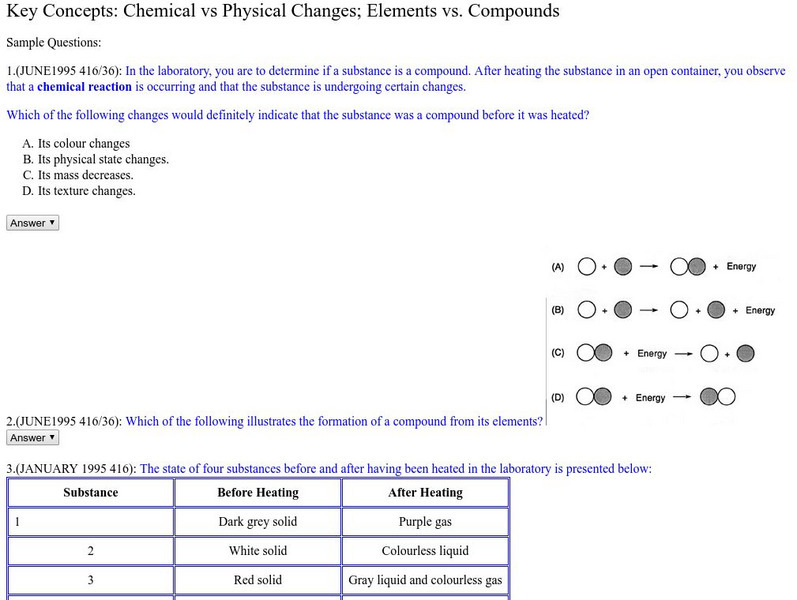
English Montreal School: Chemical vs. Physical Changes: Elements vs. Compounds
A laboratory experiment where students classify matter into a homogenous mixture, heterogeneous mixture, solution, or pure substance. Also students will test for physical and chemical changes.
Read Works
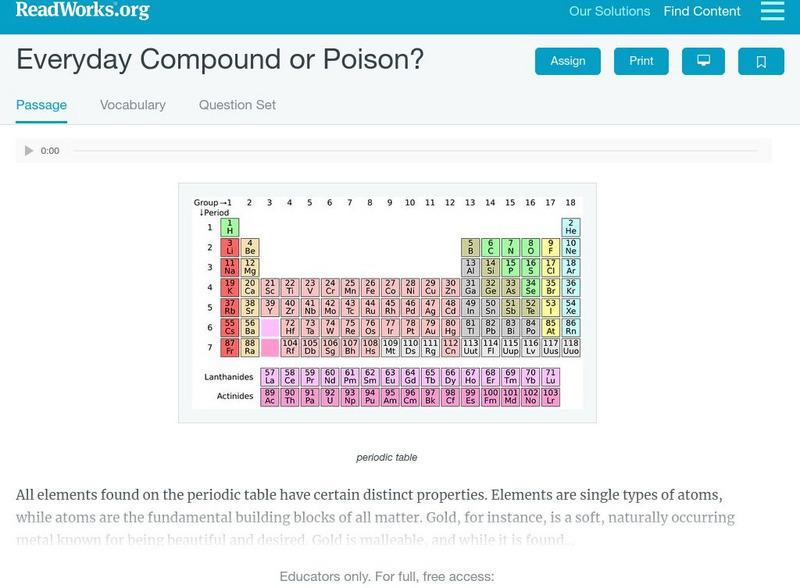
Read Works: Everyday Compound or Poison?
[Free Registration/Login Required] An informational text about how chemicals can be combined to form safe or unsafe compounds. A question sheet is available to help students build skills in reading comprehension.

Other
The Science House: Dancing Spaghetti
The chemical change of matter is illustrated in this lab experiment when spaghetti is placed in a solution of baking soda and vinegar. Watch the spaghetti rise to the surface and sink again once the gas is released.
Other
The Science House: Ziptop Bag Chemistry
In this experiment, three reactions are performed in a sealed Ziploc bag so that they can be observed. Students identify whether physical or chemical change has taken place.
Read Works
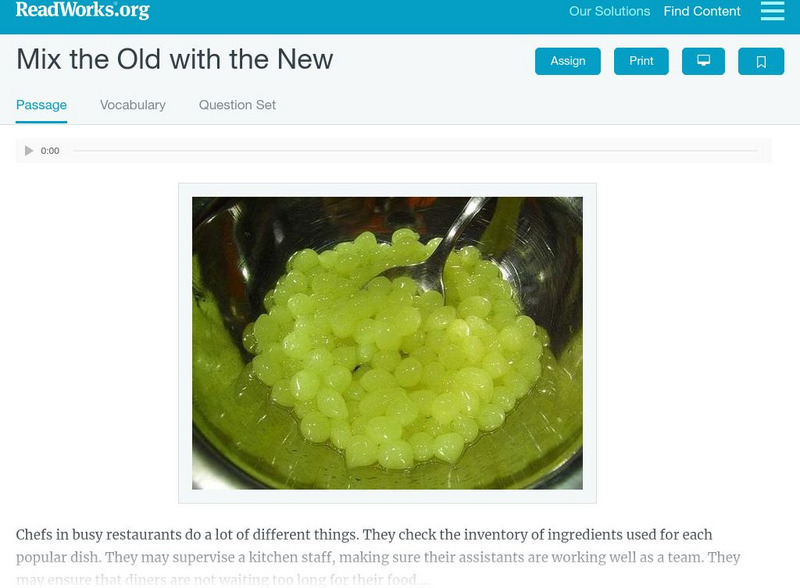
Read Works: Mix the Old With the New
[Free Registration/Login Required] An informational text about how cooking causes changes in matter. A question sheet is available to help students build skills in reading comprehension.
Science Buddies
Science Buddies: Rubber Band Elasticity and Temperature
Many materials expand when heated and contract when cooled. What do you think will happen to the elasticity (stretchiness) of a rubber band when it is heated or cooled to various temperatures?
Other
The Science House: Combustion
In this experiment, students will observe that the weight of the product of combustion is greater than that of the starting material. Teacher's notes address the key concepts of this experiment.
TeachEngineering
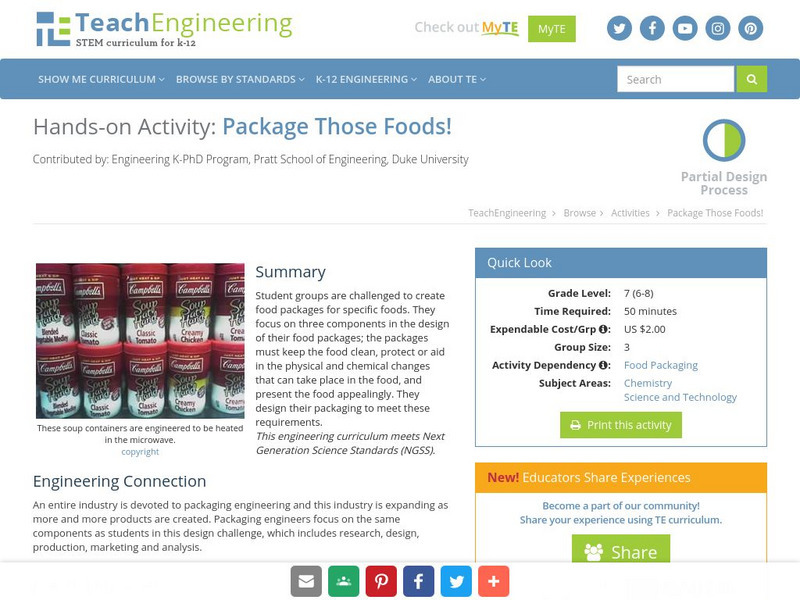
Teach Engineering: Package Those Foods!
This activity provides students with the opportunity to create a food package for a specific food. The students have three components to focus on in the design of their food package. The package will have to keep the food clean, protect...