Hi, what do you want to do?






Serendip
Diffusion and Cell Size and Shape
Is your class ready to size up the topic of diffusion? Help them get cell shape savvy with a well-written handout. The resource covers how substances such as oxygen passively move through the cell membrane and how cell size and shape...

Exploratorium
Viral Packaging
Create a protective protein shell as a package. Using the included template, pupils tape together 20 triangles to create a 20-sided shape to represent the protective shell of a virus. The model of the protein shell incases the nucleic...

Illustrative Mathematics
Hexagonal Pattern of Beehives
Young geometers and biologists investigate the math of nature in an activity that is just the bee's knees. Participants will study the tessellations of hexagons in a beehive, along with the natural rationale behind the specific shape....

National Nanotechnology Infrastructure Network
Silver and Bandages: Assessment of Inhibition of Bacteria by Silver Colloid-Impregnated Bandages
Silver: more than jewelry, it's also a natural antimicrobial agent. An inquiry-based lesson asks collaborative groups to design and implement an experiment to test this property. Using samples of silver nanoparticles and a strain of...
Texas Instruments
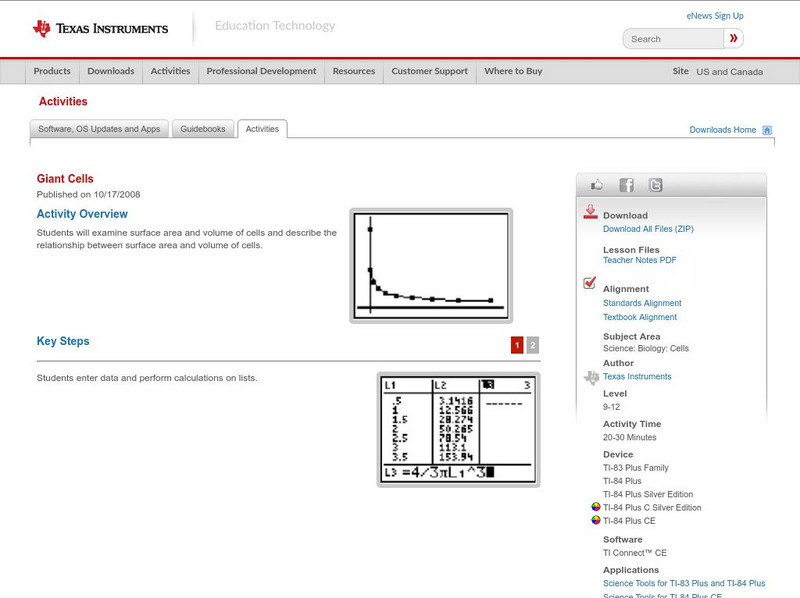
Texas Instruments: Giant Cells
In this activity you will examine surface area and volume of cells and will describe the relationship between surface area and volume of cells.
Texas Instruments
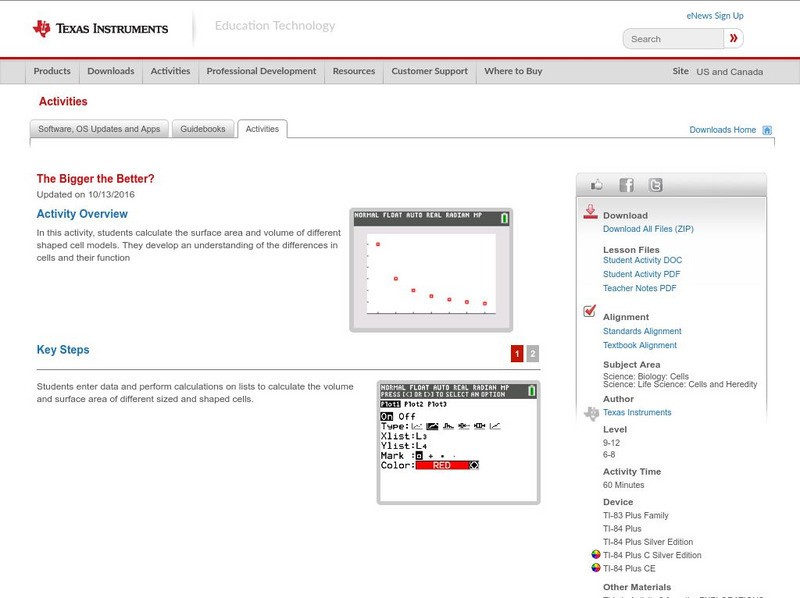
Texas Instruments: The Bigger the Better?
In this activity, students calculate the surface area and volume of different shaped cell models. They develop an understanding of the differences in cells and their function

National Health Museum
Access Excellence: Modeling Limits to Cell Size
Why can't cells continue to grow larger and larger to become giant cells, like a blob? Why are most cells microscopic in size? Find out answers to these questions through this "hands-on" activity that simulates the changing relationship...