Hi, what do you want to do?






Curated OER
Introduction to Lego Robotics
Students utilize computer programs to operate a simple robot. In this technology lesson, students create robots using Lego pieces and simple motors to move them. Students measure the speed of the robots by running Robolab...

DiscoverE
Levitating Train
Levitation isn't just for magicians. Pupils design and build a small portion of track for a maglev train using magnets and Lego bricks. The goal is to get the trains to levitate—without using magic!

NOAA
Oceans of Energy
Are the earth's oceans really just giant batteries, waiting for their energy to be harnessed? Middle school mechanical engineers will be shocked by the amazing amount of energy that forms around them after diving into part four of a...

Curated OER
Structures
Students choose which building material to use to create their structure and which animal to house. After being read a story, they examine and identify the differnet types of homes mentioned. They take pictures of their structures...

Curated OER
A Human-Powered Vehicle for Trans-Glacial Transport
Young scholars practice problem solving skills and experimental design. They build a vehicle that can traverse "glacial" ice capable of carrying a specific load and glide smoothly, creating as little effort as possible for the skier...

Curated OER
Photosynthesis
Students conduct a variety of experiments on photosynthesis. In this biology lesson, students identify the factors required for the process to occur. They perform computerized experiments to test the amount of oxygen produced when plants...
TeachEngineering
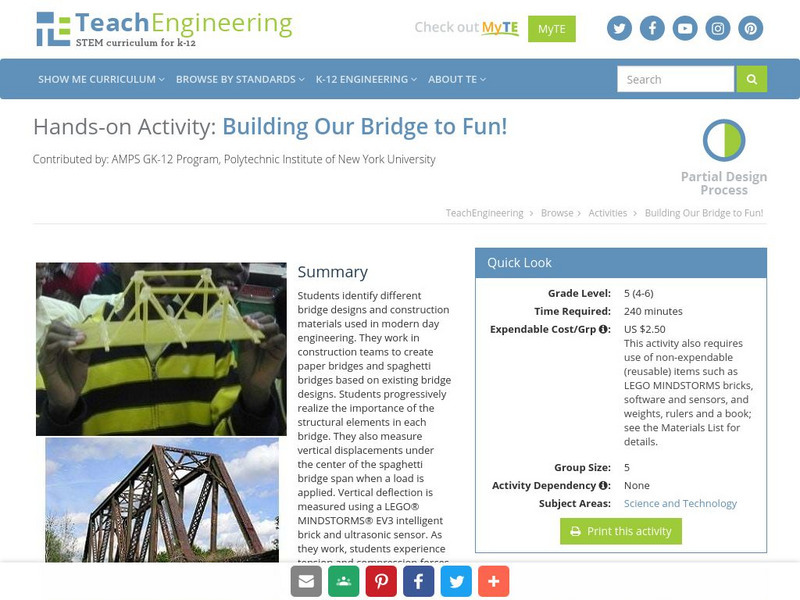
Teach Engineering: Building Our Bridge to Fun!
Students identify different bridge designs and construction materials used in modern day engineering. They work in construction teams to create paper bridges and spaghetti bridges based on existing bridge designs. Students progressively...
TeachEngineering
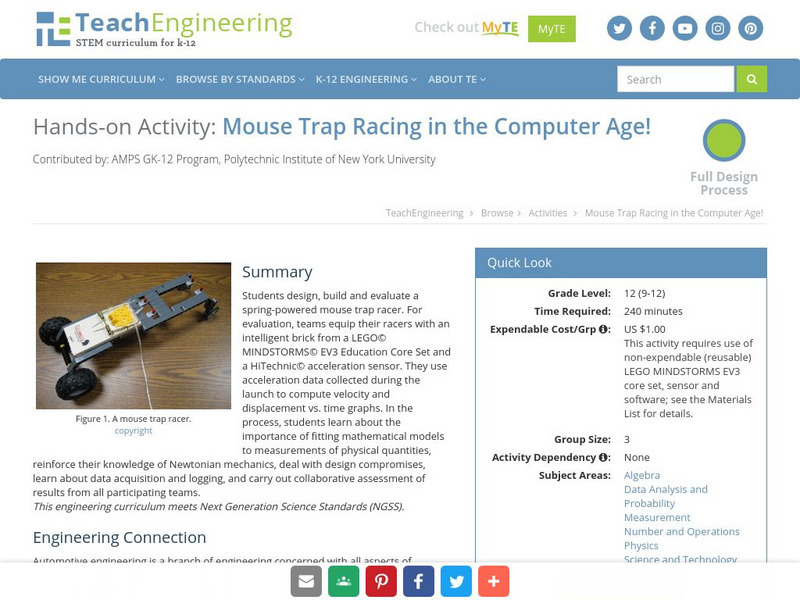
Teach Engineering: Mouse Trap Racing in the Computer Age!
Students design, build and evaluate a spring-powered mouse trap racer. For evaluation, teams equip their racers with an intelligent brick from a LEGO MINDSTORMS NXT Education Base Set and a HiTechnic acceleration sensor. They use...
TeachEngineering
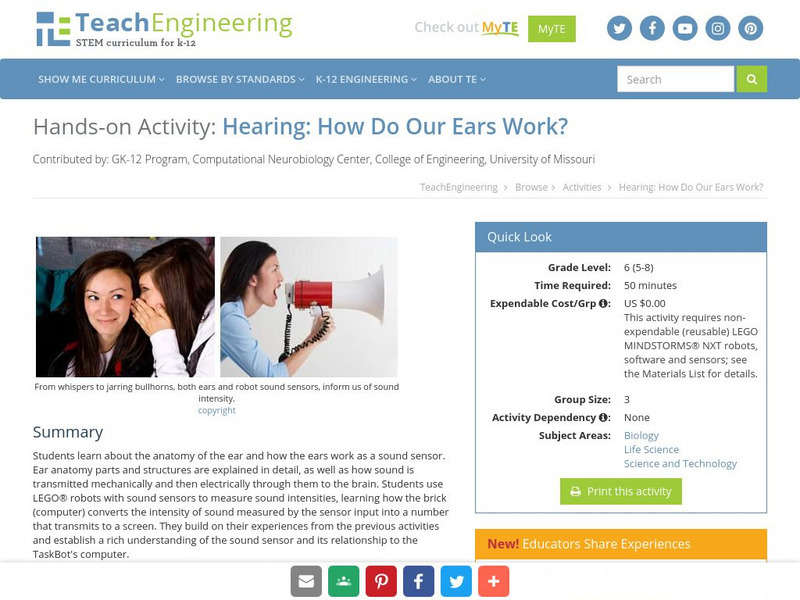
Teach Engineering: Hearing: How Do Our Ears Work?
Students learn about the anatomy of the ear and how the ears work as a sound sensor. Ear anatomy parts and structures are explained in detail, as well as how sound is transmitted mechanically and then electrically through them to the...