Hi, what do you want to do?






Concord Consortium
Comparing Potential Energy of a Bond
Have you reached your breaking point in looking for great resources that illustrate bond energy? Demonstrate the potential energy changes that occur when polar and non-polar bonds are broken with a stimulating simulation. Pupils pull on...

Concord Consortium
Hydrogen Bonds: A Special Type of Attraction
How does hydrogen bonding explain ice crystals? An engaging interactive answers just that. Scholars explore how polar molecules interact and observe the changes as temperature fluctuates as well as the hydrogen bond attraction.

Concord Consortium
Polarization
This is one cool resource for teaching about polarity! Chemistry scholars observe electron distribution and molecular shape as they select different non-metals and form bonds. The interactive offers two views, surface charge and electron...

Spark Notes
Review of Chemical Bonding: Review Test
This is an online exercise in which chemistry learners answer a series of multiple choice questions about bonding. Topics addressed include ionic and covalent bonds, electronegativity, ions, valence electrons, resonance structure, and...

Concord Consortium
Elements and Polarity
Take a look at some molecules that are so cool, they're polar! Scholars examine the effect polarity has on a molecule's shape and charge. Change up the view and choose between an opaque or transparent molecular surface, complete with...

Concord Consortium
Making Molecules
It's molecule magic! Skillful scholars explore the effects of different atoms on molecular polarization using an intuitive interactive. The resource displays the charge at different locations on the molecule, then adapts as the user...

CK-12 Foundation
Soap
Examine the chemistry of the laundry room! A thorough video explains the polarity and non-polarity properties of soap. The tutorial continues to explain the advantage of these properties in stain removal by showing the...

Concord Consortium
Boiling Point
Is it getting hot in here? Observe boiling from inside a beaker in an engaging interactive. Chemistry scholars heat and cool polar and non-polar solids and observe how molecules react to temperature changes. Your class' misconceptions...
Concord Consortium
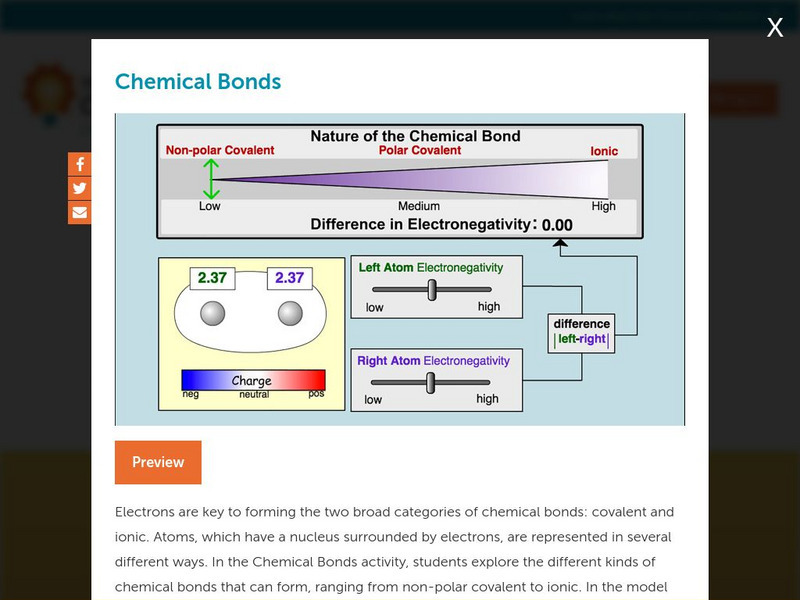
Concord Consortium: Stem Resources: Chemical Bonds
By working through this web-based activity, students differentiate between ionic, non-polar covalent, and polar covalent bonds. Specifically, distinctions are made between bonding types based on orbital shapes and electronegativity...

Concord Consortium
Concord Consortium: Molecular Workbench Showcase: Chemistry, Chemical Bonds
Simulations to show students the nature of chemical bonds. Simulations include an explanation of stereochemistry, atomic orbitals, chemical polarity, formation of an atom, and a summary quiz.

PBS
Pbs Learning Media: Covalent Bonding
This interactive activity from ChemThink takes a closer look at a covalent bond: how it is formed and how the sharing of two electrons can keep atoms together.

Concord Consortium
Concord Consortium: Stem Resources: Electrons in Atoms and Molecules
A module with animations, explanations, and questions about the importance of electrons in the structure of an atom. Understand the definition and locations of electrons in the atom. Explore the role of electrons in bonding, polarity,...
Concord Consortium
Concord Consortium: Comparing Potential Energy of Bond
Explore the change in potential energy when molecules are separated from each other or broken apart.

Concord Consortium
Concord Consortium: Stem Resources: Intermolecular Attractions
Learn that boiling point, solubility, and DNA are affect by intermolecular forces in this module. Module includes lessons with questions and animations to explain London dispersion and dipole-dipole attractions. To conclude the lessons,...