Hi, what do you want to do?






University of Southern California
How do Organisms Interact?
Examine how organisms interact through a hands-on experience. Learners study population dynamics and distribution during an informative five-lesson unit. The focus is on the ocean environment and the organisms within it.

Kenan Fellows
Unit 4: The Brain
Drugs interact with the brain to alter moods, emotions, and behaviors by changing the brain's chemistry, perceptions, and interactions. The final lesson in the Pharmacology unit shows scholars experiments, has them complete four labs,...

Tech Museum of Innovation
Analogous Models
What goes into a museum display? A secondary-level STEM project prompts groups to design a museum display for the Tech Museum of Innovation. They create an analogous, interactive model illustrating a science concept to complete the...

Kenan Fellows
Unit 1: Introduction to Biotechnology
Biotechnology is big! Introduce the uses of biotechnology to science scholars with a fascinating, fact-filled unit. The first installment in a series of four biotechnology units covers the role biotechnology plays in human and...

Curated OER
Anthropogenic Biomes
If you teach a man to fish, he will never go hungry—or he will overfish and permanently damage the ecosystem? Address the traditional biomes as well as the human-included ecosystems and contrasts the biotic and abiotic factors in each....

Montana Natural History Center
Studying Grassland Ecosystems
At first glance, grassland ecosystems might seem dull and uninteresting, but once you start to explore it's amazing the things you'll find! Through this series of engaging lessons, activities, and experiments, elementary students examine...
CK-12 Foundation
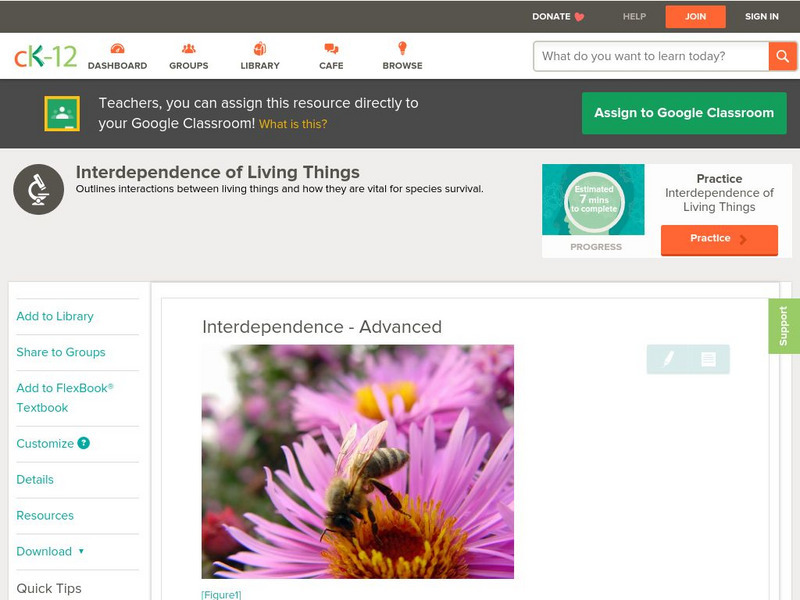
Ck 12: Biology: Interdependence of Living Things
[Free Registration/Login may be required to access all resource tools.] Covers interactions between organisms.
Vision Learning
Visionlearning: Biology: Taxonomy I: What's in a Name
Instructional module focusing on biological classification. Discussion includes Carolus Linnaeus' taxonomic classification system for organizing and classifying living things. Site also includes an interactive practice quiz and links...
Vision Learning
Visionlearning: Biology: Taxonomy Ii: Ruling Names of Giants
Instructional module focusing on binomial nomenclature. Discussion includes Carolus Linnaeus' taxonomic classification system for naming all species. Site also includes an interactive practice quiz and links relating to the topic.
Department of Defense
Do Dea: Biology: Unit 3: Cell Structure
In this third unit of a Biology course, students learn about cells and cell structure. They compare prokaryotic and eukaryotic cells and learn about the specialized structures in a cell and what their functions are. They will also learn...
Vision Learning
Visionlearning: Biology: Charles Darwin Ii: Natural Selection
Instructional module focusing on Charles Darwin's explanation of natural selection as the mechanism for evolution. Discusses how this force of natural selection promotes changes in species over time. Site also includes an interactive...
Vision Learning
Visionlearning: Biology: Charles Darwin Iii: Descent With Modification
Instructional module focusing on Charles Darwin's theory of Descent with Modification. Discusses how slight changes from parent to offspring create variation and potentially create new species over time. Site also includes an interactive...
Vision Learning
Visionlearning: Biology: Genetics Ii: Mendel and Multiple Genetic Traits
Instructional module focusing on Gregor Mendel's scientific legacy and analysis of multiple genetic traits. Discussion includes Mendel's work on his second law, the Law of Independent Assortment, which states that different traits are...

Concord Consortium
How Are Interactions With Water Important for Maintaining My Life?
An investigation of how polar and nonpolar interactions affect shapes of biological molecules and their function. Modules explore the following: 1. Why don't oil and water mix? 2. Can a substance dissolve in both a nonpolar and a polar...

Georgia Department of Education
Ga Virtual Learning: Ap Biology: Chemistry of Life
Through informational text, interactive activities, animations, and video clips, students examine the chemistry of living things, and they learn how interactions from atoms are fundamental to life as we know it.
Georgia Department of Education
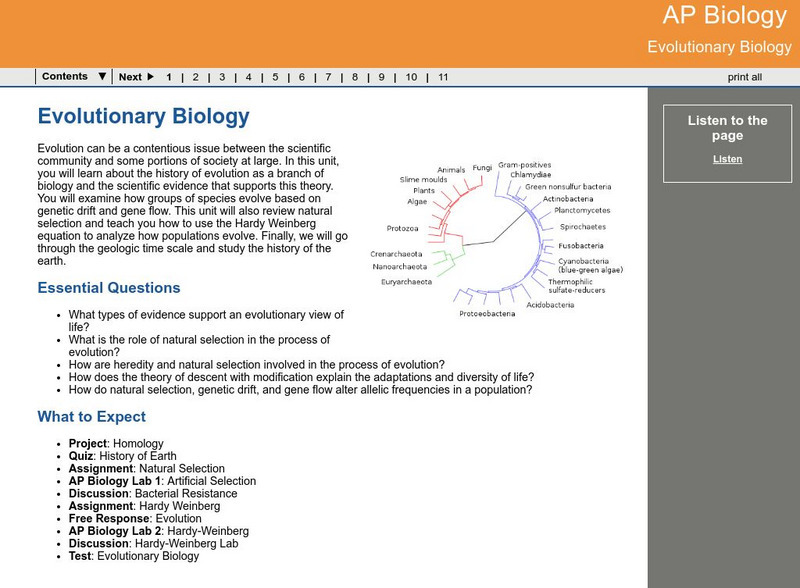
Ga Virtual Learning: Ap Biology: Evolutionary Biology
Through informational text, interactive activities, animations, and video clips, students investigate evolutionary biology.
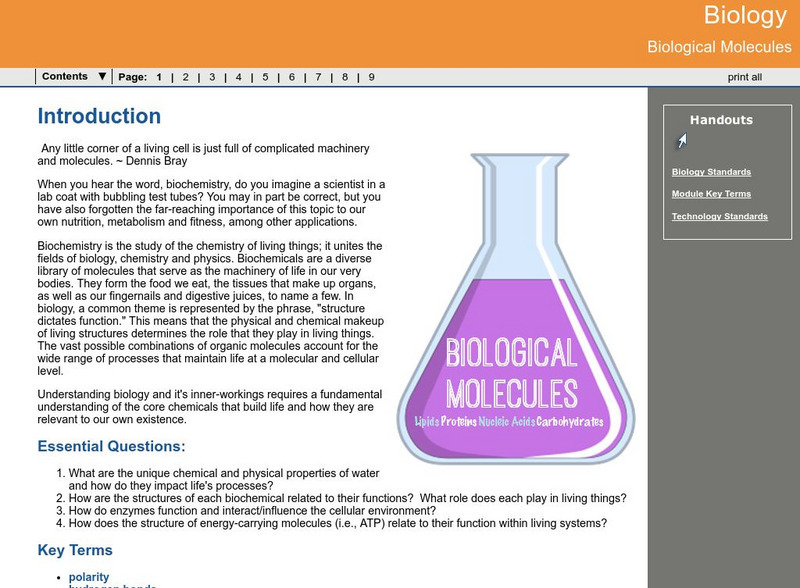
Georgia Department of Education
Ga Virtual Learning: Biology: Biological Molecules
Through informational text, interactive activities, step-through animations, and video clips, studnet explore biochemistry and the molecules that make up living things.
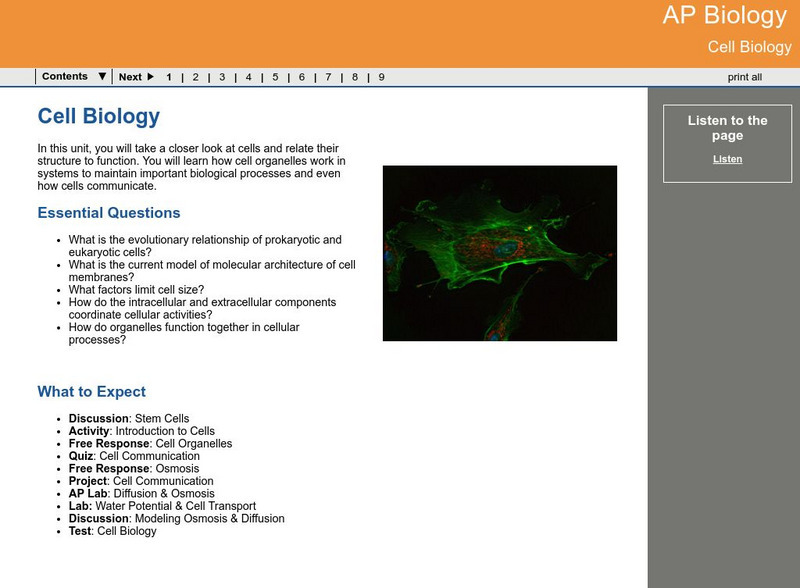
Georgia Department of Education
Ga Virtual Learning: Ap Biology: Cell Biology
An interactive module where students take a closer look at cells and relate their structure to function. They also discover how cell organelles work in systems to maintain important biological processes and how cells communicate.

Georgia Department of Education
Ga Virtual Learning: Biology: Cells
A complete, interactive course where students analyze the nature of the relationships between structures and functions in living cells.

Georgia Department of Education
Ga Virtual Learning: Ap Biology: Heredity
This interactive learning module allows AP Biology students to explore the principles of Mendelian genetics and non-Mendelian patterns of inheritance. Students will also study the role of chromosomes in heredity.
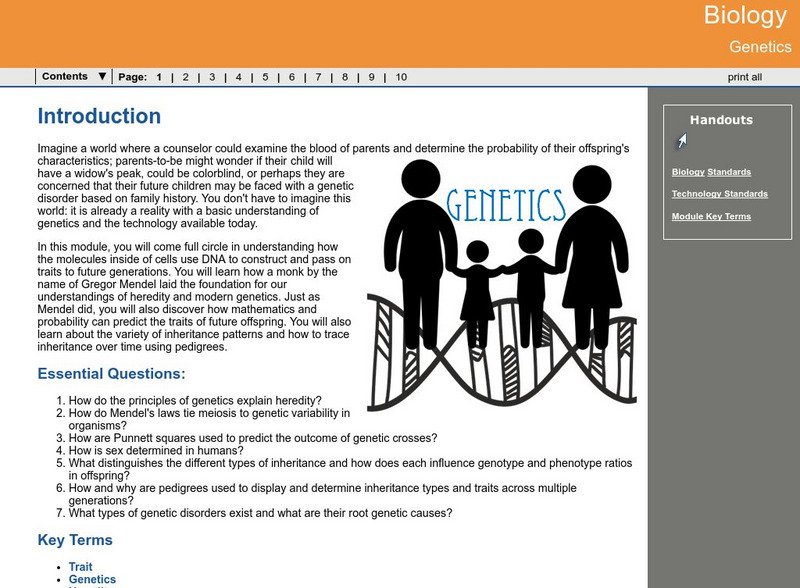
Georgia Department of Education
Ga Virtual Learning: Biology: Genetics
Through informational text, interactive activities, practice problems, and video clips, students analyze how biological traits are passed on to successive generations.

Georgia Department of Education
Ga Virtual Learning: Ap Biology: Molecular Genetics
This interactive learning module allows AP Biology students to explore DNA and molecular genetics. The study also covers the concepts of biotechnology.
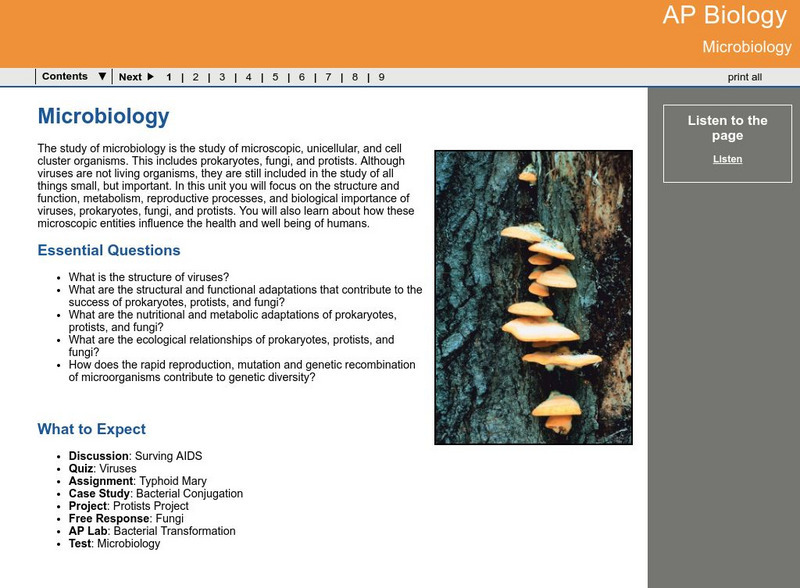
Georgia Department of Education
Ga Virtual Learning: Ap Biology: Microbiology
In this interactive learning module, students focus on the structure and function, metabolism, reproductive processes, and biological importance of viruses, prokaryotes, fungi, and protists.

Georgia Department of Education
Ga Virtual Learning: Biology: Cell Energetics
An interactive module where students describe, compare, contrast and explain the relationship between photosynthesis and cellular respiration.