
Curated OER
How Do You Turn a Terminating Decimal Into a Fraction?
The instructor demonstrates how to convert a terminating decimal to a fraction. She calculates a base 10 denominator and then reduces the fraction to simplest form.

Curated OER
How Do You Solve a Word Problem Using the Elimination by Subtraction Method?
Use word problems to teach systems of equations! The instructor in this video demonstrates how to solve a word problem using a system of equations and the elimination by subtraction method. She goes through each step, carefully...

Curated OER
How Do You Factor a 6-Term Polynomial by Grouping?
An example of factoring by grouping is shown in this video. We look at a polynomial with six terms, by grouping the terms into two trinomials with common factors. Then we factor a couple times so that we factor completely.

Curated OER
How Do You Solve a Word Problem by Dividing Monomials?
A word problem, a triangle, monomials, exponents, what to do? The instructor explains how to set up this ratio in order to solve the problem and express it as a monomial in simplest form.

Curated OER
How Do You Find Equivalent Ratios?
Ratios are a comparison of numbers. So given a ratio, how can an equivalent ratio be written? Just multiply or divide, both the numerator and the denominator, by the same value. The result will be different numbers, but equal values that...

Curated OER
How Do You Find the Greatest Common Factor If There are No Common Factors?
Use prime factorization to find the greatest common factor of three given values. Okay. But what if there doesn't seem to be any integer that is common in all three given values? Well, then, the greatest common factor must be 1. Not sure...

Curated OER
How Do You Turn a Terminating Decimal Into a Fraction?
The instructor demonstrates how to convert a terminating decimal to a fraction. She calculates a base 10 denominator and then reduces the fraction to simplest form.

Curated OER
How Do You Subtract Fractions with Different Denominators?
Combining fractions with unlike denominators. Wait! You can't do that! You have to have common denominators to combine the numerator of fractions. Here's a quick review of changing the denominator by multiplying each fraction by that...

Real Engineering
The History of Iron and Steel
Steel a great resource to teach your class all about iron. Viewers of an engaging video see how the production of wrought iron, cast iron, and steel have changed over time. The video also explains some societal advances due to these...

Howard Hughes Medical Institute
Somatic Cell Nuclear Transfer Animation
One cloning technique is somatic cell nuclear transfer (SCNT). Observe the process in action through an animated video. Review the applications of the process for both therapeutic cloning and cloning of an individual.

TED-Ed
How Do Crystals Work?
What do amazonite, heliotrope, carnelian, and diamonds have in common? There are all crystals and members of one of the six crystal families. Viewers of a fascinating short video learn about the molecular structure of crystals that cause...

Curated OER
How Do You Turn an Integer Into a Fraction?
So you want to write an integer as a fraction? Well, all you have to do, is write the integer as the numerator with a denominator of 1.

Curated OER
How Do You Turn an Integer Into a Fraction?
So you want to write an integer as a fraction? Well, all you have to do, is write the integer as the numerator with a denominator of 1.
Math TV
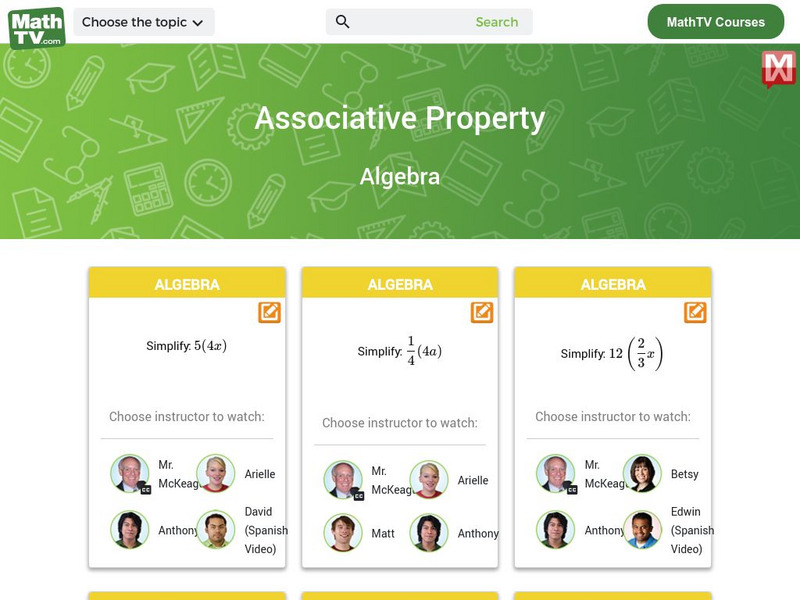
Math tv.com: Properties of Numbers: Associative Property
A math teacher and several students show you how to simplify expressions using the associative property. Several video demonstrations offer clear, step-by-step solutions to eight problems.

Khan Academy
Khan Academy: Using Associative Property to Simplify Multiplication
Sal Khan uses the associative property to multiply 2-digit numbers by 1-digit numbers. [4:30]
Math Mammoth
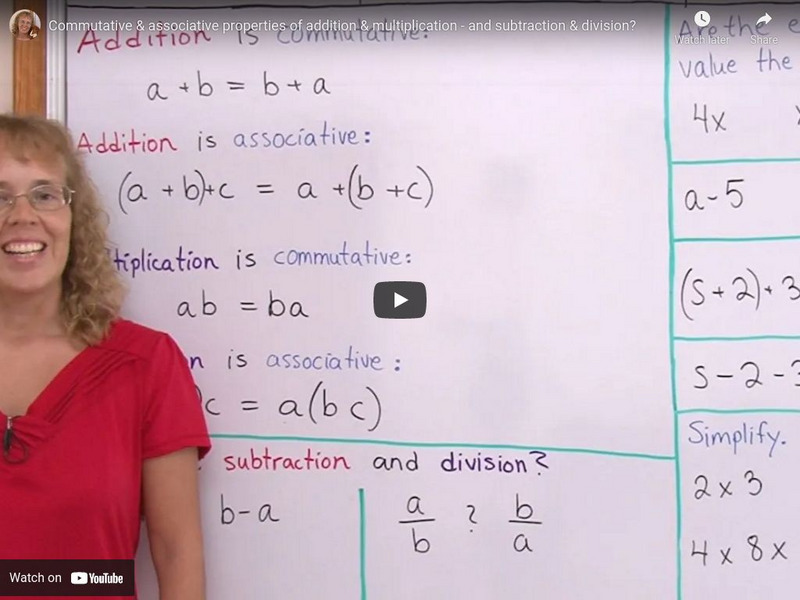
Math Mammoth: Commutative and Associative Properties
Explains what the commutative and associative properties of addition and multiplication are and investigates whether they work for subtraction and division. The video then looks at examples to see if expressions are equal and simplifies...
Imagine Learning Classroom
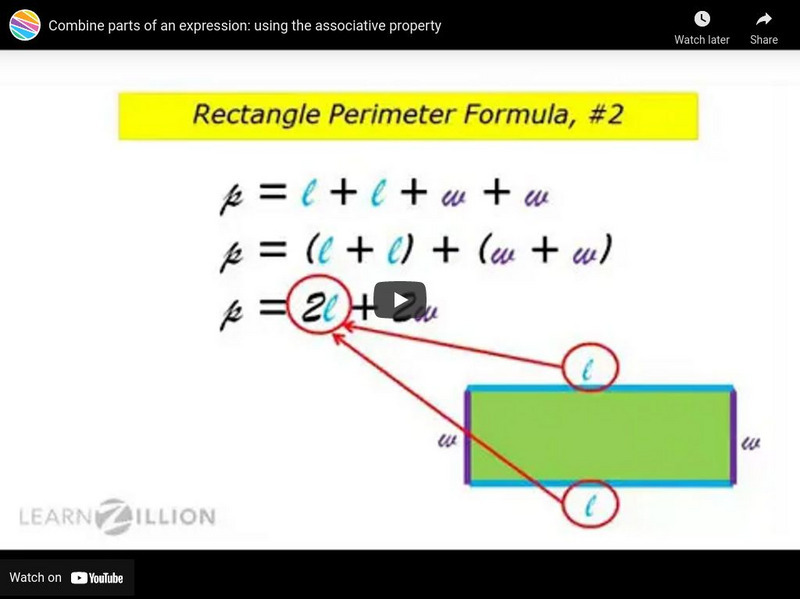
Learn Zillion: Combine Parts of an Expression: Using the Associative Property
In this lesson, you will learn how to combine parts of an expression using the associative property. [4:25]

Virtual Nerd
Virtual Nerd: What Are the Associative Properties of Addition and Multiplication
Take a look at this instructional video to learn about one of the most fundamental properties of math, the associative property. [5:13]
Virtual Nerd
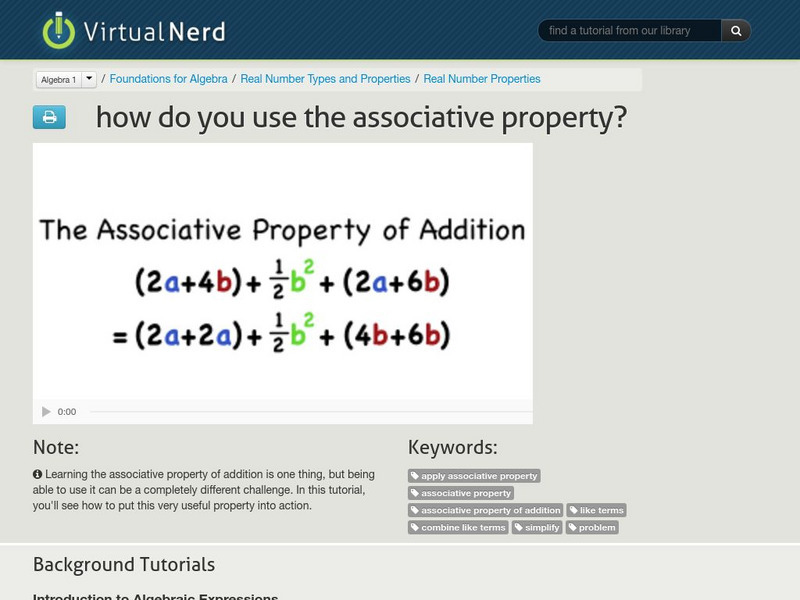
Virtual Nerd: How Do You Use the Associative Property?
Watch this video tutorial to learn how to apply the associative property of addition. [1:07]
Sophia Learning
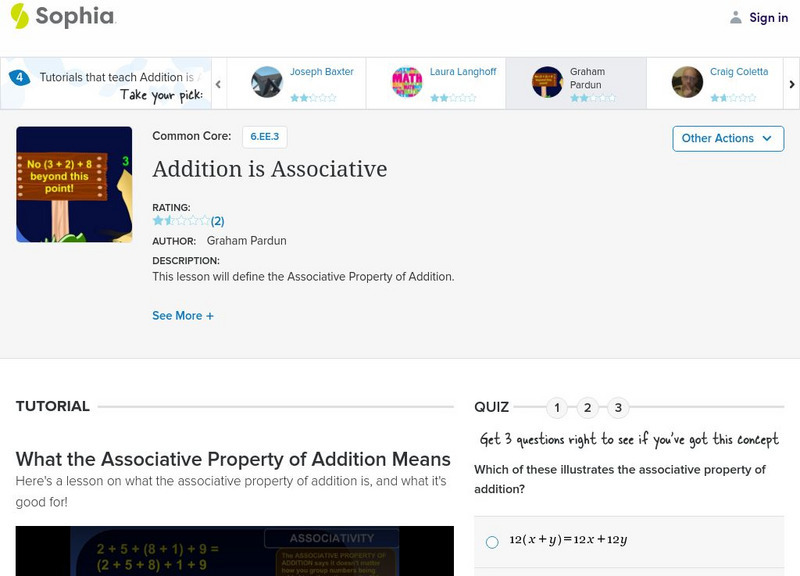
Sophia: Addition Is Associative
Explore the associative property of addition and take a quiz to assess learning.

Art of Problem Solving
Art of Problem Solving: Associative Property of Addition
Video tutorial uses examples to reinforce understanding of the Associative Property of addition. [3:09]

Khan Academy
Khan Academy: Associative Property of Multiplication
Sal Khan regroups numbers to simplify multiplication problems. [3:34]

Khan Academy
Khan Academy: Associative Property of Addition
Demonstrates the associative law of addition and how rearranging the numbers and parentheses does not change the sum. [2:10]
Loyola University Chicago
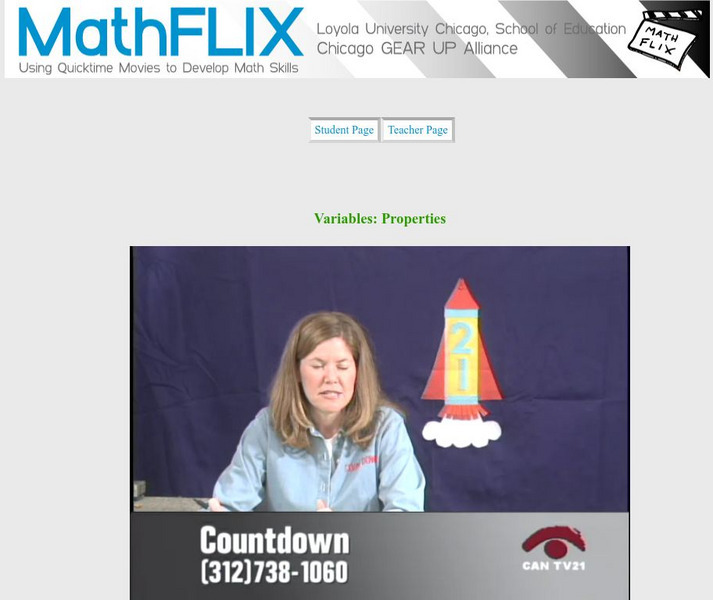
Math Flix: Variables: Properties
This QuickTime movie provides excellent explanations of the Distributive, Commutative, and Associative Properties using variables with examples. As you watch and listen to the teacher and student interact it helps clarify the thinking...
Other popular searches
- Math Associative Property
- Associative Property of Math
- Associative Property in Math
- Associative Property Lessons
- Associative Property Addition