Hi, what do you want to do?






Read Works
The What and Who of Elections
As citizens living in the United States, it is our civil duty to vote. But how does the voting process work? After reading a five-paragraph passage on the basics of elections and voting, young constituents respond to 10 questions...
Better Lesson
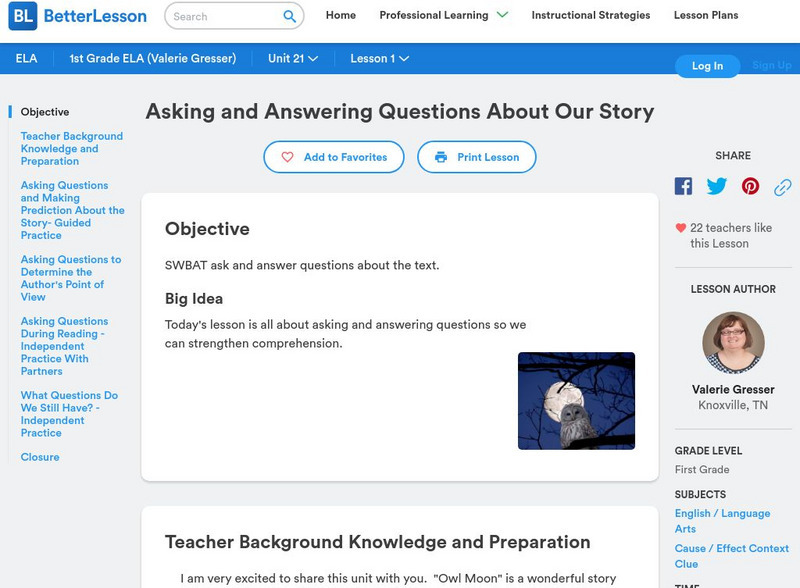
Better Lesson: Asking and Answering Questions About Our Story
A lesson plan with all resources included for asking and answering questions to strengthen comprehension.
Other
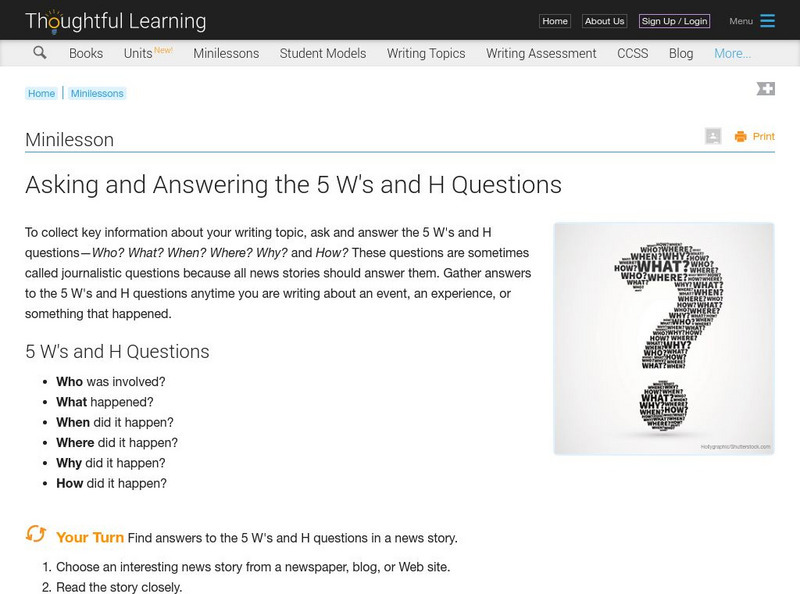
Thoughtful Learning: Minilesson: Asking and Answering the 5 W's and H Questions
Students will learn the "5 W's and H questions" needed to comprehend a news story. Then students will apply these question words [who, what, where, why, when, and how] to real news stories and to events in their own lives.

CommonLit
Common Lit: The Destinies of Two Men Who Share One Name
A learning module that begins with "The Destinies of Two Men Who Share One Name" by Melissa Block and Michele Norris, accompanied by guided reading questions, assessment questions, and discussion questions. The text can be printed as a...
Better Lesson
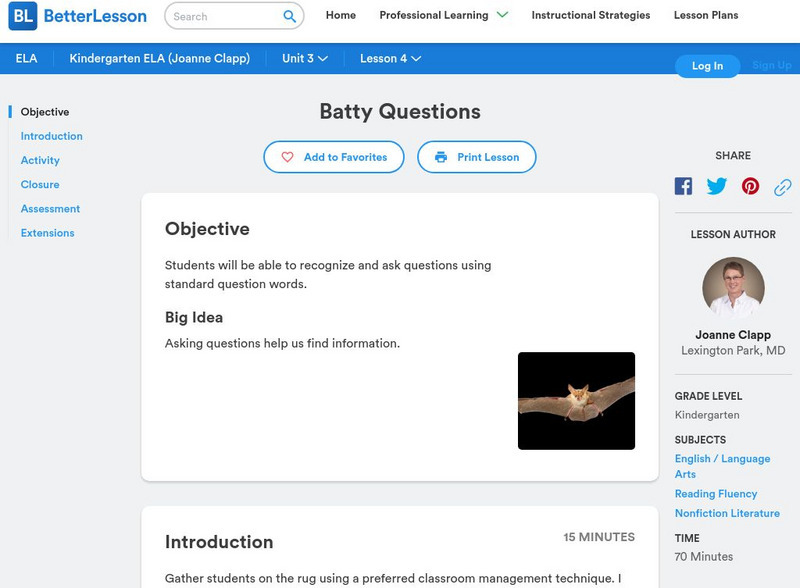
Better Lesson: Batty Questions
In this lesson, learners will be able to recognize and ask questions using standard question words while learning about bats. Included in this lesson are samples of student work, and pictures of the lesson in action.
Other
Medium: Helping Students Ask Better Questions by Creating a Culture of Inquiry
We want to see kids asking tons of questions. This is how students grow into creative, critical thinkers. This article by John Spencer gives multiple ways teachers can foster an environment in which students feel comfortable asking...
Thomas Jefferson National Accelerator Facility
Jefferson Lab: Who Wants to Win a Million Dollars?
Answer 15 science and math based questions correctly and become a (pretend!) millionaire!
Centers for Disease Control and Prevention
Centers for Disease Control: Kids' Quest on Disability and Health
KQ, the techno-health wizard, lets kids choose a WebQuest about a disability-related question they may have been wondering about. They get a page of activities and resources about Autism, Vision Impairment, Mobility Restriction, etc.,...
Centers for Disease Control and Prevention
Centers for Disease Control: Kids' Quest on Disability and Health
KQ, the techno-health wizard, lets kids choose a WebQuest about a disability-related question they may have been wondering about. They get a page of activities and resources about Autism, Vision Impairment, Mobility Restriction, etc.,...
National Snow and Ice Data Center
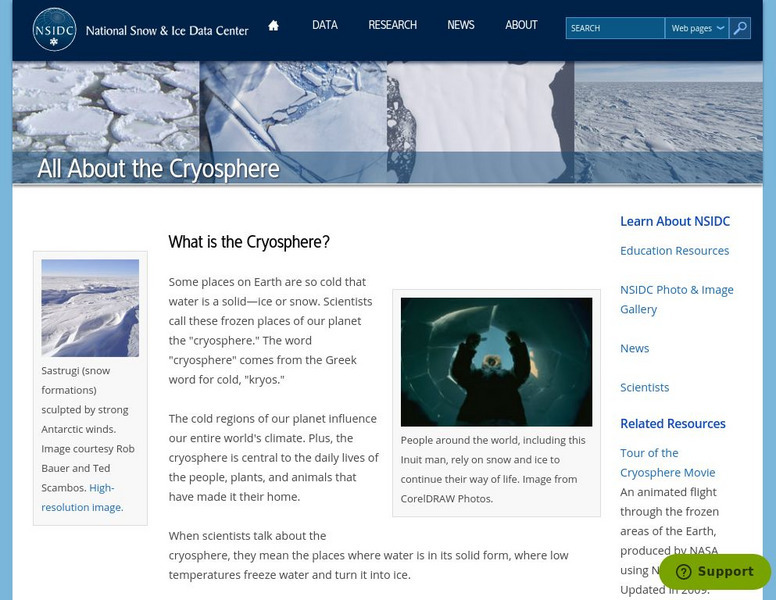
National Snow and Ice Data Center: All About the Cryosphere
What makes up the polar ice caps (cryosphere) and why are they important to those who don't live there? This comprehensive resource answers these questions and provides dramatic evidence for global warming.

Alabama Learning Exchange
Alex: Happy Constitution Day
Students work in groups to create presentations answering who, what, when, where, why, and how questions concerning the U.S. Constitution. Presentations will be used to create digital Constitution Day Program.

Alabama Learning Exchange
Alex: Exploring Explorers
Students will create a video in talk-show format about explorers from the 15th-17th centuries. They will utilize books, the Alabama Virtual Library, and the Internet for reference. Groups of students will answer who, what, when, where,...
Florida Center for Reading Research
Florida Center for Reading Research: Character Characteristics
A lesson plan in which young scholars read a narrative text and complete graphic organizers to analyze a character. Materials are included. [PDF]
PBS
Iowa Public Television: Water Mini Web Quest [Pdf]
Browse the Explore More: Water Quality website to answer these questions about how water is used, who uses it and how these uses impact the quality of water. Find ways to make a difference in water quality through the choices you make.
Better Lesson
Better Lesson: Who's Your Plant Parent?
In this activity, we observe our own plants to discover the answer to this big question: How are plants like their parents? Students will observe pre-planted seedlings and compare them to photographs of their parent plants. Included in...
Read Works
Read Works: Passages: Sarah the Seagull
[Free Registration/Login Required] Students read a fiction text about a seagull named Sarah who lived with her mom in New York and answer questions about comprehension, setting, main idea, vocabulary, and more. Links to a paired text and...
Read Works
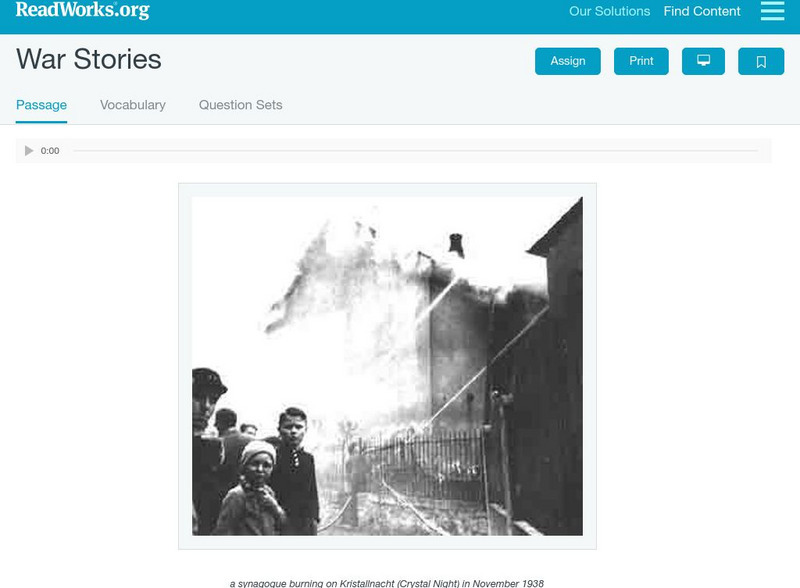
Read Works: Passages: "War Stories"
[Free Registration/Login Required] The passage "War Stories" is a collection of three interviews with people who experienced some aspect of World War II collected as a part of the "Eyewitness to History" Contest. Comprehension questions...
Stanford University
Sheg: Document Based History: Reading Like a Historian: Loyalists
[Free Registration/Login Required] Who were the Loyalists? Why did they oppose independence? In this historical inquiry lesson, students seek answers to these questions by sourcing, contextualizing, and corroborating two documents...
Utah Education Network
Uen: Africa, a Look Through the Eyes of a Child
As an introduction to the seven continents unit, 2nd graders will read and explore assorted informational texts about Africa. Students will answer the following questions to acquire knowledge about the continent: Who? What? Where? Why?...
Washington State University
Washington State University: Ask Dr. Universe: Why Are Ripe Fruits Sweet?
Dr. Universe answers Alexa's thought-provoking question with feedback from her scientist friend who works at WSU. Why is it important that we eat fruit that has ripened?
Washington State University
Washington State University: Ask Dr. Universe: How Do Mollusks Move Around the Ocean?
Dr. Universe went to a friend who is a marine biologist to find the answer to this probing question by Michel. Find out all about mollusks.
Common Sense Media
Common Sense Media: Education: You've Won a Prize!: Grades 3 5
Students learn what spam is, the forms it takes, and then identify strategies for dealing with it. They compare junk mail to spam, learn tips for handling spam safely, and use those tips to answer questions on the student handout about a...
Other
Science Superstars: Anton Van Leeuwenhoek
This site is provided for by Zephyrus. So, who was Anton van Leeuwenhoek (1632 -1723 CE)? What else did Leeuwenhoek do? Did he achieve anything else? What honors were awarded to him? These questions are answered in this informative site.

Other
Us flag.org: Francis Scott Key (1780 1843)
Who was Francis Scott Key? What did he write? You can find the answers to these two questions and much more by exploring this website.