Hi, what do you want to do?






Classroom Law Project
What does the Constitution say about voting? Constitutional Amendments and the Electoral College
As part of a study of voting rights in the US, class members examine Constitutional amendments connected with voting and the role of the Electoral College in the election process.

Middle Tennessee State University
Fights, Freedom, and Fraud: Voting Rights in the Reconstruction Era
As part of a study of post Civil War era, young historians investigate the changes in voting rights during the Reconstruction Era (1863-1876), the fraud involved in the Hayes-Tilden presidential election of 1876, and efforts by Pap...

Bill of Rights Institute
Freedom for All?
What did abolitionists have in common with those working for women's rights? How has the Native American struggle for voting rights differed from the struggles of other groups? Class members examine the 15th, 19th, 23rd, 24th, and 26th...

Classroom Law Project
What are some of today’s voting issues? Voting in Oregon, youth vote, and technology
The youth vote. Rock the Vote. Vote-By-Mail. Electronic voting. Class members investigate issues facing today's voters, and the ways they have adapted over the years to optimize voter turnout.

ProCon
Gun Control
According to some estimates, there are more guns than people in the United States. Learners decide if America should enact more gun control laws. They analyze information about gun deaths in the United States by year, read about the...

Curated OER
Concealed Handguns
Should adults be allowed to carry concealed handguns? Pupils use the website to research the topic thoroughly and weigh the pros and cons. They read background information on gun control and learn about the main arguments surrounding the...

Curated OER
Churches and Taxes
Churches have been tax-exempt since the founding of America, but should they be? Pupils ponder the question as they browse the website in preparation for a class debate or discussion. They research the history of tax-exemption for...

Deliberating in a Democracy
Free and Independent Press
Students determine how free press principles can be compromised. For this global studies lesson, students read an article titled "Free and Independent Press." Students respond to discussion questions regarding the article.

iCivics
I Can’t Wear What?
Can schools ban t-shirts picturing musical groups or bands? Your young citizens will find out with this resource, which includes a summary of a United States Supreme Court case from the 1960s about a similar dispute over learners wearing...
Thomson Reuters
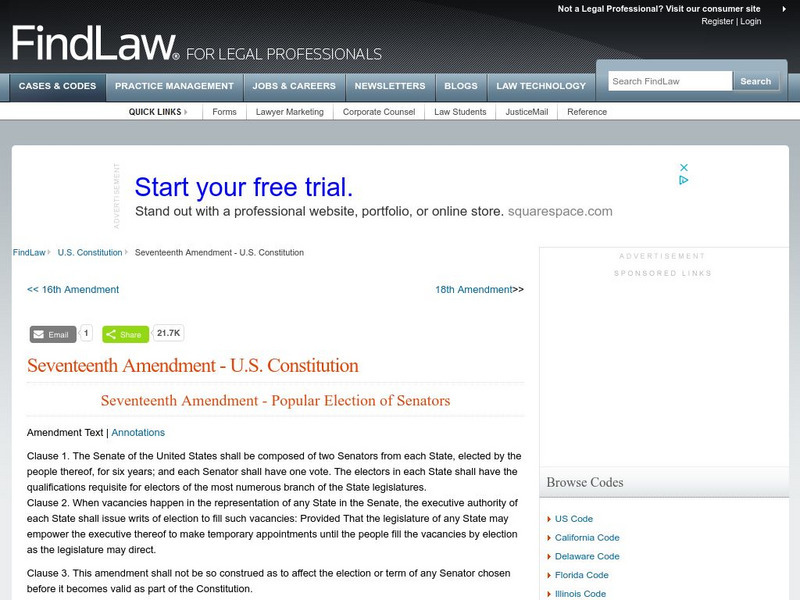
Find Law: u.s. Constitution: Seventeenth Amendment: Popular Election of Senators
This resource provides the 17th Amendment, which called for the direct election of Senators. The text is followed by a discussion of the Amendment.
Library of Congress
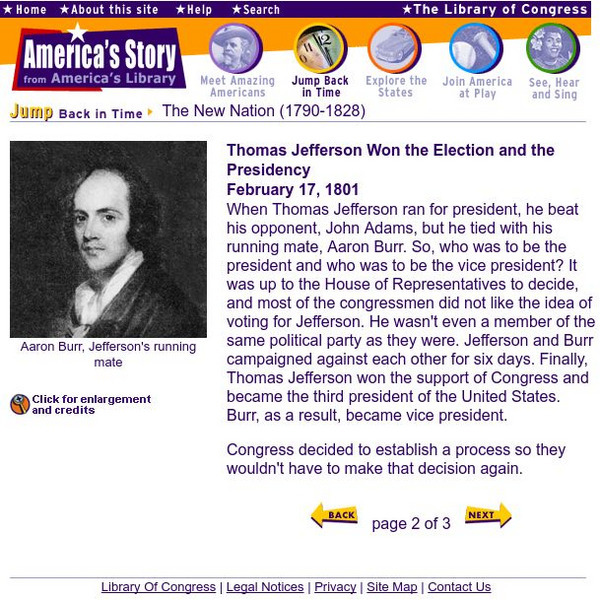
Loc: America's Story: Thomas Jefferson Won the Election
The election of 1801 shaped the way we elect our president today, as Congress adopted the Twelfth Amendment to the Constitution. Features portraits of Thomas Jefferson and Aaron Burr.
Illinois Institute of Technology
The Oyez Project: Katz v. United States
Katz v. United States altered the meaning of the 4th Amendment, the right to search and seizure, appealing his case in 1967 regarding the investigator's use of electronic surveillance. Oyez features the facts and recordings from the...

Annenberg Foundation
Annenberg Classroom: The Annenberg Guide to the United States Constitution
The Annenberg guide to the United States Constitution: what It says, what It means. RI.11-12.8 seminal U.S. texts
University of Texas at Austin
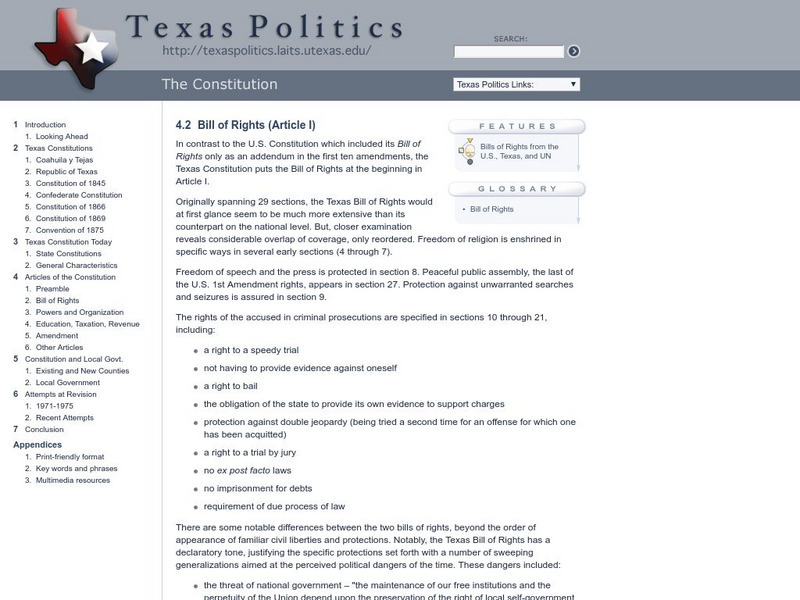
Texas Politics: The Constitution: Bill of Rights
Read the current Texas Bill of Rights, which spells out individual freedoms of state residents, and reiterates those of the United States of America.
Library of Congress
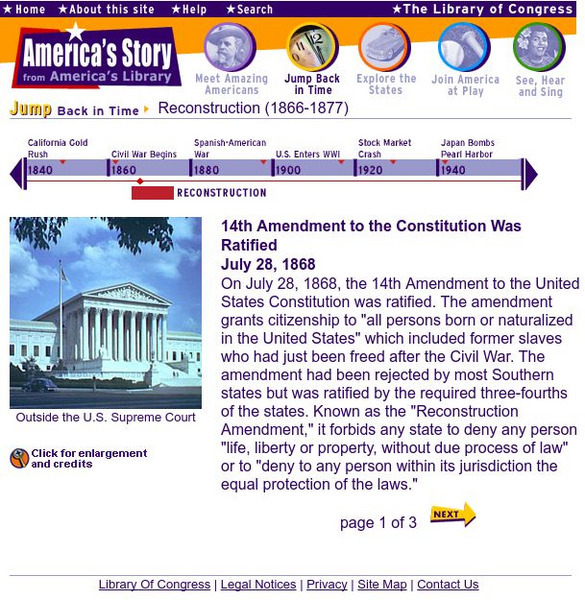
Loc: America's Story: 14th Amendment to the Constitution
After the Civil War, the 14th amendment granted citizenship to all people born or naturalized in the United States. This included former slaves. Learn about the protections this amendment offers to citizens, including those who were once...
State Library of North Carolina
N Cpedia: Constitution, State
North Carolinians have lived under three state constitutions - the Constitution of 1776, the Constitution of 1868, and the Constitution of 1971. In general, each constitution expanded the rights and privileges of the citizenry as well as...

Other
Georgia Constitution Web Page
Here you will find the text used in the state of Georgia Constitution.
Annenberg Foundation
Annenberg Classroom: Our Constitution: Second Amendment (1791)
Text and summary of the 2nd Amendment to the U.S. Constitution. Site includes a timeline as well as a link to a second timeline that has hyperlinks to additional information.
Thomson Reuters
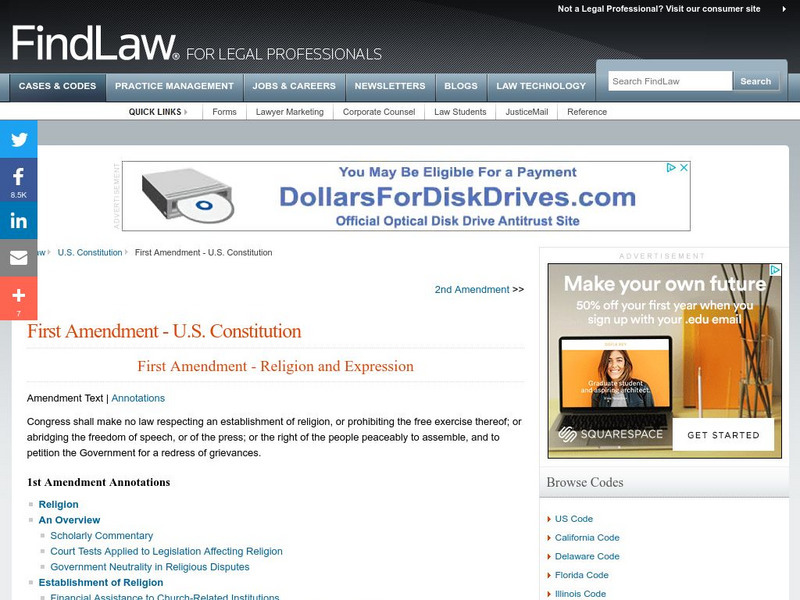
Find Law: u.s. Constitution: First Amendment Protections
This resource contains an annotated look at the different topics covered within the First Amendment of the U.S. Constitution. Click on any subtopic link for in-depth information about that part of the First Amendment.
National Constitution Center
National Constitution Center: Amendment X: Rights Reserved for States or People
Provides text to the Tenth Amendment with further interpretation about rights reserved for the states or the people.
Thomson Reuters
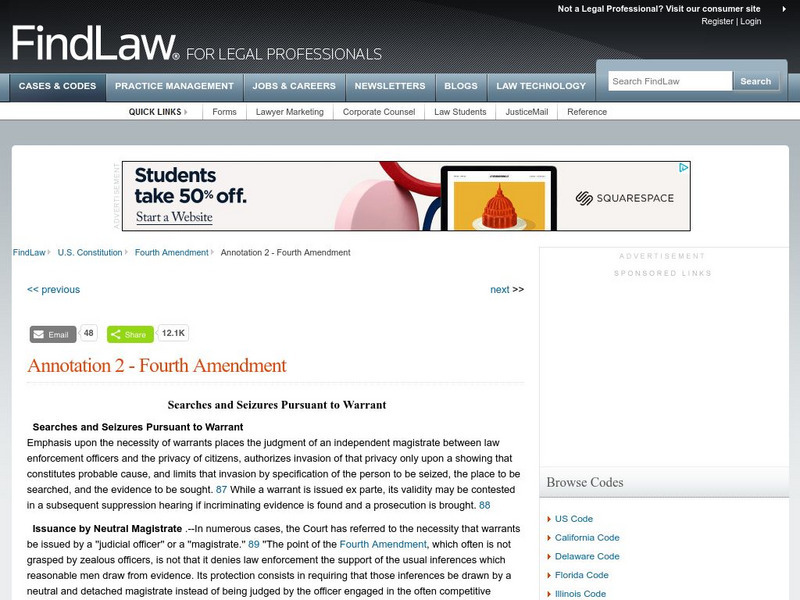
Find Law: u.s. Constitution: Fourth Amendment
This resource provides information on the reference to Rochin v California, that is found in the annotations page to the 4th Amendment. Specifically, focusing on the section covering "Property subject to seizure".

Annenberg Foundation
Annenberg Classroom: Twenty Third Amendment
Text of the 23rd Amendment and accompanying explanation in Annenberg Classroom Civics Education site.
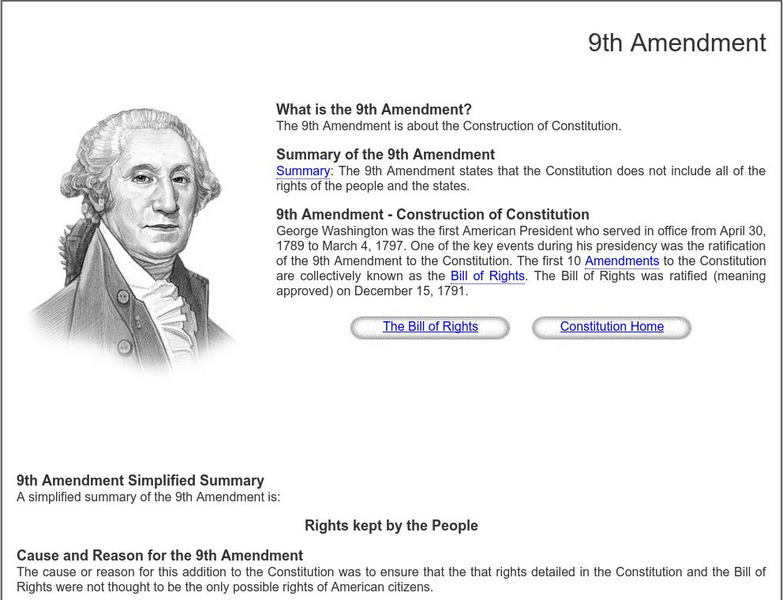
Siteseen
Siteseen: Government and Constitution: 9th Amendment
Short, simple summary with the full text of the 9th amendment of the Bill of Rights that states that the Constitution of America does not include all of the rights of the people and the states.
Siteseen
Siteseen: Government and Constitution: 5th Amendment
Short, simple summary with the full text of the 5th amendment of the Bill of Rights detailing the need for 'due process of the law' before punishing a person and the right to a trial by jury as detailed in the Constitution.