Hi, what do you want to do?






American Museum of Natural History
How Did the Universe Begin?
The Big Bang Theory is more than a television show. Pupils read how Edwin Hubble observed other galaxies and noticed that the galaxies are moving away from each other. Scholars learn about the idea of the big bang and what happened next...

American Museum of Natural History
Planetary Mysteries
A website all about planetary mysteries—it's a one-stop-shop for all things, stars, planets, and space travel. Scholars read an astronomy overview to discover the page's big ideas, then choose from the plethora of resources, including...

American Museum of Natural History
What is Astronomy?
Go study the universe. Pupils learn seven aspects about astronomy and astronomers. They begin to learn about constellations; distance and motion between objects; gravity; the electromagnetic spectrum; dark matter and energy; and teams of...
NASA
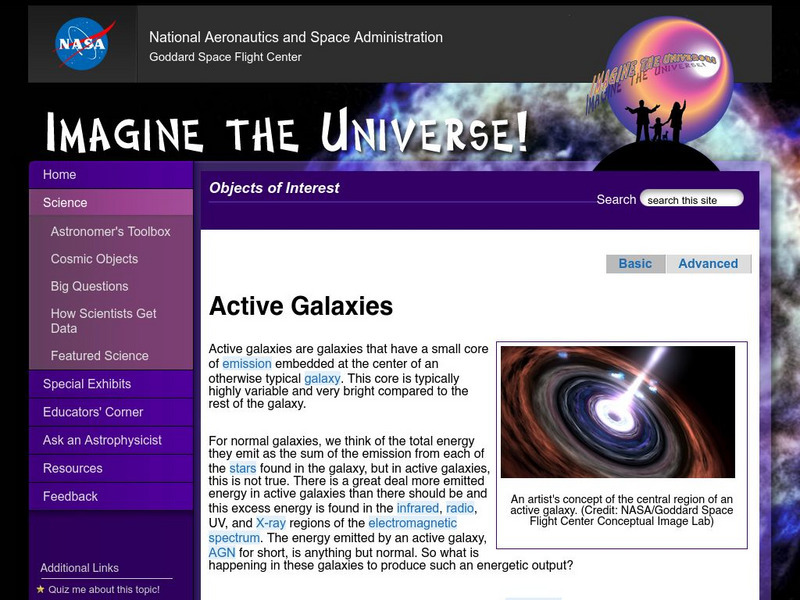
Nasa: Imagine the Universe: Active Galaxies and Quasars
Describes quasars as being classified within the category of an active galaxy. A description of the emergence of high-energy. Definitions of key words are provided.gamma-ray quasars as an important component of the gamma-ray sky.

Harvard University
Quasars and Active Galaxies
This site provides information about quasars and active galaxies. Includes a glossary of important terms.
National Earth Science Teachers Association
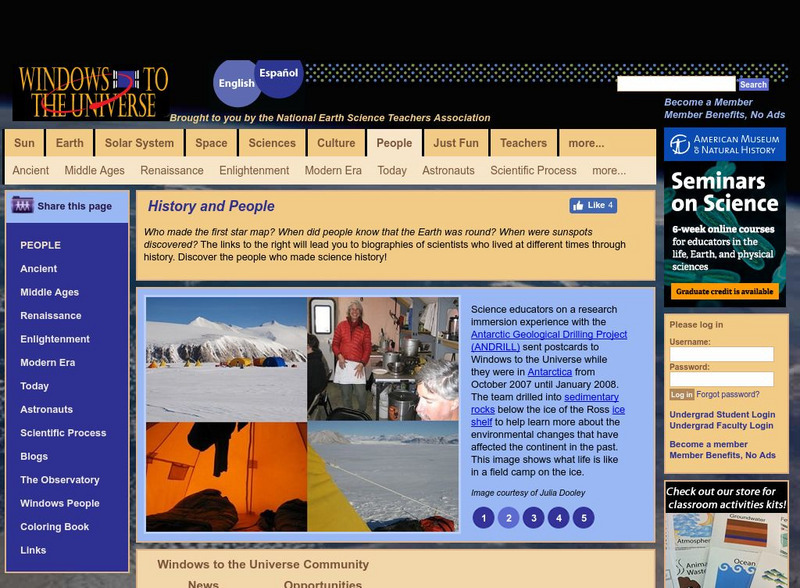
Windows to the Universe: History & People
Biographies of people throughout history who looked at the sky and wondered what was there. Links to a detailed description of the planets and interactive activities.
NASA
Nasa: Imagine the Universe: Fa Qs on Quasars
A list of answers to many questions related to quasars and active galaxies.
NASA
Nasa: The Space Place
Do you know what a solar eclipse is? Or how about a galaxy? Space Place has the answers to all your questions about space! Site includes information to explore about planets, satellites, moons, and much more. Also on the website are...
Other
Paper Plate Education: Serving the Universe on a Paper Plate
Excellent resource for "paper-plate" activities that help simplify various astronomy topics. Learn how to build a "Moon Finder" and "Planet Pointer," and create a paper-plate model that explains the Transit of Venus.
American Association of Physics Teachers
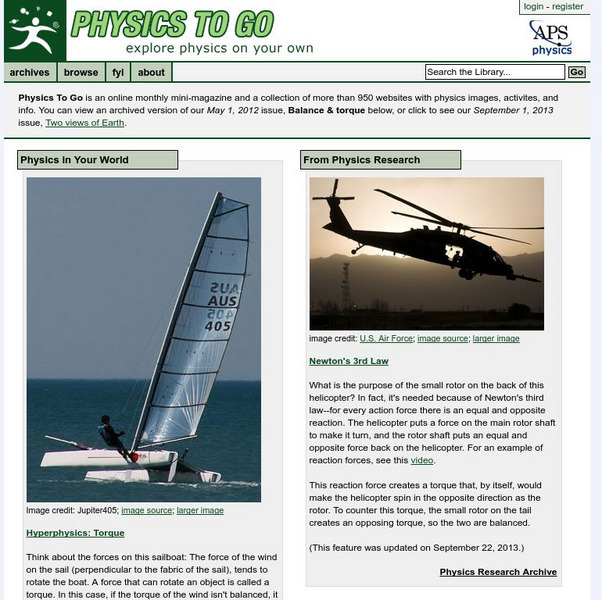
Com Padre Digital Library: Physics to Go: Explore Physics on Your Own
Contains a full physics curriculum with links to games, webcasts, and activities. By creating a free account, students and teachers can create their own personal collection of resources.
NASA
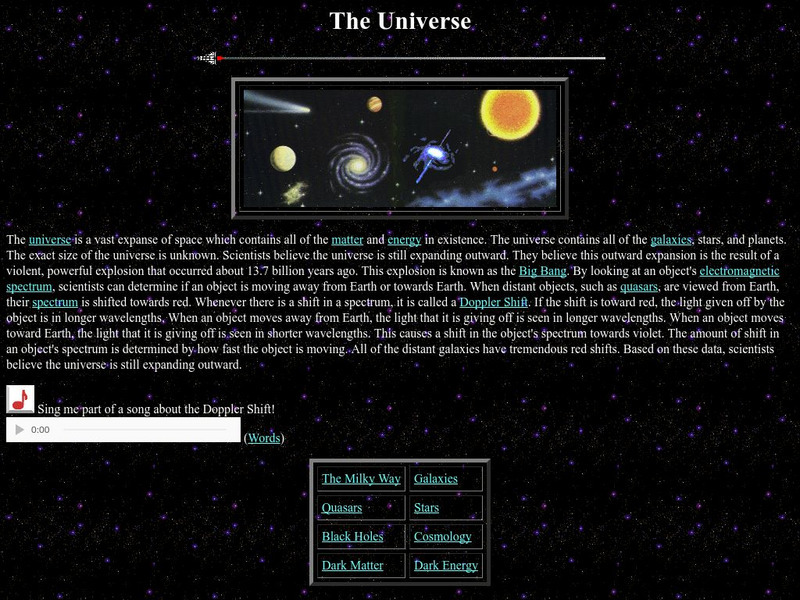
Nasa Star Child: The Universe (Level 2)
This site provides a description of the universe and what it contains. Includes links to definitions, activities, and an audio song. Printable version available.
Other
Astromador: Astronomia Para Amadores
This resources focuses exclusively on astronomy. It's packed with historical facts about space exploration, famous people who pioneered the study of stars and planets. It features chronological list of space exploration, current news,...

Enchanted Learning
Enchanted Learning: Zoom Astronomy
Where is our Solar System? How far away is the sun? What makes up the sun? Find out all you want to know about our solar system. This is a comprehensive on-line site about space and astronomy. Check out all of the excitement!