Hi, what do you want to do?





Curated OER
Mc Graw Hill: Part 2 Reading: Informational Text: Reasons and Evidence in Text
Reasons and evidence are given by the author to support topics or ideas. In this resource, learn about finding reasons and evidence in a text. Includes downloadable worksheet.

ReadWriteThink
Read Write Think: Vocabulary Instruction Lesson Plan
This lesson plan uses a virtual trip to the moon to teach vocabulary practice. Included in the lesson plan is an overview, practice, objectives, resources, preparation, and more.
![De Paul University: Center for Urban Education: Prairie Keepers [Pdf] Unknown Type](https://static.lp.lexp.cloud/images/attachment_defaults/resource/large/FPO-knovation.png "De Paul University: Center for Urban Education: Prairie Keepers [Pdf] Unknown Type")
Polk Brothers Foundation Center for Urban Education at DePaul University
De Paul University: Center for Urban Education: Prairie Keepers [Pdf]
"Prairie Keepers" is a one-page, nonfiction passage about how the prairie was saved from total destruction and the efforts of the Department of Agriculture to rebuild the prairie. It is followed by questions which require students to...
Education Development Center
Tv411: Summarizing Activity 2
This activity asks students to differentiate between main ideas and supporting details.
E Reading Worksheets
E Reading Worksheets: Patterns of Organization
This site discusses the topic of patterns of organization of paragraphs. Links with video content and further explanations about the following patterns of organization topics are provided: sequence, spatial, cause and effect; order of...
Polk Brothers Foundation Center for Urban Education at DePaul University
Depaul University: Center for Urban Education: Evaluate Support for a Claim[pdf]
This resource provides a downloadable worksheet to use after reading a nonfiction text. Students will evaluate an author's support for a claim by answering the questions and prompts provided on the worksheet.

Education Development Center
Tune in to Learning: Summarizing
Series of interactive activities for practicing skills in summarizing information, in identifying main points and ideas, and in sorting lists into meaningful categories.
Other
Prezi: Informational Text (Text Structures)
Slideshow introduces the concept of informational text or text structure.
Tom Richey
Slide Share: Claim Evidence and Reasoning
A slideshow with twelve slides about reading or writing an argument, analyzing the claim and looking at how it is supported with observation, evidence, and reasoning.
Other
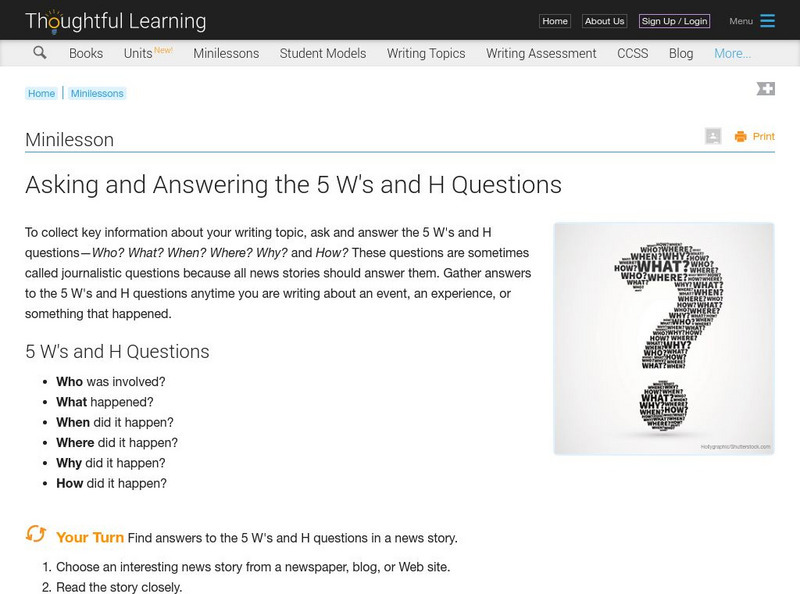
Thoughtful Learning: Minilesson: Asking and Answering the 5 W's and H Questions
Students will learn the "5 W's and H questions" needed to comprehend a news story. Then students will apply these question words [who, what, where, why, when, and how] to real news stories and to events in their own lives.

Read Works
Read Works: Aztecs, Incas, and Mayans the Aztec Empire
[Free Registration/Login Required] This nonfiction passage provides information about the ancient Aztec Empire, including the significance of Montezuma and Tenochtitlan. This passage reinforces essential reading comprehension skills....
Sophia Learning
Sophia: Your Turn Ad
In this persuasive media lesson, students will engage in viewing a Trix cereal advertisement and then engage in the process of "deconstruction" to analyze the use of propaganda techniques to attract customers. Then students will choose...
Read Works
Read Works: Main Idea 1st Grade Unit
[Free Registration/Login Required] Learners learn to use titles and supporting details in both fiction and non-fiction texts in order to identify the main idea of the book in this three-lesson plan unit. The lessons utilize the books...
Read Works
Read Works: Genre Studies: Informational Text Kindergarten Unit: Labeled Diagrams
[Free Registration/Login Required] Lesson uses Bats by Gail Gibbons to teach students how to identify facts learned from labeled diagrams within an informational text. Ideas for direct teaching, guided practice, and independent practice...
ReadWriteThink
Read Write Think: Reading Informational Texts Using the 3 2 1 Strategy
Students can count on using the 3-2-1 strategy to help them successfully comprehend and write about an informational text.
McGraw Hill
Mc Graw Hill: Informational Text: Craft and Structure: Figurative Language
Explains what figurative language is and how to determine its meaning. Also provides a practice exercise.
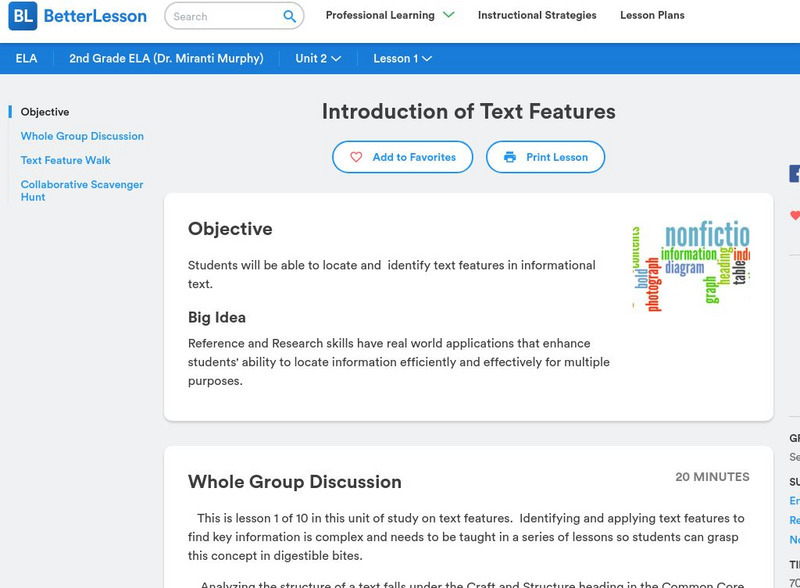
Better Lesson
Better Lesson: Introduction of Text Features
Dr. Murphy shares a comprehensive lesson plan to support students identifying various text features in informational texts. Students will mentally and physically engage in active learning to know how to navigate through different types...
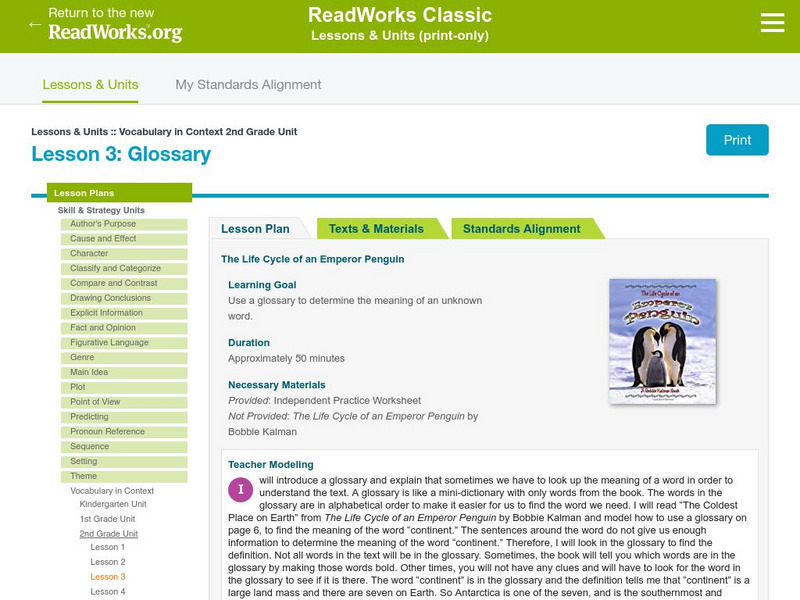
Read Works
Read Works: Vocabulary in Context 2nd Grade Unit: Glossary
[Free Registration/Login Required] A instructional activity in which students learn to use a glossary to determine the meanings of unfamiliar words. Lesson utilizes the book The Life Cycle of an Emperor Penguin by Robin Johnson and...
ReadWriteThink
Read Write Think: Weather: A Journey in Nonfiction
Questions about weather clear up when students use what they learned from their books to create a presentation to share with the rest of the class.
Read Works
Read Works: Grade 2: Two Lesson Unit: Explicit Information
[Free Registration/Login Required] Designed to teach students to identify explicit information in nonfiction and fiction texts. Lessons are based on the books Deserts (A True Book-Ecosystems) by Darlene R. Stille and The Stories Huey...
ReadWriteThink
Read Write Think: Compare/contrast Electronic Text With Traditionally Printed Text
Lesson allows for middle school students who are familiar with researching electronic sources to gain a deeper understanding of the benefits of online resources versus traditional print.
Writing Fix
Writing Fix: Compare and Contrast Lesson: Opposing Points of View in History
After reading/listening to the picture book I am the Dog I am the Cat by Donald Hall in which two characters have opposing viewpoints, students are asked to look deeply at opposing viewpoints of real people just before the Revolutionary...
Utah Education Network
Uen: Whittle, Whittle It Down: Summarizing
This multi-day jigsaw activity engages students in summary writing. Students will work in small groups after direct instruction and write short summary paragraphs. Students will refer to the 'Five Rules For Writing a Summary' chart for...
ReadWriteThink
Read Write Think: Scaffolding Comprehension Strategies Using Graphic Organizers
A three-part standards-based lesson in which students will use collaborative strategic reading to apply four reading strategies: preview, click and clunk, get the gist, and wrap-up. They will work in cooperative groups while scaffolding...