Hi, what do you want to do?






Curated OER
Cape Canaveral: Launchpad to the Stars
Students identify the geographic and climatic characteristics of Florida that made it the best location for the space program. They describe how the space program affected the economy and growth of the eastern coast of Florida.

Curated OER
The Gopher Tortoise
Can you believe the gopher tortoise was around when the dinosaurs were walking the Earth. Learn all about this creature that is one of Florida's most popular reptiles. Hands-on-activities and a glossary full of scientific terms...

Curated OER
Panther Scavenger Hunt
Students research a website to learn about the Florida panther. For this animal research lesson, students use the scavenger hunt directions to search a website about Florida panthers. Students also solve word puzzles within the activity.

Curated OER
Kitty Tunes
Students compare cat calls. In this wildlife lesson, students listen to cat calls and compose their own raps that feature the calls of Florida panthers.

Curated OER
Island Research
Students will work in small groups to gather information about the geography, history, economy, climate, culture, and other aspects of life on the island of Eleuthera. Lesson contains adaptations for all levels.

Curated OER
Illustration of the Destruction of a Rebel Salt Factory on the Florida Coast
Students view an illustration of the destruction of a salt factory. They analyze the photograph to learn more about the salt works. Students discuss what they have learned.

Curated OER
Food Chains in a Forest
Learners explore food chains in the forest. In this food chain activity, young scholars listen to the story The Tree in the Ancient Forest by Carol Reed-Jones. They create a food chain to match the story and then create a food chain...

Curated OER
My Family Tradition
Students examine different family traditions to further explain social patterns. They complete a graphic organizer using educational software.

Curated OER
Getting the Local Scoop
Fourth graders practice interviewing professionals in their area about their careers at a local watershed. They identify at least three careers that depend on the watershed and discuss its history. They write a composition to end the...

Early Childhood Learning and Knowlege Center
My Body My Senses
In a comprehensive unit of activities, learners explore the five senses. Youngsters discover the many different body parts and their functions that allow humans to have sense of sight, touch, smell, taste, and hearing. The best way to...

Curated OER
What Makes a Cat a Cat?
Students investigate the lives of pets by videotaping them. In this animal life lesson, students videotape a cat and other pets using school cameras in a computer lab. Students review the footage from the cat and other...

Curated OER
Common Gemstones and Fossils
In this science worksheet, 4th graders respond to questions pertaining to gems and fossils. Students answer ten questions which give clues and visual aids to assist in answering.

Curated OER
Creating Animal Prints
Students investigate the habits of animals by studying their prints. In this animal life lesson, students investigate the different types of tracks left from animals by researching the Internet. Students utilize clay or...

Curated OER
Lue Gim Gong and the Development of the Frost Resistant Orange
Fourth graders read about Ben Franklin's invention and talk about other inventions they have heard about. They listen to the book about Lue Gim Gong and discuss what he had to go through at first when he came to America and chart the...
University of Florida
Baldwin Library: The Natural History of the Sacred Scriptures by w.i. Bicknell
This is an online photocopy of the original text of the children's book The Natural History of the Sacred Scriptures and Guide to General Zoology by W.I. Bicknell (1892), an illustrated guide to zoology based on the Bible.
University of Florida
Baldwin Library: Pictures & Stories From Natural History by Mc Loughlin Bros.
This is an online photocopy of the original text of the children's book Pictures & Stories from Natural History by McLoughlin Bros. (1886), a nonfiction, illustrated book about all types of animals including domestic, farm, wild, and...
Smithsonian Institution
National Museum of Natural History: American Mammals: Florida Mouse
Hot, dry, sandy uplands in central and coastal Florida are habitats for prickly pear cactus, pocket gophers, gopher tortoises, and the Florida Mouse. Gopher tortoises dig long, deep burrows that provide homes for Florida Mice and as many...
Smithsonian Institution
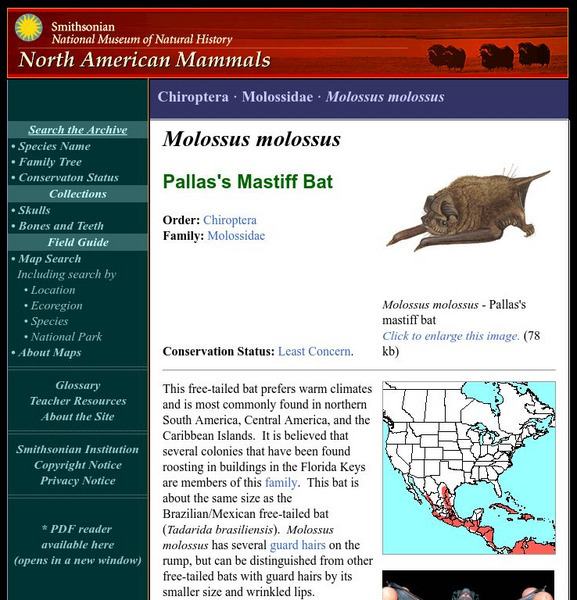
National Museum of Natural History: American Mammals: Pallas's Mastiff Bat
This free-tailed bat prefers warm climates and is most commonly found in northern South America, Central America, and the Caribbean Islands. It is believed that several colonies that have been found roosting in buildings in the Florida...
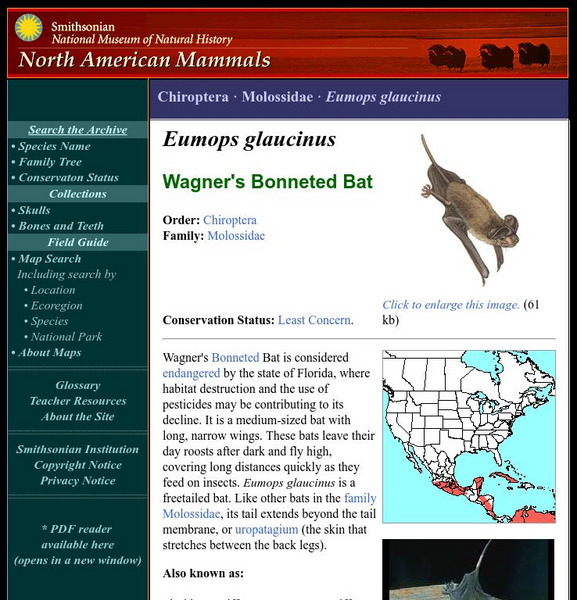
Smithsonian Institution
National Museum of Natural History: American Mammals: Wagner's Mastiff Bat
Wagner's mastiff bat is considered endangered by the state of Florida, where habitat destruction and the use of pesticides may be contributing to its decline. It is a medium-sized bat with long, narrow wings. Learn more about the Eumops...
Other popular searches
- Florida History
- 4th Grade History Florida
- Florida History Archeology
- Teaching Florida History
- Florida History Projects
- Lessons on Florida History
- Early Florida History
- Florida History and Art
- Florida History Worksheets
- Florida History Archaelogy
- Florida History Lesson Plans
- Florida History Pioneers