Hi, what do you want to do?






SciShow
The Lake Where Hundreds of People Died… Twice
India's Roopkund Lake, also known as Skeleton Lake, is the site of gruesome sculptures of human bones. Many causes of these deaths have been proposed, from hail to divine intervention. But scientists now think that whatever happened,...
SciShow
We Know Exactly Who This Guy Is
In the 1930s, a skeleton was discovered at the bottom of a well at the site of a medieval Norwegian fortress, severely injured and buried under large rocks. And to uncover his story, we need a combination of carbon dating, genetics,...
SciShow
The Skeleton That Was 8 Different People
In the 1970s, archaeologists discovered a strange grave in western Belgium, dating back to 100 CE or so. Unlike the 76 other graves, it actually had a skeleton inside it. But 50 years later, we learned it was even weirder, because that...
SciShow
Doggerland: A Real-Life Atlantis
Though we probably won’t find a literal Atlantis beneath the sea, that doesn’t mean that a human settlement hasn’t ever been lost to the water. Meet Doggerland.
SciShow
The Oldest Shipwreck in the World
Marine archeologists accidentally found the world’s oldest known intact shipwreck, and their work scanning, diving, and exploring has given us some very cool insights into more than just our history sailing the oceans.
SciShow
How to Date a Dead Thing
SciShow explains radiocarbon dating, the best way to date a dead thing!
SciShow
Doggerland: A Real-Life Atlantis
Though we probably won’t find a literal Atlantis beneath the sea, that doesn’t mean that a human settlement hasn’t ever been lost to the water. Meet Doggerland.
SciShow
Should You Worry About Antarctica's New, Massive Iceberg?
How concerned are scientists about the Larson C ice shelf calving its most recent iceberg? Archeologists have also found new evidence that confirms earlier dates for the existence of ancient Australian humans.
SciShow
How Junk Food Hacks Your Brain
Scientists think that evolution may not have prepared our brains for donuts, and an international research team has found out that some of earth’s oldest, largest trees are suddenly on the decline.
Bozeman Science
Radiocarbon Dating
Mr. Andersen explains how carbon-14 dating can be used to date ancient material. The half-life of radioactive carbon into nitrogen is also discussed.
SciShow
What Science Has Taught Us About Stonehenge
Over the years, lots of explanations have been proposed as the origin of Stonehenge, including lost technologies, outright magic, and — of course — aliens. What do we actually know about this prehistoric mystery?
Science Buddies
Random Math Test Generator in Scratch
Write a program to generate random math problems and automatically grade them.
Curated Video
How the Ilopango Eruption Altered Ancient Civlizations Across the Globe
A recent study of an ice core sample from Greenland has pinpointed the Central American Ilopango mega-eruption to 431 AD. This eruption is believed to have devastated an entire Maya region and caused global cooling that affected...

Curated OER
Radiocarbon Dating
Mr. Anderson explains how scientists are able to date ancient objects using radiocarbon dating. He describes carbon 14, what it is, and how it can be used to date an object. This lecture provides a very clear explanation of a slightly...

PBS
Pbs Learning Media: Radiometric Dating
In this video segment from A Science Odyssey, scientists explain how Earth's age was determined by examining the radioactive rocks in Earth's crust.
PBS
Pbs Learning Media: Dating Lava Flows on Mauna Loa Volcano, Hawaii
In this video segment adapted from NOVA, scientists search for carbonized remains of plants preserved in lava flows to find out how long it has taken rain forests on Hawaii to regenerate after a volcanic eruption.

Khan Academy
Khan Academy: Measuring Age on Earth: Chronometric Revolution
Discussion of the relatively recent changes in our ability as a species to shine light on our deep past. [9:53]
Bozeman Science
Bozeman Science: Radiocarbon Dating
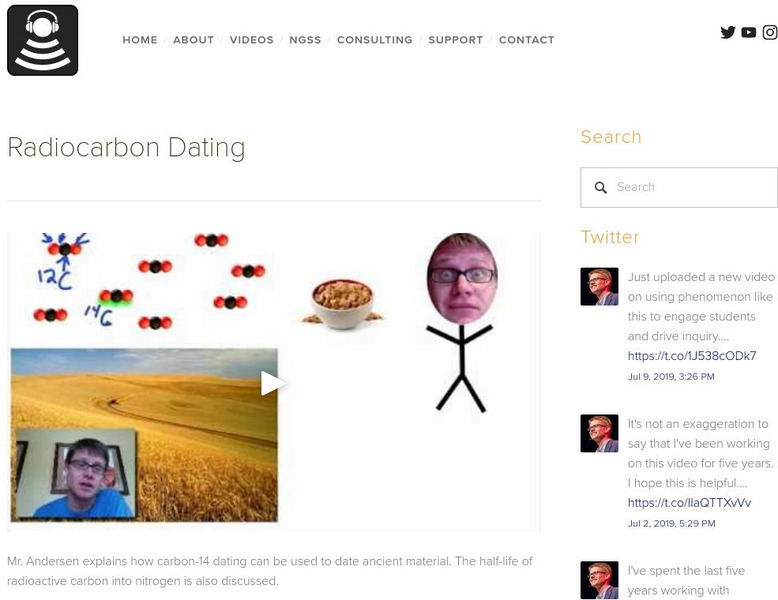
Mr. Andersen explains how carbon-14 dating can be used to date ancient material. The half-life of radioactive carbon into nitrogen is also discussed.