Hi, what do you want to do?






James Madison Memorial Fellowship Foundation
Those "Other Rights:" The Constitution and Slavery
Did the United States Constitution uphold the institution of slavery, or did it help to destroy it? Young historians study Article 4, Section 2, Clause 3 of the Constitution and evaluate the rights of slaveowners as they compared to...

K12 Reader
Slavery in the Constitution
Your young historians will read excerpts from three parts of the United States Constitution—Article One, the Thirteenth Amendment, and the Fourteenth Amendment—and discuss how they each address the issue of slavery.

National Endowment for the Humanities
Slavery and the American Founding: The "Inconsistency Not to Be Excused"
High schoolers examine slavery in the revolutionary and colonial eras of the United States. In this slavery lesson, high schoolers investigate the presence of slavery in early America, the language of the Constitution, and the intent of...

Center for History and New Media
Slavery and Free Negroes, 1800 to 1860
What was life like for enslaved and free black people before the American Civil War? Explore the building tension between states and the freedom of individuals with a thorough social studies lesson. Learners of all ages explore...

C3 Teachers
Emancipation: Does It Matter Who Freed the Slaves?
Scholars generally agree on the emancipation of enslaved people in the United States. This inquiry-based lesson asks high schoolers to consider more than the claims of who freed the enslaved people but the significance of the issues...

NPR
This Isn't Right: Women Reform Leaders
The 20th century saw many new possibilities open up to women in America, thanks to many well-known female historical figures — and some women who are not as famous but who are equally accomplished. Learn about the women who contributed...

Gilder Lehrman Institute of American History
Slave Narratives: Frederick Douglass, Harriet Jacobs, and the Columbian Orator
Young historians practice in-depth, quality analysis of primary source texts in this three-lesson unit, which examines excerpts from the slave narratives of Frederick Douglass, Harriet Jacobs, and Caleb...

Student Handouts
The Formation of the U.S. Constitution #3
Finish up your study of the United States Constitution with the third resource in a three-part series. Class members respond to three questions that focus on the relationship between the Articles of Confederation and the Constitution and...

Central Bucks School District
Making Generalizations
Being able to recognize patterns, craft generalizations, and draw conclusions based on information in a text passage are essential critical thinking skills. Encourage learners to hone these skills with a worksheet that asks them to read...

Reading Through History
The Emancipation Proclamation
The Emancipation Proclamation: one of the most important primary sources for studying American history! An interdisciplinary resource includes a reading of Abraham Lincoln's seminal speech quoted directly. Following the reading, pupils...

School Rack
Westward Expansion Project Choices
What a great list of brief research projects for reviewing the era of westward expansion in the United States! Learners are directed to choose and complete three of the projects on the given list, which includes opportunities to design...

Smithsonian Institution
George Washington: A National Treasure
Take a closer look at the life and presidency of George Washington with this great set of lesson plans and worksheets. The resource includes a timeline of the president's life and multiple opportunities for primary source and...

Annenberg Foundation
Social Realism
Many American writers in the late nineteenth century wanted their writing to reflect real life. Individuals watch and discuss a video, read and explore author biographies, write a journal entry and a poem, and complete a multimedia...

Polk Country Schools
The Death of Abraham Lincoln DBQ
The assassination of Abraham Lincoln was a pivotal moment in American history, but what were the immediate effects throughout the newly unified country? A document-based question focuses on the consequences of the first...

Lessons on American Presidents
Abraham Lincoln
Honor Abe Lincoln with a set of activity-based worksheets that can be used independently and in collaborative groups. Young historians participate in a listening activity where they fill in the missing blanks in a passage while being...

Chicago Historical Society
Are We the People?
Taking on the roles of a fiery Boston patriot, a Philadelphia merchant's wife, and a prominent abolitionist, your young historians will consider the reactions of these early Americans to the creation of the Declaration of...

Soft Schools
Civil Rights
Informational text about the Civil Rights Movement challenges young historians to prove their reading comprehension skills with six multiple choice questions. After answers are submitted a new screen displays a score,...

Scholastic
Scholastic: The Underground Railroad: Escape From Slavery
Imagine being a slave escaping from the South in 1860, and heading to freedom through the underground railroad. Students will hear from first-person accounts and investigate other primary sources from the 1800s.
Department of Defense
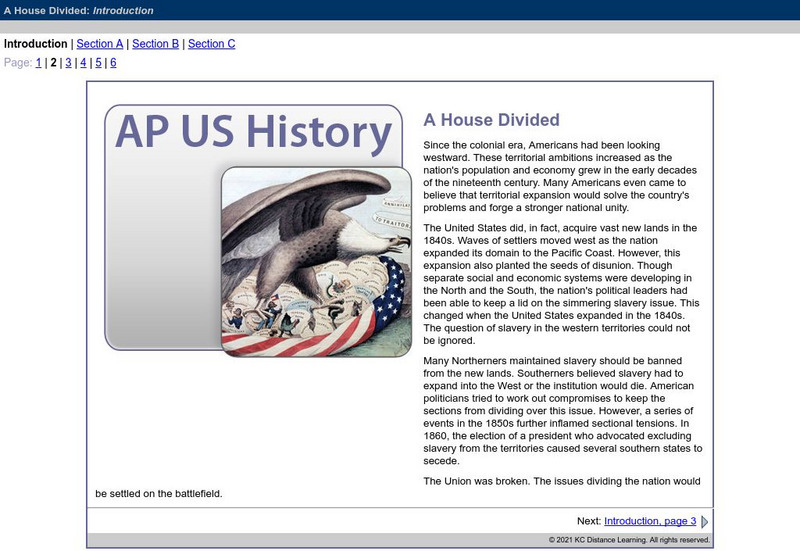
Do Dea: Ap Us History: Unit 4: A House Divided
This extensive learning module examines how the United States became more connected with the world as it pursued an expansionist foreign policy, became the destination for many new immigrants, and encouraged migration to the Pacific...
C3 Teachers
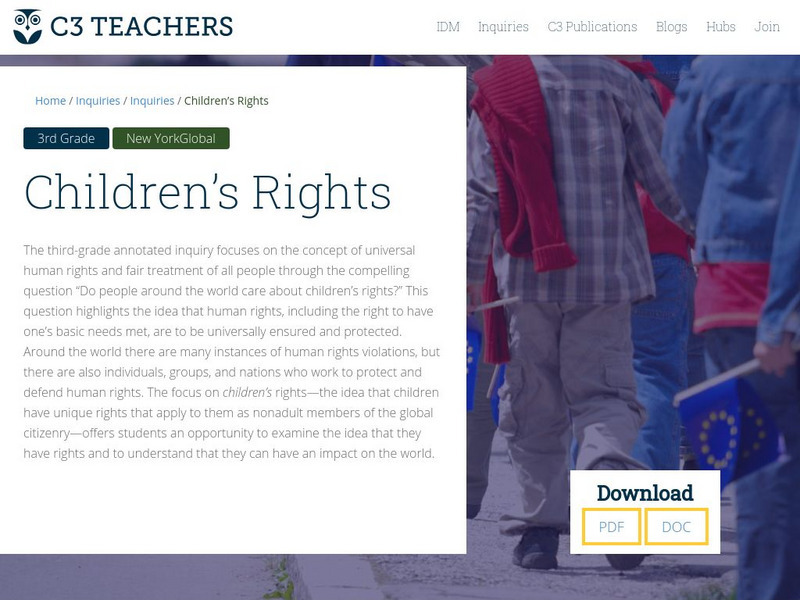
C3 Teachers: Inquiries: Children's Rights
A learning module on children's rights that includes several supporting questions accompanied by formative tasks and source materials, followed by a summative performance task. Topics covered include how children's rights are defined,...