Hi, what do you want to do?






Center for Learning in Action
Properties of Balls
Enhance your states of matter lessons with a hands-on science investigation that compares six different balls' color, texture, size, weight, ability to bounce, and buoyancy.

Center for Learning in Action
Water—Changing States (Part 1)
Here is part one of a two-part lesson in which scholars investigate the changing states of water—liquid, solid, and gas. With grand conversation and up to three demonstrations, learners make predictions about what they think will happen...

Center for Learning in Action
Water – Changing States (Part 2)
Here is part two of a two-part lesson in which scholars investigate the changing states of water—liquid, solid, and gas—and how energy from heat changes its molecules. With grand conversation, two demonstrations, and one hands-on...

Center for Learning in Action
Introduction to the States of Matter
Liquids, gases, and solids are the states of matter in which scholars investigate in a lesson plan that offers in-depth information and engaging activities that look into the three states and the changes their properties make when mixed...

Center for Learning in Action
Investigating Physical and Chemical Changes
Super scientists visit ten stations to predict, observe, and draw conclusions about the physical and chemical changes that occur when different states of matter—liquid, solid, and gas—are placed under a variety of conditions. To...

Center for Learning in Action
Introducing Physical and Chemical Changes
Young scientists investigate chemical and physical changes to the states of matter—gas, liquid, and solid—as well as solutions and suspensions with a variety of demonstrations, grand conversation, and an interactive quiz to check for...

Curated OER
Rock On! Featuring the Igneous, Sedimentary and Metamorphic Trio!
Get your classroom rocking with this four-lesson earth science unit. Through a series of shared reading activities and hands-on investigations, young geologists learn about the three types of rocks and the unique properties of each.

Center for Learning in Action
Challenge with Solids, Liquids, and Gases
There's a container for every matter—liquid, solid, and gas. Pupils design three different containers, each with the capability to hold one of the states of matter, and share their design with the class.

Center for Learning in Action
Gases
Explore the properties of gases through one activity and two investigations in which super scientists observe the changes gas makes when encountering different conditions.

Mr. E. Science
Sound
Since light travels faster than sound, some people may appear bright until you hear them speak. The presentation covers what sound is, how fast it travels in various mediums, properties of sound, hearing, and the parts of the human...

PBS
Blow the Roof Off!
Blow the minds of young scientists with this collection of inquiry-based investigations. Based on a series of eight videos, these "hands-on, minds-on" science lessons engage young learners in exploring a wide range of topics...

Mr. E. Science
An Introduction to Matter
What's the matter? Gas, solid, liquid, or plasma. The presentation covers how to describe and identify matter, changes in matter, types of matter, measuring matter, particles of matter, Democritus, and John Dalton's Atomic Theory.

LABScI
Freezing Point Depression: Why Don’t Oceans Freeze?
Can you go ice fishing in the ocean? Learners examine the freezing point of different saltwater solutions. Each solution has a different concentration of salt. By comparing the freezing points graphically, they make conclusions...

Umaine Museum of Art
Bony Fish Anatomy Worksheet
Take time to appreciate the beauty in the anatomy of animals with this cross-curricular art and science activity. After viewing examples of fish-themed artwork, children complete the included learning exercise by labeling...

NOAA
Watching in 3D
Bring the ocean floor to life! Earth science scholars discover the process of deep sea mapping in the third installment in a series of five lessons about ocean exploration. The teacher's guide includes helpful resources, worksheets, and...

Earth Day Network
Staying Green While Being Clean
Clean up the environment with a lesson that focuses on replacing hazardous cleaning supplies with green, environmentally-friendly products. Using a dirty patch of surface as a control area, kids clean other parts of various surfaces...

American Chemical Society
Middle School Chemistry: Lesson Plans: Surface Tension
Students observe and investigate why water has a strong surface tension.
Texas Instruments
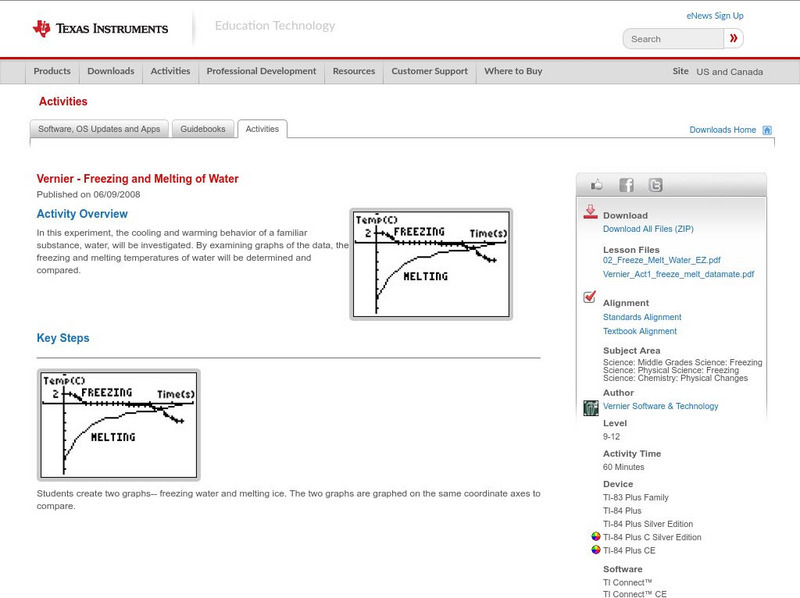
Texas Instruments: Freezing and Melting of Water
Freezing temperature, the temperature at which a substance turns from liquid to solid, and melting temperature, the temperature at which a substance turns from a solid to a liquid, are characteristic physical properties. In this...
Physics Aviary
Physics Aviary: Practice Problems: Flow Rate From Beverage Dispenser Problem
Students determine the flow rate and speed of the water leaving a faucet based on the properties of the beverage dispenser that it is coming from.
BBC
Bbc: Gcse Bitesize: Predicting Chemical Reactions
This lesson focuses on predicting chemical reactions using The Group 1 elements in the Periodic Table are known as the alkali metals. They include lithium, sodium and potassium, which all react vigorously with air and water. It provides...