Hi, what do you want to do?






Brigham Young University
Rosencrantz and Guildenstern Are Dead: Fishbowl Discussion
After reading through Act II of Rosencrantz and Guildenstern Are Dead, take some time to discuss the references to death in the play. For this fishbowl discussion, learners prepare questions, practice answering individually and with...

Crabtree Publishing
Remarkable Lives Revealed
Six lessons make up a unit all about biographies. Scholars read about a remarkable life while taking notes and identifying characteristics of the biographical genre. Readers examine the tale's obstacles, accomplishments, and sequence of...

EngageNY
What Are Similarity Transformations, and Why Do We Need Them?
It's time for your young artists to shine! Learners examine images to determine possible similarity transformations. They then provide a sequence of transformations that map one image to the next, or give an explanation why it is...

EngageNY
The Geometric Effect of Some Complex Arithmetic 1
Translating complex numbers is as simple as adding 1, 2, 3. In the ninth lesson in a 32-part series, the class takes a deeper look at the geometric effect of adding and subtracting complex numbers. The resource leads pupils into what it...

EngageNY
Which Real Number Functions Define a Linear Transformation?
Not all linear functions are linear transformations, only those that go through the origin. The third lesson in the 32-part unit proves that linear transformations are of the form f(x) = ax. The lesson plan takes another look at examples...

EngageNY
Getting a Handle on New Transformations 2
Use 2x2 matrices to move along a line. The second day of a two-day lesson is the 28th installment in a 32-part unit. Pupils work together to create and solve systems of equations that will map a transformation to a given...

EngageNY
Ordered Pairs
Scholars learn to plot points on the coordinate plane. The lesson introduces the idea that the first coordinate of a coordinate pair represents the horizontal distance and the second coordinate represents the vertical distance.

Film Education
The Jungle Book
Accompany a viewing of Disney's live-action feature film, The Jungle Book, with a packet equipped with several activities focused on story elements. Scholars discuss and complete diagrams and charts about the movie's characters, setting,...

EngageNY
Why Move Things Around?
Explore rigid motion transformations using transparency paper. Learners examine a series of figures and describe the transformations used to create the series. They then use transparency paper to verify their conclusions.

EngageNY
Projecting a 3-D Object onto a 2-D Plane
Teach how graphic designers can use mathematics to represent three-dimensional movement on a two-dimensional television surface. Pupils use matrices, vectors, and transformations to model rotational movement. Their exploration involves...
FNO Press
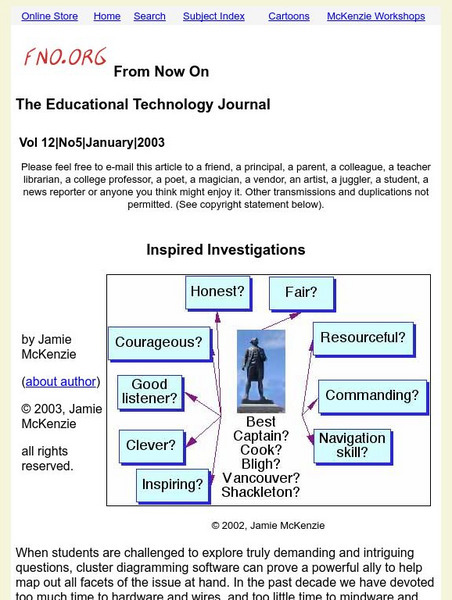
Fno.org: Inspired Investigations
An article at From Now On about how to help students do better research by changing the focus of research assignments and teaching students to ask essential questions. Some suggestions include using mind mapping, and using Inspiration to...