Hi, what do you want to do?






Teach Engineering
May the Magnetic Force Be with You
Class members use mathematics in order to better understand magnetic forces and their interaction on charged particles. After a demonstration of the interaction between a magnet and an electron beam using a CRT computer monitor,...

PHET
Mapping the Field of Multiple Dipole Magnets
So you built a magnetometer, now what? High school scientists use their magnetometer made in a previous lesson to map the union of magnetic fields of dipole magnets. They experiment with different alignments and draw conclusions about...

LABScI
The Separation Lab: Candy Colors
There's no better motivator than candy! An engaging activity has pupils explore methods for separating mixtures. A two-part lab first explores methods of separation based on size and magnetism. The second activity introduces learners to...

PBS
NOVA Sun Lab Lesson Plan
Looking for a sun-sational multi-lesson plan full of videos, simulations, and discussion? Introduce your young scientists to all things solar with a four-part hands-on adventure. Pupils learn the basics of solar anatomy, space weather,...

Lakeshore Learning
Winter Bear Warm-Up
Don't be left out in the cold, ensure young learners are prepared for the winter weather with this clothing activity. After introducing them to different clothing items using the provided picture cards, students sing a song before...

Ascanius: The Youth Classics Institute
Anatomy and Simple Commands
Poor Joe is all in pieces, and he needs students to learn the Latin words for his body parts so that they can put him back together! Learners work as a class first to perform whole-body reconstruction, and then individually. In addition,...

Really Good Stuff
Sequencing Pocket Chart
Cut it out! Beginning readers practice sequencing skills at home or at school with a variety of activities that require cutting out multiple sets of picture cards and putting them in the correct order.

Cornell University
Glued into Science—Classifying Polymers
Explore the unique characteristics of polymers. A complete lesson begins with a presentation introducing polymers. Following the presentation, young scientists develop a laboratory plan for creating substances using polymers. They...

Illustrative Mathematics
Grandfather Tang's Story
It's amazing the complex figures that can be made using only a few simple shapes. Following a class reading of the children's book Grandfather Tang's Story by Ann Tompert, young mathematicians use sets of tangrams to create models...

Teach Engineering
Archimedes' Principle, Pascal's Law and Bernoulli's Principle
What do Pascal's law, Archimedes' Principle, and Bernoulli's Principle have to do with fluid mechanics? The included PowerPoint presentation provides the basic definitions and equations associated with the three. A set of homework...

Santa Monica College
Flame Tests of Metal Cations
Scientists used flame tests to identify elements long before the invention of emission spectroscopy. Young chemists observe a flame test of five metal cations in the fourth lesson of an 11-part series. Individuals then work...
TeachEngineering
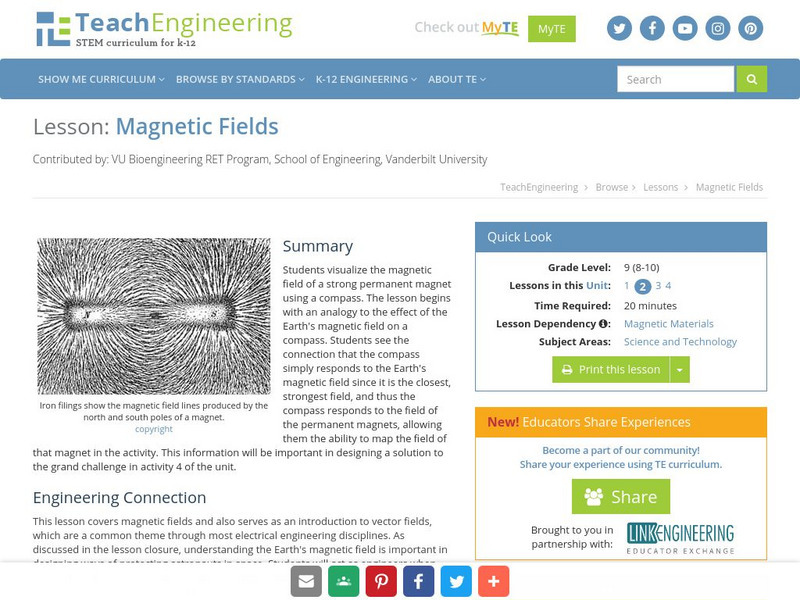
Teach Engineering: Magnetic Fields
Students visualize the magnetic field of a strong permanent magnet using a compass. The instructional activity begins with an analogy to the effect of the Earth's magnetic field on a compass. Students see the connection that the compass...
The Wonder of Science
The Wonder of Science: 3 Ps2 4: Magnetic Design Solution
See work samples, phenomena, and assessment templates that directly address standard 3-PS2-4: designing a magnetic solution.

Alabama Learning Exchange
Alex: The Magnetic Maglev Train
This is a hands-on, inquiry-based lesson that includes three magnetic stations in which students or small groups rotate in order to test and discover different magnetic properties and then use their knowledge to build a Maglev Train...
![Hes Energy Net: Energy Use and Delivery: Lesson Plan 3.3: Electromagnets [Pdf] Lesson Plan](https://statictemp.lp.lexp.cloud/images/attachment_defaults/resource/large/FPO-knovation.png "Hes Energy Net: Energy Use and Delivery: Lesson Plan 3.3: Electromagnets [Pdf] Lesson Plan")
Other
Hes Energy Net: Energy Use and Delivery: Lesson Plan 3.3: Electromagnets [Pdf]
In this lesson, students learn how to identify and explain an electromagnet, describe the relationship between electricity and magnetism, and compare an electromagnet to a bar magnet.
Illustrative Mathematics
Illustrative Mathematics: Building Toward Fluency
The purpose of this task is to promote certain addition strategies that will help learners learn to fluently add and subtract within 20. Students will use a number line or magnetic cubes to solve addition problems. Learners will be asked...
Other popular searches
- Electricity and Magnetism
- Magnetism Worksheets
- Magnets and Magnetism
- Gravity and Magnetism
- Electricity Magnetism
- Magnetism and Poles
- Induced Magnetism
- Science, Magnetism
- Bill Nye Magnetism
- Science Magnetism
- Magnetism Lesson Plans
- Energy and Magnetism