Hi, what do you want to do?






Mr. E. Science
Light
Where does bad light end up? In a prism! The presentation covers light, mirrors, lenses, and the structure of the eye. It also provides explanations of reflection, refraction, concave and convex mirrors and lenses, and a comparison of...

Rice University
College Physics for AP® Courses
Take a look at an organized physics course. The 34-section electronic textbook covers material in AP® Physics 1 and 2. Teachers use the text to supplement lectures and have the class work through the labs. Each section contains...

PBS
Blow the Roof Off!
Blow the minds of young scientists with this collection of inquiry-based investigations. Based on a series of eight videos, these "hands-on, minds-on" science lessons engage young learners in exploring a wide range of topics...
University of Colorado
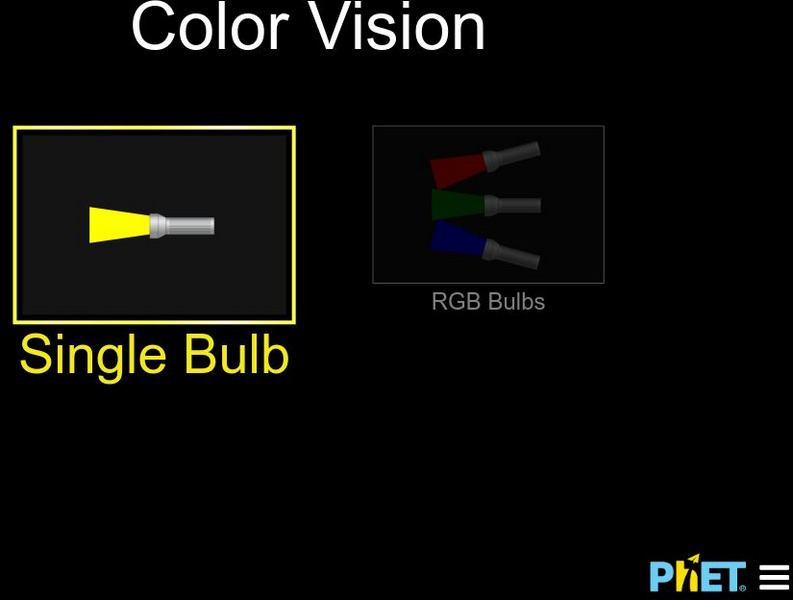
University of Colorado: Ph Et Interactive Simulations: Color Vision
Make a whole rainbow by mixing red, green, and blue light. Change the wavelength of a monochromatic beam or filter white light. View the light as a solid beam, or see the individual photons.
TED Talks
Ted: Ted Ed: How We See Color
There are three types of color receptors in your eye: red, green and blue. But how do we see the amazing kaleidoscope of other colors that make up our world? The following learning module explains how humans can see everything from...
TeachEngineering
Teach Engineering: What Makes Up a Color?
As a part of the research and revise step of the Legacy Cycle, this lesson provides students with information they will need later on to be able to average pixels to simulate blurring in the peripheral plane of vision. Students learn why...

Physics Classroom
The Physics Classroom: The Electromagnetic and Visible Spectra
A tutorial on the electromagnetic and visible spectra. Discusses dispersion and how perceptions of white and black are related to the visible light spectrum.