Hi, what do you want to do?






Scholastic
Study Jams! Divisibility Rules
Learning division is a challenge for many young mathematicians, but this presentation on divisibility rules can make it much easier. Seven different rules are clearly explained and modeled with the support of multiple examples. Consider...

EngageNY
Divisibility Tests for 3 and 9
Who knew the sum of a number's digits gives such interesting information? The 18th installment of a 21-part module has scholars investigate division by three and nine. After looking at several examples, they develop divisibility tests...

Freecloud Design
Mathmateer
Three, two, one...liftoff! Elevate math skills to new heights while having a blast. A great resource that combines entertainment and education for children of all ages.

Scholastic
Study Jams! Prime & Composite Numbers
Prime or composite, that is the question. Teach your class how to find the answer with this step-by-step presentation that defines and provides examples of each type of number. When addressing larger numbers, divisibility rules are...

Math Mammoth
Divisors = Factors 1
In this mathematics worksheet, 4th graders fill in the chart with the factors divisible by each number. Then they study the charts and respond to the five word problems that follow. Students also find as many common factors of the given...

Mathed Up!
Proof
Scholars learn how to write number theory proofs by viewing a video reviewing techniques for proofs on divisibility, parity, and consecutive integers. They then write proofs for a handful of conjectures on a worksheet.

Houghton Mifflin Harcourt
Unit 2 Math Vocabulary Cards (Grade 5)
Twenty-eight flashcards make up a set designed to reinforce math vocabulary. Two styles of cards showcase either a bold-faced word or a corresponding definition card equipped with an example and labels. Terms include commutative property...

Scholastic
Study Jams! Double-Digit Division
RJ had an awesome basketball season this year! Use division by double-digit numbers to calculate his scoring average in this instructional presentation. Starting with an explanation of the terms dividend, divisor,...

MLC
Fractions Packet
Your fifth graders will appreciate the simple, direct explanations, examples, and practice exercises in this well-organized unit on fractions. Beginning with an introduction to fractions, the packet flows smoothly through the fraction...

National Security Agency
Fraction Fever
This unit on fractions allows for upper-aged elementary learners to explore ways to find the greatest common factor and least common multiple of two numbers. Ultimately, young mathematicians will be able to identify equivalent fractions,...

Mathed Up!
HCF, LCM, and Product of Primes
Give the class a prime example of using prime numbers. After reviewing prime factorization of numbers with the video, pupils use their knowledge to determine greatest common factors and least common multiples in the worksheet. The...

EngageNY
Dividing by (x – a) and (x + a)
Patterns in math emerge from seemingly random places. Learners explore the patterns for factoring the sum and differences of perfect roots. Analyzing these patterns helps young mathematicians develop the polynomial identities.

Concord Consortium
Leap Years and Calendars
How many birthdays do leap year babies have in a lifetime? Learners explore the question among others in a lesson focused on different calendar systems. Given explanations of the Julian, Gregorian, and Martian calendars, individuals use...

Math Mammoth
Factors
In this math worksheet, 3rd graders focus on determining missing factors. Students complete 34 problems representing factors of whole numbers.

Curated OER
Equivalent Fractions and Comparing Fractions
How can you tell if fractions have equal value? Use various collaborative activities to demonstrate the ways to determine whether or not fractions are equivalent.

Mathigon
Mathigon: Math Foundations: Divisibility and Primes: Divisibility Rules
There are a few different rules that can make it easy to check if a number is divisible by another. In this lesson you will learn some of them such as,any number that ends in 0, 2, 4, 6, or 8 is divisible by 2, divisibility by 5 we...
Mathigon
Mathigon: Math Foundations: Divisibility and Primes: The Distribution of Primes
This lesson focuses on the distribution of large prime numbers. It offers a calculator to check numbers for prime and a calculator that allows you to create prime numbers. It also provides the history of methods find the distribution of...
Mathigon
Mathigon: Math Foundations: Divisibility and Primes: Prime Numbers
This lesson focuses on prime numbers, numbers that can only be divided by one and itself. It explains the Fundamental Theorem of Arithmetic and the Sieve of Eratosthenes. Includes practice activities.
Illustrative Mathematics
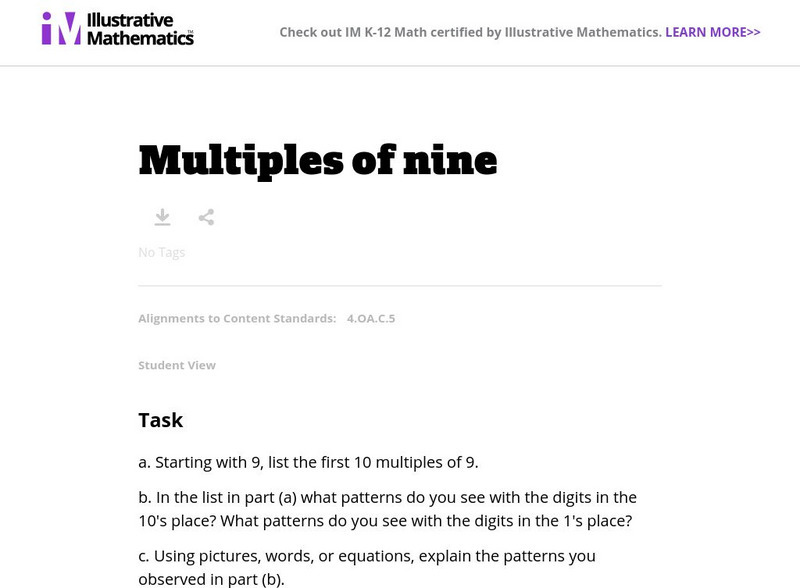
Illustrative Mathematics: 4.oa Multiples of Nine
This task examines the interesting fact that when a number is divisible by 9 then the sum of its digits is also divisible by 9. Aligns with 4.OA.C.5.

TED Talks
Ted: Ted Ed: Why Can't You Divide by Zero?
Learn about the math rule that says we cannot divide by zero.
Mathigon
Mathigon: Algebra: Sequences: Pascal's Triangle
This lesson focuses on Pascal's Triangle, a number pyramid in which every cell is the sum of the two cells directly above. It contains all binomial coefficients, as well as many other number sequences and patterns.