Hi, what do you want to do?






Concord Consortium
Squares and Cubes
The task is simple, but the solution is a little more complex. Learners must find the smallest number that results in a perfect square when multiplied by two and a perfect cube when multiplied by three. The task requires an analysis...

Illustrative Mathematics
Many Ways to Do Addition
A great aspect of teaching math is that children have the freedom to solve problems using a variety of different strategies. The focus of this lesson is for young mathematicians to become aware of many ways of answering addition...

EngageNY
Mastering Factoring
Math class is full of drama—there are so many problems to work out! Pupils work out factoring problems. They use quadratic methods of factoring higher degree polynomials, in addition to factoring the sum and difference of two...

Learner
Solid Shapes
A collection of two lessons, kindergartners will identify two-dimensional shapes in solid shapes. They will develop basic knowledge of the components that make up a sphere, rectangular prism, pyramid, cylinder, cone, and cube. Young...

EngageNY
Solving Equations with Radicals
Show learners how to develop a procedure for solving equations using radicals with the fifth lesson of the 25-part module that challenges learners to use properties to solve multi-step quadratic and cubic equations. Individuals round out...

National Security Agency
Awesome Area - Geometry and Measurement
Break out those math manipulatives, it's time to teach about area! Capturing the engagement of young mathematicians, this three-lesson series supports children with learning how to measure the area of squares, rectangles, and other...

Curated OER
All About Money
Few topics engage young mathematicians as much as learning about money. Through a series of shared readings and hands-on activities, children explore the US currency system, learning how to count money and calculate change as they create...

Odell Education
Order Up!
Order in the math class! Scholars learn to evaluate expressions using the order of operations. A game has them rolling number cubes to determine numbers to use when evaluating.

World Wildlife Fund
Shapes
Investigate the properties of three-dimensional figures with this Arctic-themed math lesson. Beginning with a class discussion about different types of solid figures present in the classroom, young mathematicians are then given a...

Charleston School District
Review Unit 5: Equations
It's time for them to show you what they've learned! The review provides a sampling of the different concepts learned throughout the eight-part series. Learners solve equations by combining like terms, applying the distributive property,...

Oregon Department of Education
Building Number Sense
It's never too early to begin a child's math education. This collection of fun hands-on activities engage youngsters in building their number sense as they learn how to count objects, identify numerals, compare amounts, and much more.

Mathematics Vision Project
Module 5: Modeling with Geometry
Solids come in many shapes and sizes. Using geometry, scholars create two-dimensional cross-sections of various three-dimensional objects. They develop the lesson further by finding the volume of solids. The module then shifts...

Mathematics Vision Project
Module 7: Modeling with Geometry
Model good modeling practices. Young mathematicians first learn about cross sections and solids of revolution. They then turn their attention to special right triangles and to the Laws of Sine and Cosine.

Mathematics Assessment Project
Geometry
Help learners find joy in facing mathematical challenges. The questions posed on this instructional activity encourage young mathematicians to utilize skills learned throughout a geometry unit, and to apply themselves and persevere...

EngageNY
First-Person Computer Games
How do graphic designers project three-dimensional images onto two-dimensional spaces? Scholars connect their learning of matrix transformations to graphic design. They understand how to apply matrix transformations to make...

Illustrative Mathematics
Field Day Scarcity
Introduce young mathematicians to concepts of financial literacy with this open-ended word problem. With seven dollars to spend during field day and given a list of available items and their prices, children must determine how they want...

Willow Tree
Three-Dimensional Figures
Time to move into the third dimension! Learn the names of the geometric solids and count faces, edges, and vertices. Then learn to recognize nets that create a given solid.

Kentucky Educational Television
The Road to Proportional Reasoning
Just how big would it really be? Young mathematicians determine if different toys are proportional and if their scale is accurate. They solve problems relating scale along with volume and surface area using manipulatives. The...

EduGAINs
Ratio and Proportion
Do these items have the same ratio? Through a learning contract, pupils master proportions by practicing proportions via word problems, graphs, and with manipulatives. An exit ticket checks for understanding at the end of the...

EduGAINs
Solving Linear Equations
To find x, you have to get it by itself, correct? Individuals solve a linear word problem and share their solutions with others that solved the problem in a similar fashion. They then complete a self-assessment on how they feel about...

California Education Partners
Yum Yum Cereal
Design an efficient cereal box. Scholars use set volume criteria to design a cereal box by applying their knowledge of surface area to determine the cost to create the box. They then determine whether their designs will fit on...
University of Cambridge
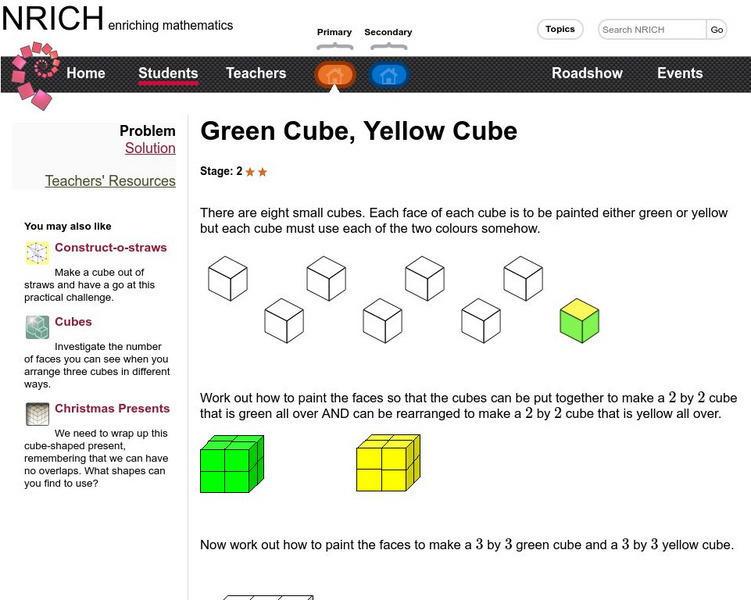
University of Cambridge: Nrich: Green Cube, Yellow Cube
Think about the surface area of a cube. At this one page website, you use that information to complete the challenge. Solutions are offered right at the website.
Illustrative Mathematics
Illustrative Mathematics: Building Toward Fluency
The purpose of this task is to promote certain addition strategies that will help students learn to fluently add and subtract within 20. Students will use a number line or magnetic cubes to solve addition problems. Students will be asked...
University of Cambridge
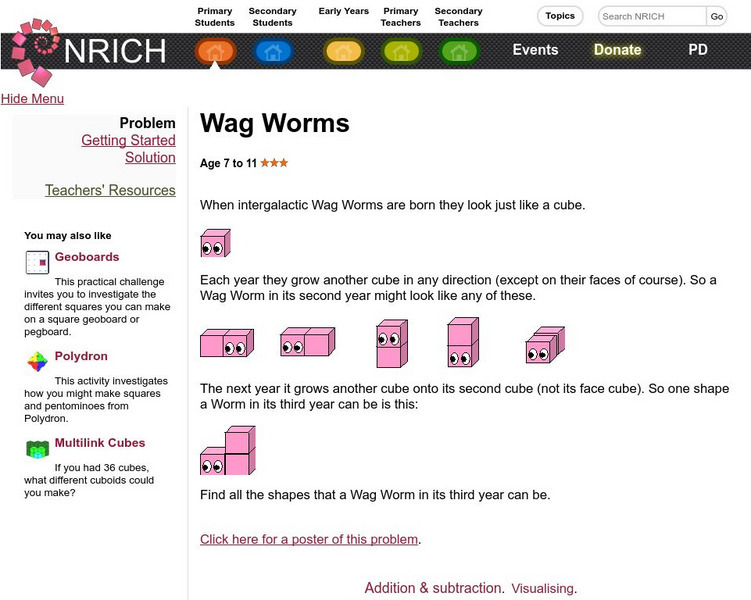
University of Cambridge: Nrich: Wag Worms
Use this challenge to see how many unique shapes can be created using exactly 5 cubes. At this one page website you can also check your results.