Hi, what do you want to do?






Howard Hughes Medical Institute
Lesson 1: WildCam Gorongosa
Take a walk on the wild side! Episode one of an eight-part series of interactive lessons regarding Gorongosa National Park invites learners to become a part of the citizen science community. Scholars read a brief overview of the trail...

Kentucky School for the Deaf
Levels of Organization within an Ecosystem
From tiny organisms to entire biomes, young scientists examine the interdependent relationships tying all living and non-living things together with this collection of ecology resources.

Howard Hughes Medical Institute
Lesson 4: Gorongosa's Food Webs
Who eats who in the savannas of Africa? Explore trophic levels with part four of an eight-part series of lessons focused around Gorongosa National Park. After young explorers identify animals using trailcam images, they construct a food...

National Park Service
Living & Non-Living Interactions
What better way to learn about ecosystems than by getting outside and observing them first hand? Accompanying a field trip to a local park or outdoor space, this series of collaborative activities engages children in...

CK-12 Foundation
Ck 12: Life Science: 12.2 Ecological Organization
See how ecosystems are organized into several different levels, and an ecosystem can be studied at any one of the various levels of organization.
TeachEngineering
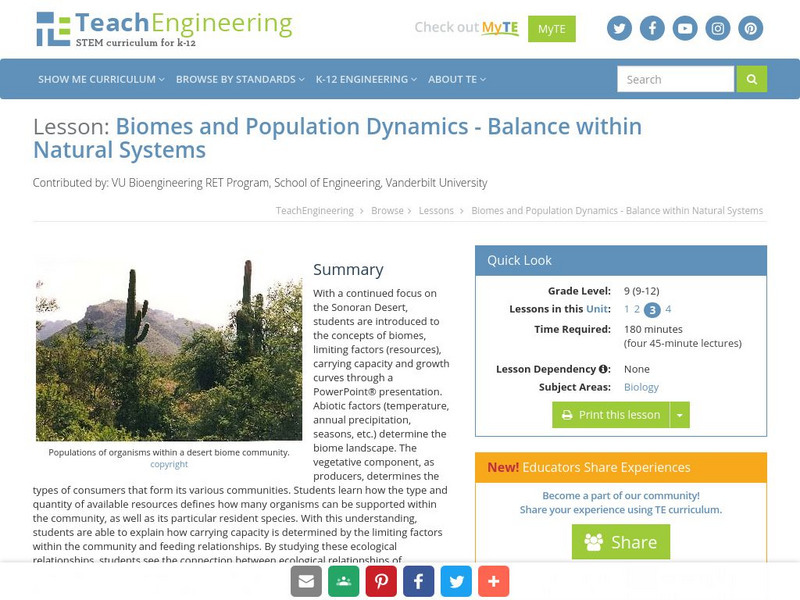
Teach Engineering: Biomes and Population Dynamics
This lesson begins with a PowerPoint slideshow that covers important ecological concepts about biomes, limiting factors, carrying capacity, and population growth. Young scholars will look at the population dynamics involved with the...
CK-12 Foundation
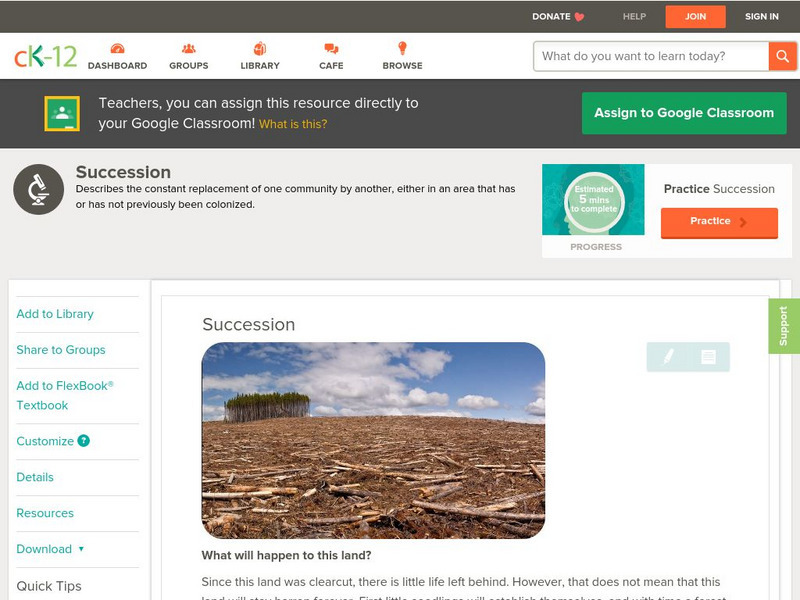
Ck 12: Life Science: Succession
[Free Registration/Login may be required to access all resource tools.] Ecosystems are "dynamic." This means that ecosystems change over time. Both natural forces and human actions cause ecosystems to change. Learn more about succession...