Hi, what do you want to do?






SciShow
7 New Species Discovered in Cities
Scientists discover more than 15,000 new species each year. Viewers learn about seven new species discovered in cities, often right next to where people live. As part of a larger playlist, a video discusses the techniques researchers use...

TED-Ed
How Long Will Human Impacts Last?
If aliens visit Earth a million years from now, what will they find? Explore the Anthropocene epoch with a hard-hitting video. Viewers examine the changes humankind has made to the planet, how these overshadow events of the past, and...

Bozeman Science
LS2C - Ecosystem Dynamics, Functioning and Resilience
How do ecosystems react to change over time? Show your class how natural and man-made factors affect the organisms in an area using the guidelines in a video about standard LS2C. Topics include biotic and abiotic factors, biodiversity,...

Bozeman Science
LS4D - Biodiversity and Humans
Humans have both positive and negative impacts on biodiversity. A video lesson highlights important human impacts on biodiversity through examples and diagrams. The narrator provides insight to the progression of the topic from...

MinuteEarth
Why Poor Places Are More Diverse
Poor soil actually grows the most diverse plants. Although this sounds like a contradictory statement, the video lesson explains how and why this is true. Learners discover how rich soils typically cater to the stronger, faster-growing...

MinuteEarth
Why Biodiversity Is Good For The Economy
Variety is the spice of life! Biodiversity is important for the health of ecosystemsand also the health of industries like timber and agriculture. Junior conservationists learn the link between biodiversity and profitability in a short,...

TED-Ed
Why No Aquarium Has a Great White Shark
Are great white sharks too big for captivity? Why don't great whites survive in aquarium tanks? View this short video that explains why great white sharks have a history of dying in aquarium captivity.

Crash Course
Conservation and Restoration Ecology
Address types of diversity, conservation biology, and restoration ecology. A video also includes small population conservation, declining population conservation, structural restoration, bioremediation, biological augmentation,...

Crash Course
5 Human Impacts on the Environment
It is estimated that within 100 years, there will be no rain forests. The video on ecosystems covers the impact humans have on the environment. It includes ecosystem services, the importance of biodiversity, deforestation,...

Crash Course
Ecological Succession: Change is Good
Discuss how communities and the ecosystem of the earth deal with change. An informative video includes primary succession, secondary succession, climax community model, and intermediate disturbance hypothesis.

Amoeba Sisters
Food Webs and Energy Pyramids: Bedrocks of Biodiversity
How come we don't eat worms, but we eat fish that eat worms? A video features the food chain and explains why a food web is a better explanation for biodiversity. It includes explanations of producers, autotrophs, consumers,...

TED-Ed
Why Is Biodiversity So Important?
There are millions of plant and animal species on the planet, but why do we need so many? Follow along with this short video as it explains how biodiversity helps strengthen ecosystems, allowing them to adapt to change so that life...

Science Today
189 New Species
Only two minutes long, this video explains that 189 species of animals were added to the list of known species in the year 2012. An interview with the Dean of Science and Research Collections from the California Academy of Sciences...
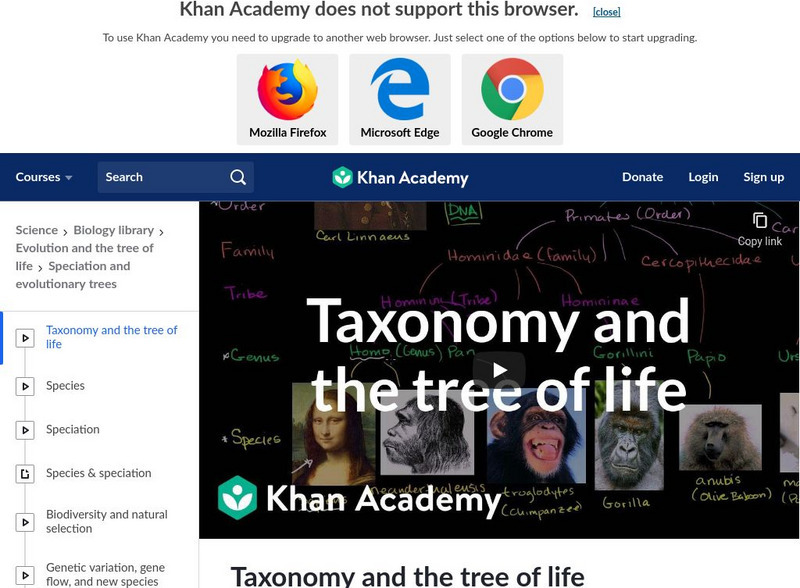
Khan Academy
Khan Academy: Taxonomy and the Tree of Life
Dicover the science of taxonomy and where humans fit into the tree of life. [12:41]
Khan Academy
Khan Academy: Biodiversity and Natural Selection
Explore the patterns and processes of evolution. Learn how evolution and natural selection are reflected in the similarities and differences of organisms. [9:03]

CPALMS
Florida State University Cpalms: Florida Students: Measuring Biodiversity to Evaluate Human Impact
A video to learn about the interactions of humans and the environment. Also, learn how the environment is impacted by humans. [4:40]
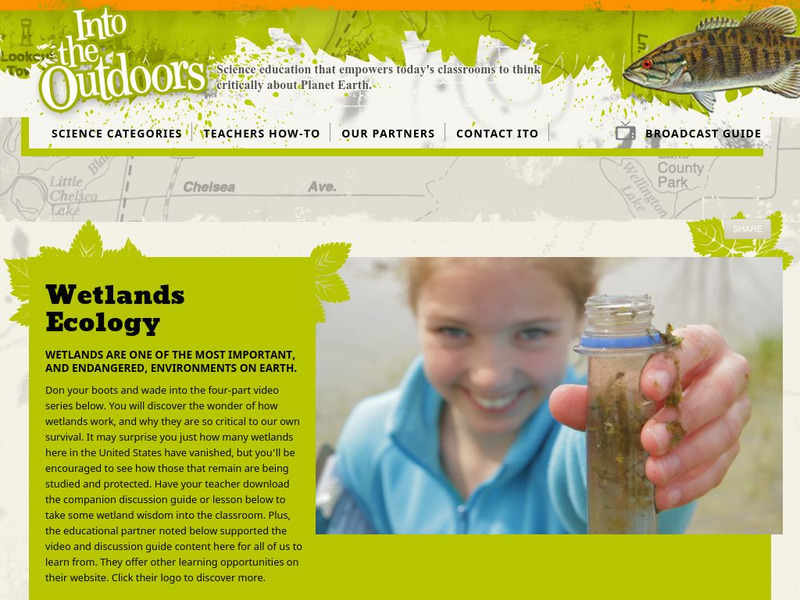
Into the Outdoors
Into the Outdoors: Wetlands Ecology
A collection of four video clips that discuss wetlands. Through these video clips understand the importance of wetlands to our environment, different species of animals, and food production. Also learn about biodiversity, water cycle,...

Smithsonian Institution
National Museum of Natural History: Qrius: How to Discover a New Mammal Species
A zoologist from the National Museum of Natural History discusses his discovery of new mammals and why scientists are still looking for new mammals. What can finding new mammals tell us about Earth? [37:59]
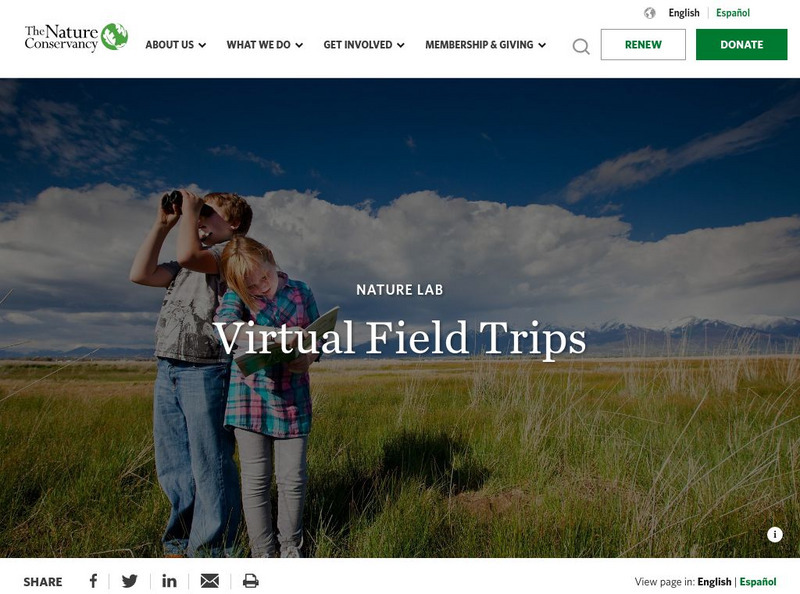
Nature Conservancy
Nature Works Everywhere: China's Great Forests: Giant Panda and Earth's Climate
Join an expert conservation planning officer on a virtual field trip across the world to two stunning provinces in China, and explore majestic forests, towering mountains, and other iconic landscapes. [36:47] Includes lesson plan.
Smithsonian Institution
National Museum of Natural History: Qrius: Island Biodiversity Tracking Human Influences
How do inhabitants on islands alter the ecosystem over time? An archaeologist will identify specific changes over many years that occurred as a result of human arrival on islands. [29:16]

TED Talks
Ted: Ted Talks: David Gallo: Underwater Astonishments
Enter the depths of the ocean to see actual footage of several amazing sea creatures, and witness animal survival behaviors unseen by casual observers. [5:25]
PBS
Pbs Learning Media: An Everglades Visit
In this adapted video segment, ZOOM guest Tommy takes us on a tour of the Florida Everglades. He describes what makes a wetland biome unique, including the soil, precipitation, and biodiversity. [2:53]
PBS
Pbs Learning Media: Splash & Bubbles: Lu the Explorer
Splash takes his pals to go see his friend, Lu, a fearless explorer in the deep. He has met Lu in his travels, and she has been an inspiration for Splash. Lu turns out to be a female football fish (the "Lu" stands for "bio-LU-minescent")...
Science Friday Initiative
Science Friday: Letter to a Young Scientist
The father of biodiversity, Edward O. Wilson addresses young scientists. [4:10]