Hi, what do you want to do?






The Business Professor
Professionalism - Email Etiquette
This Video Explains Professionalism - Email Etiquette
Rock 'N Learn
Learn to Read with Phonics | Consonant Blends, Digraphs, Silent e, Story Practice | Part 2 of 4
Here is the fun and easy way to learn to read with Rock 'N Learn Phonics. Part 2 of our 4-part series covers consonant blends, digraphs, silent e to make long vowels, and story practice. This proven method complements any reading...
Curated Video
Reading with Punctuation: How to Read Fluently
This video teaches students how to read fluently by paying attention to punctuation marks. By stopping and thinking about whether to take a full stop or a quick break with their voice, students can improve their understanding of the text...
Curated Video
Rereading Dialogue to Match Voice and Clues
This video is a lesson for students on how to improve their reading fluency by rereading dialogue and matching their voice to the clues in the text. The teacher demonstrates examples and provides helpful strategies, such as using tag...
Curated Video
The Whole Child: Ackermann’s 8 Forces of Natural Development
The video discusses Edith Ackermann's theory of whole child development, which emphasizes the importance of nurturing all aspects of a child's potential beyond just academic intelligence. The theory identifies four natural urges that...
Cerebellum
The Elements Of Poetry - Figurative Language Continued
The Elements of Poetry - Figurative language, meter and rhyme, simile, and metaphor . these are a few of the many topics explored in this lively video tour through the genre of poetry. Other elements illustrated in the program include:...
Curated Video
Matching Your Voice to End Punctuation Marks
In this video, the teacher explains how readers can match their voice to different end punctuation marks, such as periods, exclamation points, and question marks.
Rachel's English
How to say HELLO! How are you? Greet Americans! English Pronunciation
Learn how to pronounce and respond to "how are you" in English. See how Americans greet each other.
Curated Video
Using Voice Effectively: Emphasizing the Actor or the Action
This video provides a clear explanation of how to effectively use voice in writing by switching between active and passive voices. It discusses the reasons for choosing one over the other and provides examples to illustrate each case.

TED-Ed
Using your voice Is a Political Choice - Amanda Gorman
National Youth Poet Laureate Amanda Gorman delineates her reasons for claiming that all poetry is political. The video captures the poet's passion and commitment to speaking up and speaking out. It is a must-have resource.

Steve Spangler Science
Sulfur Hexafluoride - Deep Voice Gas
In one of the more memorable Spangler episodes, Spangler has a large terrarium filled with sulfur-hexafluoride gas, which is six times heavier than the air we breathe! It has some amazing properties, one of which it doesn't allow...

TED-Ed
Why Does Your Voice Change as You Get Older?
Most listeners can correctly identify the relative age and gender of speakers without being able to see them. How is it that the human voice is capable of producing such a range of sounds? Find out with a short video that examines the...

Sophia Learning
Sophia: Making Passive Voice Active
This screencast explains when and why to use active voice and passive voice in writing and how to change from one voice form to the other. It also includes links to additional web resources for changing voices. [3:08]

Sophia Learning
Sophia: The Passive Voice
This screencast [2:25] defines passive voice, offers reasons for its use, explains how to write using it, and provides examples throughout. It also offers links to more information about passive voice.

Sophia Learning
Sophia: The Passive Voice vs the Active Voice
This screencast focuses on voice including the difference between active and passive voice, why active voice is preferred, and when it is acceptable to use passive voice. Links to more resources are also provided. Real Player is required

PBS
Pbs Kids Clubhouse Adventures: Clubhouse Theme: What Is Music?
Exploring our world is fun! Abby Brown, KIDS Clubhouse Adventures co-host, loves to help kids have fun while learning! In this segment, Abby teaches all about music, including instruments, voice, pitch, tempo, and volume. [2:38]
PBS
Pbs Learning Media: What Sounds Do Animals Make?
Although they can't speak, most animals have their own way of communicating. This video segment presents examples of animal communication.
Favorite Poem Project
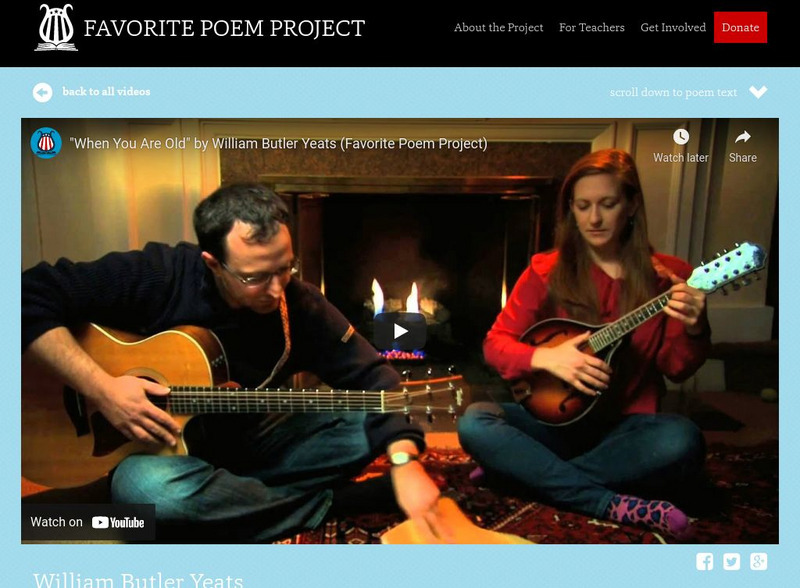
The Favorite Poem Project: "When You Are Old" by William Butler Yeats
In this video episode [10:19] from The Favorite Poem Project, Samantha Kyrkostas, a development manager who has traveled the world, and Dr. Charles Schlegel, a retired dentist and Krykostas' grandfather, share their special connection to...
Sophia Learning
Sophia: The Author's Voice
Notes introducing author's voice and identifying specific techniques authors use to express their voice. Students can either read or listen to the notes. W.11-12.1d Tone/Style