Hi, what do you want to do?






University Corporation for Atmospheric Research
Ucar: Virtual Ballooning to Explore the Atmosphere Activity
In this computer-based virtual lab, students will learn about the layers of Earth's atmosphere by launching virtual balloons to collect temperature and pressure data at various altitudes. Given a limited number of balloon flights,...

National Geographic
National Geographic: Interactions Within Earth's Atmospheres
Using computational models, students investigate the interaction between greenhouse gases, solar radiation, and the Earth's surface for the impact on climate. They then look at data on atmospheric carbon dioxide to analyze changes in...
University Corporation for Atmospheric Research
Ucar: Introduction to the Atmosphere
A detailed overview of the Earth's atmosphere, with explanations about atmospheric properties, the structure of the atmosphere, its four layers, atmospheric processes, energy heat transfer, conduction and convection, and radiation. All...
South Carolina Educational Television
Know It All: Atmosphere | Nasa Online
The Earth is surrounded by a thin envelope of gases called the atmosphere. More than 500 active volcanoes erupt around the world affecting the Earth's atmosphere and global climate.

NASA
National Aeronautics and Space Administration: Scijinks: Atmosphere
Activity describing how the Earth's atmosphere was formed, why it stays close to the Earth, and why the sky is blue.
Smithsonian Institution
Smithsonian Environmental Research Center: Forces of Change:meet Your Atmosphere
This superb site has detailed information about the composition of the atmosphere, how it is always changing, how it protects life on earth, and the destructive impact human activity has on it. There is an atmosphere design lab, as well...
Georgia Department of Education
Ga Virtual Learning: Air, Atmosphere, and Climate Change
Sixteen essential questions lead student learning about Earth's atmosphere and global warming as they have to do with global climate change.
Other
Spacetech's Orrery: Earth Our Home Planet
This site provides a very interesting overview of our home planet, Earth. Content includes a focus on the atmosphere, the pull of gravity, and the active surface.
Center for Educational Technologies
Nasa Classroom of the Future: Earth on Fire
Information and activities looking at the impact of industrial and agricultural practices on global warming.
TeachEngineering
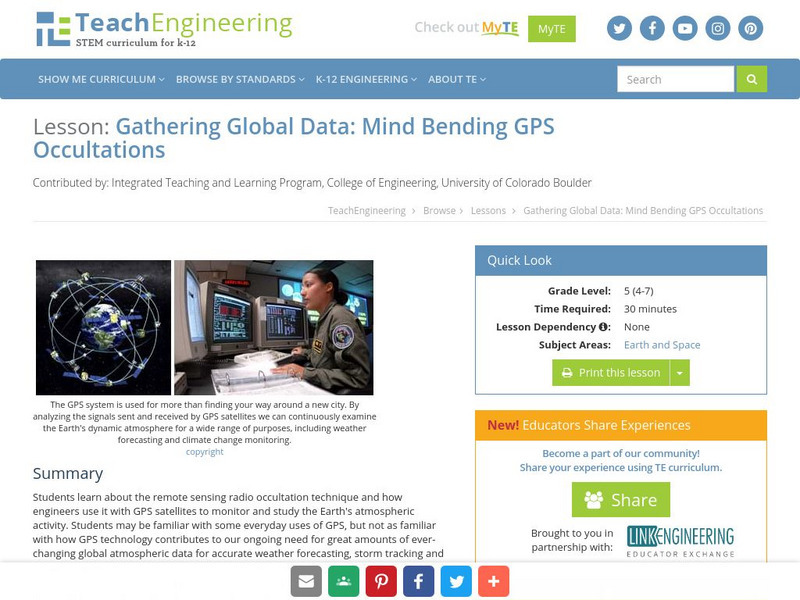
Teach Engineering: Mind Bending Gps Occultations
Students learn about the remote sensing radio occultation technique and how engineers use it with GPS satellites to monitor and study the Earth's atmospheric activity. Students may be familiar with some everyday uses of GPS, but not as...
University Corporation for Atmospheric Research
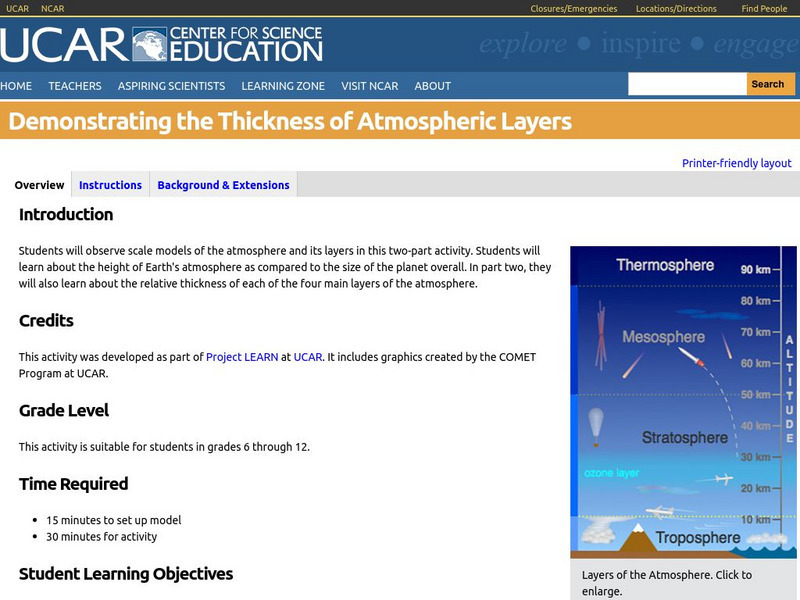
Ucar: How High Does the Atmosphere Go?
This lesson shows the parts of the atmosphere and their size (thickness) relative to the size of the Earth. It includes background information, lesson outline, links to standards and assessments.
American Geosciences Institute
American Geosciences Institute: Earth Science Week: Build Your Own Weather Station
Students are guided in how to build their own weather station that will measure temperature, humidity, precipitation, atmospheric pressure, and wind direction and speed.
Concord Consortium
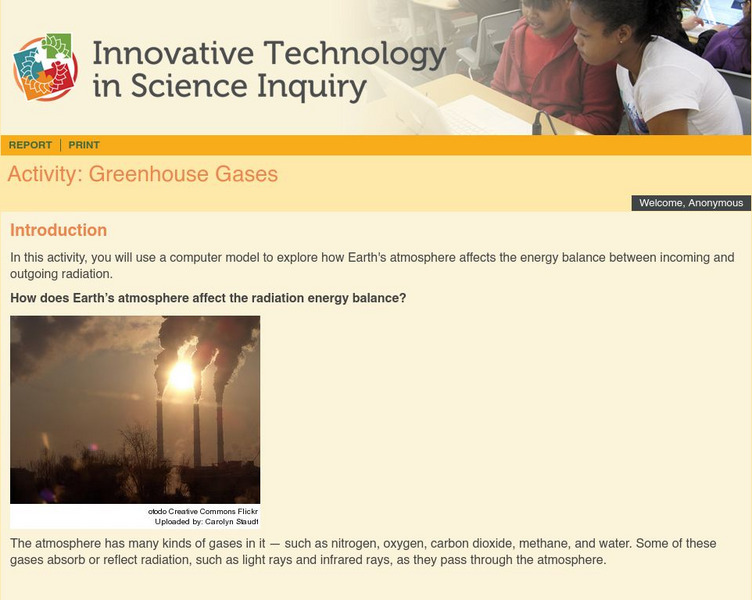
Concord Consortium: Stem Resources: Greenhouse Gases
Do you understand the relationship between temperature and carbon dioxide in our atmosphere? This computer model shows factors such as clouds and carbon dioxide that could cause global temperatures to rise. Students investigate how the...
Science Education Resource Center at Carleton College
Serc: Learn: Atmospheric Science Explorers
Learning modules created by teachers for teachers to increase the "knowledge of and interest" in the atmospheric sciences. Modules include background information, hands-on activities, and assessments. Modules cover topics such as ozone,...
University Corporation for Atmospheric Research
Ucar: Atmospheric Science Explorers: Global Climate Change
A detailed overview of global climate change, with explanations of Earth's climate change, the carbon cycle, ecosystems, and greenhouse gases, and how the movements of matter and energy impact on climate. All information is reinforced...
Other
Digital Library for Earth System Education (Dlese)
This resource provides materials for teachers on a huge array of topics. Search site by topic, grade level, and desired output (such as lesson plan, case study, assessment or tutorial). Site is focused on earth science, geography, and...
American Geosciences Institute
American Geosciences Institute: Earth Science Week
This site includes learning resources and activities for Earth Science Week 2016. The goal of the week is to "engage young people and others in exploring geoheritage throughout the Earth systems, including the geosphere, hydrosphere,...
Encyclopedia of Earth
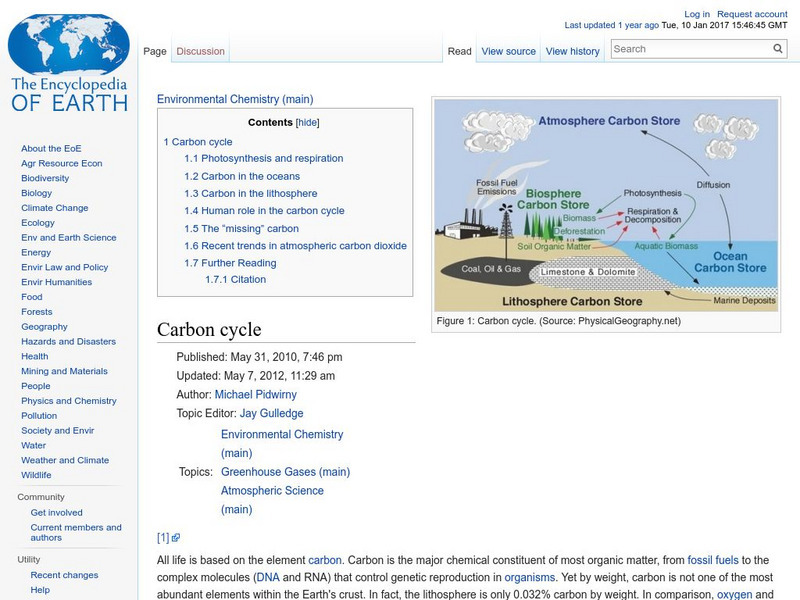
Encyclopedia of Earth: Environmental Chemistry: Carbon Cycle
Article explaining the importance of carbon as the basis for life, carbon dioxide's role in photosynthesis and respiration, carbon in the ocean and lithosphere, the impact of human activities on the carbon cycle, carbon that seems to be...
University Corporation for Atmospheric Research
Ucar: Elementary Globe: Earth System in a Bottle
If you have seeds at home, try this activity to help kids learn what a seed needs to grow. Students will create experimental conditions in terrariums to study what plants need to live. They will learn about the importance of the...
American Geosciences Institute
American Geosciences Institute: Earth Science Week: Geoscience and Petroleum Careers
In this activity, students think about how various real-world careers relate to personal interests and Earth's systems- the geosphere, hydrosphere, atmosphere, and biosphere.
American Geosciences Institute
American Geosciences Institute: Earth Science Week: Dangerous Atmosphere
For this activity, students research what types of severe weather their county has had over the past 50-60 years. They will look at the severity of these events and the number of injuries and deaths they caused. They will then decide...

Khan Academy
Khan Academy: Activity: Living in the Extremes of the Biosphere
In this activity, you'll describe what you think it might be like for humans to live in the extremes of the biosphere. Think about the challenges associated with living either underwater or in the upper atmosphere. Also, think about what...
American Geosciences Institute
American Geosciences Institute: Earth Science Week: Surficial Features
Using a surficial features map, students see the connections between those features and other Earth systems. They will consider the interactions of the geosphere, hydrosphere, biosphere, and atmosphere.
American Geosciences Institute
American Geosciences Institute: Earth Science Week: Look Up!
Get ready to set a course for sky exploration. The following activity is designed to help learners learn to listen, read, and communicate in both written and oral formats about the sky.