Lesson Planet
Search educational resources
  • Sign In Try It Free
  • AI Teacher Tools
    • Discover Resources Search reviewed educational resources by keyword, subject, grade, type, and more
    • Curriculum Manager (My Content) Manage saved and uploaded resources and folders To Access the Curriculum Manager Sign In or Join Now
    • Browse Resource Directory Browse educational resources by subject and topic
    • Curriculum Calendar Explore curriculum resources by date
    • Lesson Planning Articles Timely and inspiring teaching ideas that you can apply in your classroom
    • Our Story
    • Frequently Asked Questions
    • Testimonials
    • Contact Us
  • Pricing
  • School Access
    • Your school or district can sign up for Lesson Planet — with no cost to teachers
      Learn More
  • Sign In
  • Try It Free

Hi, what do you want to do?

Create a lesson plan
Generate resources with 80+ AI teacher tools
Search 200,000 instructional videos
Find a teaching resource
Teach Engineering: Mind Bending Gps Occultations Lesson PlanTeach Engineering: Mind Bending Gps Occultations Lesson Plan
Publisher
TeachEngineering
Curator Rating
Educator Rating
Not yet Rated
Lesson Plan

Teach Engineering: Mind Bending Gps Occultations

Curated by ACT

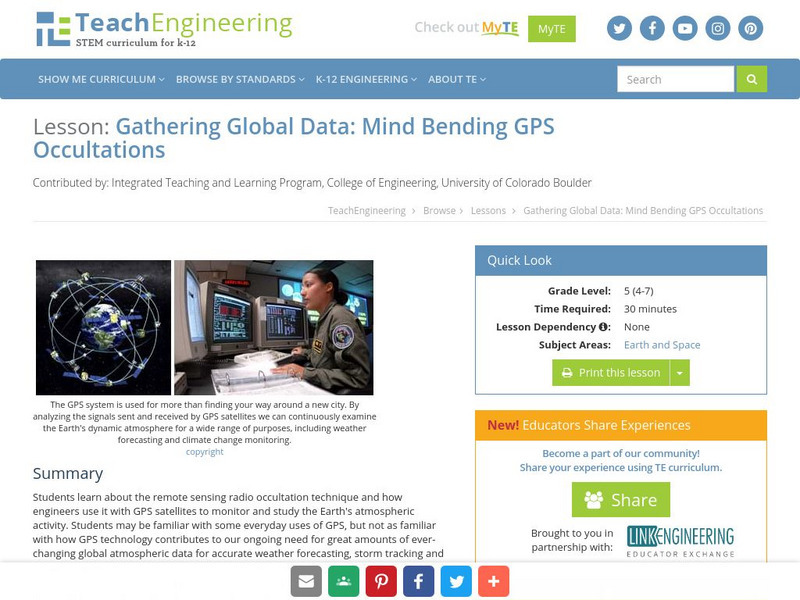
Students learn about the remote sensing radio occultation technique and how engineers use it with GPS satellites to monitor and study the Earth's atmospheric activity. Students may be familiar with some everyday uses of GPS, but not as familiar with how GPS technology contributes to our ongoing need for great amounts of ever-changing global atmospheric data for accurate weather forecasting, storm tracking and climate change monitoring. GPS occultations are when GPS signals sent from one satellite to another are altered (delayed, refracted) by the atmosphere passed though, such that they can be analyzed to remotely learn about the planet's atmospheric conditions.

3 Views 0 Downloads
Concepts

weather, gps, stem

Additional Tags

aerospace engineering, atmosphere, occultation, integrated teaching and learning program and laboratory, teachengineering, satellite, aerospace engineering concepts
Show More Show Less

Resource Details

Grade
4th - 7th
Subjects
Science
3 more...
Resource Type
Lesson Plans
Audiences
For Administrator Use
1 more...
Lexile Measures
0L

See similar resources:

Activity

Teach Engineering: Distorted Disturbances

TeachEngineering
Students pass around and distort messages written on index cards to learn how we use signals from GPS occultations to study the atmosphere. The cards represent information sent from GPS satellites being distorted as they pass through...
4th - 7th STEM
Activity

Teach Engineering: Wimpy Radar Antenna

TeachEngineering
Students will reinforce an antenna tower made from foam insulation, so that it will withstand a 480 N-cm bending moment (torque) and a 280 N-cm twisting moment (torque) with minimal deflection. One class will be used to discuss the...
6th - 8th Science
Activity

Teach Engineering: State Your Position

TeachEngineering
To navigate, you must know roughly where you stand relative to your designation, so you can head in the right direction. In locations where landmarks are not available to help navigate (in deserts, on seas), objects in the sky are the...
6th - 9th Science
Lesson Plan

Teach Engineering: Fairly Fundamental Facts About Forces & Structures

TeachEngineering
This lesson will introduce students to the five fundamental loads: compression, tension, shear, bending, and torsion.
6th - 8th Science
Unit Plan

Teach Engineering: Plot Your Course Navigation

TeachEngineering
In this unit, students learn the very basics of navigation, including the different kinds of navigation and their purpose. The concepts of relative and absolute location, latitude, longitude and cardinal directions are discussed, as well...
6th - 8th Science
Activity

Teach Engineering: Construction Technologies: Construct the Strongest Bridge

TeachEngineering
In this activity, students will work in pairs to create three simple types of bridges. They will observe quantitatively how the bridges work under load and why engineers use different types of bridges for different places. They also will...
6th - 8th STEM
Activity

Teach Engineering: Shapes of Strength

TeachEngineering
Students are introduced to brainstorming and the design process in problem solving as it relates to engineering. They perform an activity to develop and understand problem solving with an emphasis on learning from history. Using only...
3rd - 5th Science
Activity

Teach Engineering: Cooking With the Sun Creating a Solar Oven

TeachEngineering
For this activity, students will be given a set of materials: cardboard, a set of insulating materials (i.e. foam, newspaper, etc.), aluminum foil, and Plexiglas. Students will then become engineers in building a solar oven from the...
3rd - 8th Science
Unit Plan

Teach Engineering: Rockets

TeachEngineering
This unit teaches students how and why engineers design satellites to benefit life on Earth as well as allows students an opportunity to explore motion, rockets and rocket motion. Students discover that the motion of all objects...
3rd - 5th Science
Activity

Teach Engineering: Test a Beam

TeachEngineering
Students measure different types of small-sized beams and calculate their respective moments of inertia. They compare their calculations to how much the beams bend when loads are placed on them, gaining insight into the ideal geometry...
6th - 9th STEM
Try It Free
© 1999-2026 Learning Explorer, Inc.
Teacher Lesson Plans, Worksheets and Resources

Sign up for the Lesson Planet Monthly Newsletter

Open Educational Resources (OER)

  • Health
  • Language Arts
  • Languages
  • Math
  • Physical Education
  • Science
  • Social Studies
  • Special Education
  • Visual and Performing Arts
View All Lesson Plans

Discover Resources

  • Our Review Process
  • How it Works
  • How to Search
  • Create a Collection

Manage Curriculum

  • Edit a Collection
  • Assign to Students
  • Manage My Content
Contact Us Site Map Privacy Policy Terms of Use