Hi, what do you want to do?






EngageNY
TASC Transition Curriculum: Workshop 12
How can opinions slant facts? Workshop participants learn how to examine primary and secondary sources and identify the author's point of view. They also examine how visual art impacts the meaning and rhetoric of sources. Full of...

New York State Education Department
TASC Transition Curriculum: Workshop 11
You'll C-E-R a difference in classroom achievement after using a helpful activity. Designed for economics, civics, government, and US history classes, participants practice using the CER model to craft arguments about primary and...
![Florida Center for Reading Research: Text Analysis: Fact or Opinion Game [Pdf] Lesson Plan](https://content.lessonplanet.com/knovation/original/509095-73da26d30a9eaa9b2f5c24d21663aace.jpg?1661786981 "Florida Center for Reading Research: Text Analysis: Fact or Opinion Game [Pdf] Lesson Plan")
Florida Center for Reading Research
Florida Center for Reading Research: Text Analysis: Fact or Opinion Game [Pdf]
A lesson plan in which students play a game where they move around a board by determining if statements are facts or opinions. Materials are included.
![Florida Center for Reading Research: Text Analysis: Fact or Opinion Football [Pdf] Lesson Plan](https://content.lessonplanet.com/knovation/original/509104-a8eda078a78bb5576ea4d58dd580df72.jpg?1661786968 "Florida Center for Reading Research: Text Analysis: Fact or Opinion Football [Pdf] Lesson Plan")
Florida Center for Reading Research
Florida Center for Reading Research: Text Analysis: Fact or Opinion Football [Pdf]
A lesson plan in which students play a football card game by determining if sentences are facts or opinions. Materials are included.
University of Illinois
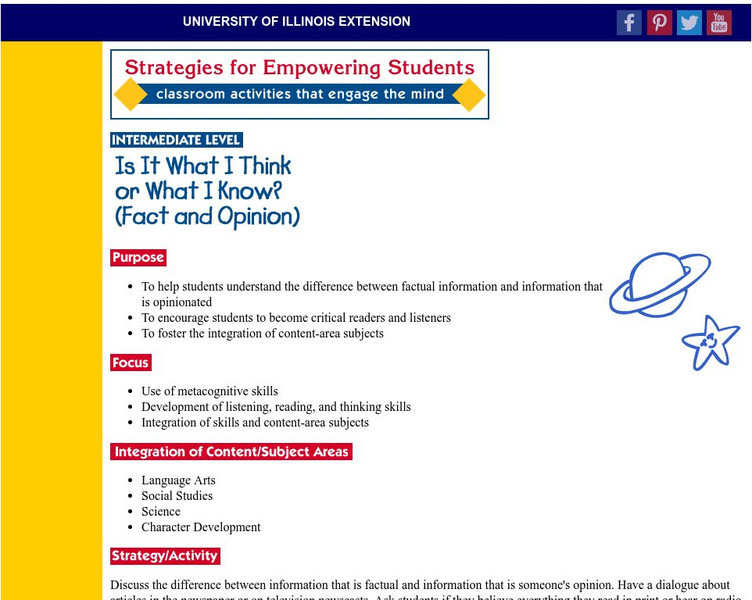
University of Illinois Extension: Is It What I Think or What I Know? (Fact or Opinion)
This short lesson provides a fairly simple way to teach young students the difference between fact and opinion.

University of Illinois
University of Illinois Extension: Is It What I Think or What I Know? (Fact or Opinion)
This short instructional activity provides a fairly simple way to teach young students the difference between fact and opinion.
Soft Schools
Soft Schools: Reading Skills: Fact or Opinion? Quiz
Determine whether each statement is fact or opinion in this fifteen-question quiz.
Quia
Quia: Comprehension: Fact or Opinion Game #3
Read each sentence and determine whether it is a fact or an opinion in this thirty-question quiz.
Soft Schools
Soft Schools: Comprehension: Facts and Opinions Quiz
Determine whether each statement is fact or opinion in this ten-question quiz.
Soft Schools
Soft Schools: Comprehension: Facts vs. Opinions Quiz
Determine whether each statement is fact or opinion in this nine-question quiz.

ClassFlow
Class Flow: Fact or Opinion
[Free Registration/Login Required] Students will be introduced to the difference between facts and opinions. They will practice determining which statements are facts and which are opinions. Activities include sorting and classifying...
Quia
Quia: Comprehension: Fact or Opinion? Game #2
Read each sentence and determine whether it is a fact or an opinion in this thirty-question quiz.
Other
Learn the net.com: Evaluating Online Information: Fact or Fiction
How can you determine if online information is fact or fiction? Use this online article to become more computer literate in this topic. Includes a video.
Quia
Quia: Fact and Opinion
Read each sentence and determine whether it is fact or opinion in this ten question quiz.

ClassFlow
Class Flow: Fact and Opinion
[Free Registration/Login Required] Designed for grade 6, this flipchart covers the differences between fact and opinion. Students will analyze statements to determine if they are a fact or if they are an opinion.
![De Paul University: Center for Urban Education: Comprehensive Questions: Nonfiction [Pdf] Unknown Type](https://statictemp.lp.lexp.cloud/images/attachment_defaults/resource/large/FPO-knovation.png "De Paul University: Center for Urban Education: Comprehensive Questions: Nonfiction [Pdf] Unknown Type")
Polk Brothers Foundation Center for Urban Education at DePaul University
De Paul University: Center for Urban Education: Comprehensive Questions: Nonfiction [Pdf]
Questions are provided to help students determine the main idea, topic, and fact versus opinion of a nonfiction piece. Students are prompted to write a summary of an informational text.