Hi, what do you want to do?






CK-12 Foundation
Exponential Growth: Exponential, Fractal Snowflakes
Examine an exponential growth model. Using a fractal, learners calculate the perimeters of each stage. When comparing the consecutive perimeters, a pattern emerges. They use the pattern to build an equation and make conclusions.

National Council of Teachers of Mathematics
Math Challenge #23: Fractals
Young scholars explore the concepts of Sierpinski's triangle, ratios, and concentrations. For this exploratory lesson, students are given three problems to solve. Young scholars learn about Sierpinski's triangle, how to calculate mpg for...

PBS
Human Tree: Ratios
Create a personal tree. By visiting an exhibit at the National Museum of Mathematics, the resource introduces the idea of fractals. The exhibit takes an image of the person and creates a tree by repeating scaled images on the shoulders...

Noyce Foundation
Surrounded and Covered
What effect does changing the perimeter have on the area of a figure? The five problems in the resource explore this question at various grade levels. Elementary problems focus on the perimeter of rectangles and irregular figures with...

Noyce Foundation
Cut It Out
Explore the mathematics of the paper snowflake! During the five lessons progressing in complexity from K through 12, pupils use spatial geometry to make predictions. Scholars consider a folded piece of paper with shapes cut out....

Curated OER
Fractal Worksheets
This page contains links to 4 different worksheets containing fractal problems relating to calculus.There are also 2 links to triangular and square dot paper. All items are available for download.

Shodor Education Foundation
Two Variable Function Pump
Use a function to operate on two variables. Pupils look at operating with complex numbers as a function of two variables. The interactive squares the input and adds a constant to it. Learners visualize the resulting output and its...

Wake Forest University
Authentic Activities for Connecting Mathematics to the Real World
Check out the handout from a presentation that contains a collection of high school algebra projects connecting a variety of mathematics to the real world. Activities range from simple probabilities to calculus. The activities...

Curated OER
Two-Variable Function Pump Exploration Questions
Guiding students through two variable (complex) functions, this worksheet helps them perform complex arithmetic on 6 expressions. They iterate several functions with given starting points, determining whether each is a prisoner, escapee,...
TED Talks
Ted: Ted Ed: Fractals and the Art of Roughness
Mathematics legend Benoit Mandelbrot develops a theme he first discussed in 1984- the extreme complexity of roughness and the way that fractal math can find order within patterns that seem unknowably complicated. [17:10]
University of Massachusetts
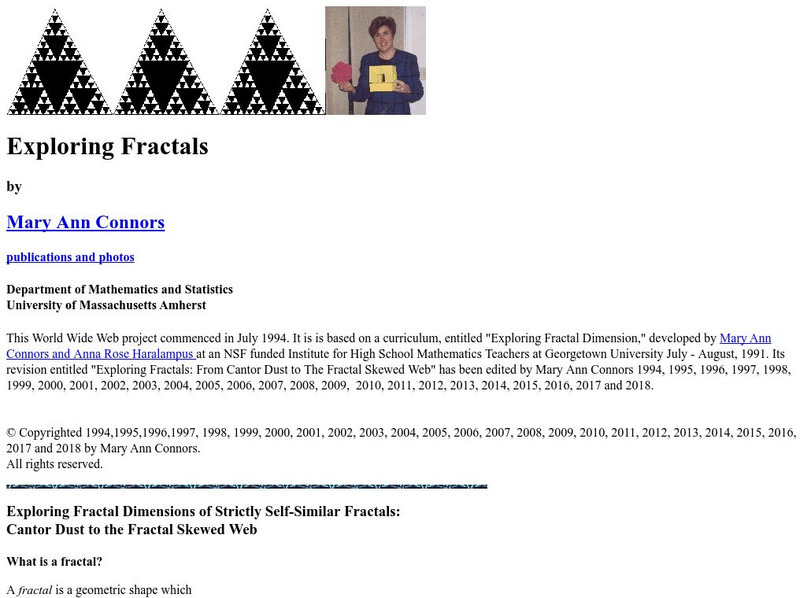
Fractal Project: Exploring Fractals
A good beginner's site for fractals - the language is straightforward and requires only minimal experience to be able to understand the topic. (Note: When clicking on links on archived site, they may pause and appear not to be found...
Fundación Cientec
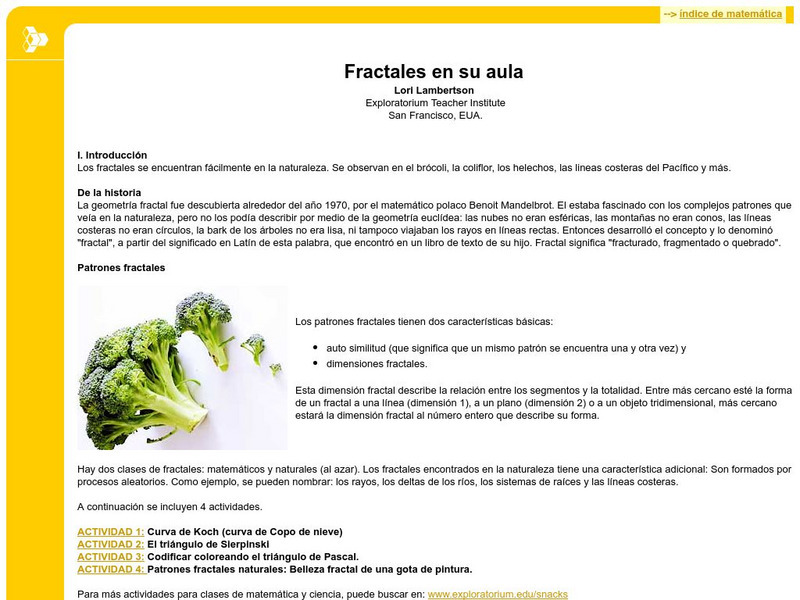
Fractales en Su Aula
Lesson plans and activities available in Spanish dealing with fractals. Some are also available in English. Activities are step by step and easy to understand. Included topics are the Koch Snowflake, Sierpinski's triangle, and Pascal's...
Rice University
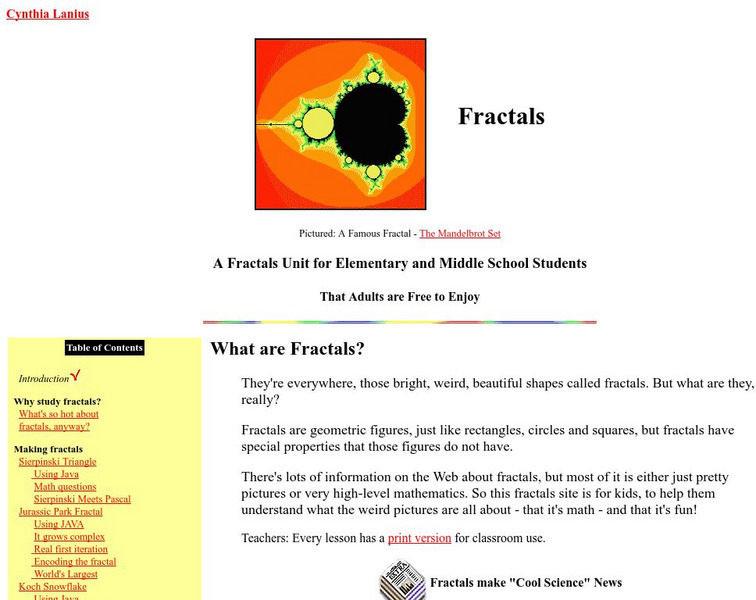
Rice University: Cynthia Lanius: Fractals Unit
This site from the Rice University provides a Fractals Unit for Elementary and Middle School Students. Find out what a fractal is and what it looks like. You can value fractals for their visual delight or mathmatical properties. This is...
Boston University
Boston University: Chaos, Fractals and Arcadia
This is an interesting site for information on chaos and fractals. Includes links to interactive activities to learn more.

Other
Fractal Explorer
The fractal explorer shows how a very simple pattern, when repeated can produce an incredible range of images. From organic tree like structures to rigid geometric forms. Fun to use and lots of mathematical concepts involved.
Incredible Art Department
The Incredible Art Department: Art Tessellations
Looks at tessellation artists, including M.C. Escher, Robert Fathauer, and Roger Penrose. This is followed by a discussion of fractals and their similarities and differences to tessellations, and links to lessons and resources on...
Boston University
Fractal Geometry of the Mandelbrot Set Ii
This web site addresses counting and adding in fractal operations, as well as the role of the Fibonacci sequence in fractal geometry.
National Council of Teachers of Mathematics
The Math Forum: Fractals
This site contains many links to Fractal information where students go to the given links to discover interesting facts about fractals and many mathematical equations that represent a fractal.
Boston University
Bu: Fractal Geometry of the Mandelbrot Set
This site progresses in iterations through Mandelbrot and Julia sets to explain fractals and the mathematics behind them.
PBS
Pbs: Positive Exponents as Fractals
Explore the relationship between graphic patterns and their mathematical representation. This video focuses on how fractals can be a visual representation of positive exponents.
PBS
Pbs: Negative Exponents as Fractals
Determine the relationship between graphic patterns and what they represent mathematically. This video focuses on how fractals can be a visual representation of negative exponents, which are a way to express repeated division.
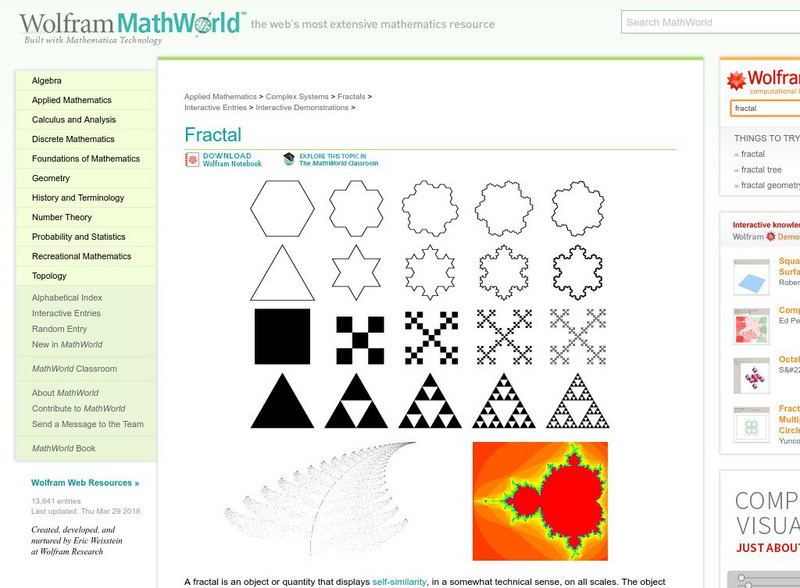
Wolfram Research
Wolfram Math World: Fractals
This page briefly illustrates and discusses fractals, which are closely linked to the concept of iteration (repitition.) Site links to well known pictured fractals.
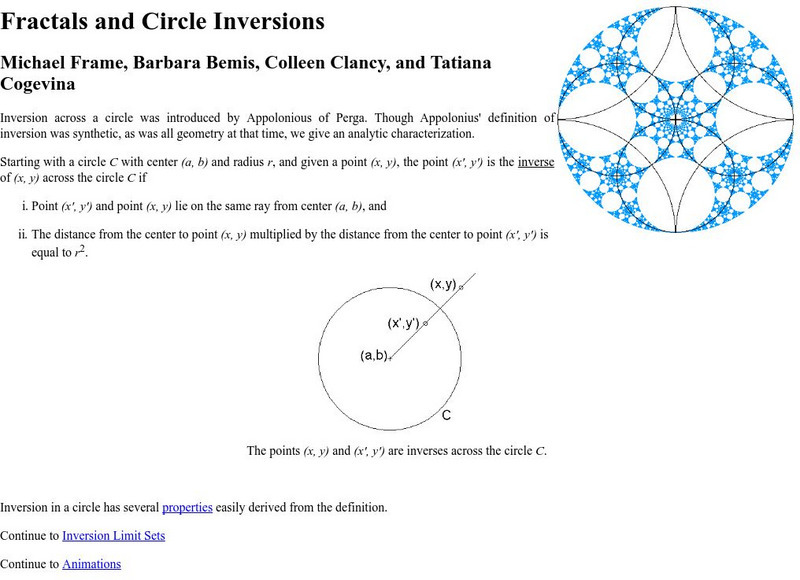
Other
Research Pages: Circle Inversion Fractals
This site introduces the iteration of circle inversions and describes the associated properties.
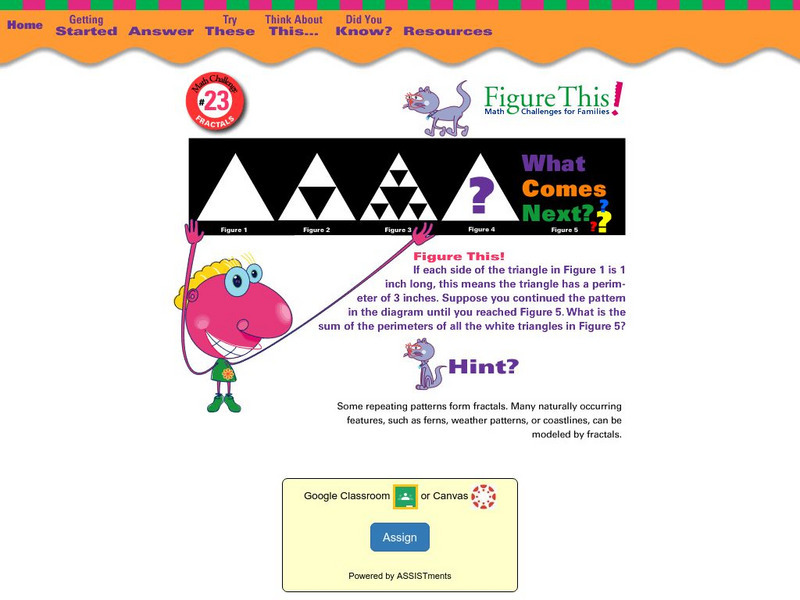
National Council of Teachers of Mathematics
Nctm: Figure This: Fractals
Can you figure out what pattern comes next? Explore patterns and perimeter in this math challenge on fractals. A one page activity from the NCTM Math Challenges for Families collection.