Lesson Planet
Search educational resources
  • Sign In Try It Free
  • AI Teacher Tools
    • Discover Resources Search reviewed educational resources by keyword, subject, grade, type, and more
    • Curriculum Manager (My Content) Manage saved and uploaded resources and folders To Access the Curriculum Manager Sign In or Join Now
    • Browse Resource Directory Browse educational resources by subject and topic
    • Curriculum Calendar Explore curriculum resources by date
    • Lesson Planning Articles Timely and inspiring teaching ideas that you can apply in your classroom
    • Our Story
    • Frequently Asked Questions
    • Testimonials
    • Contact Us
  • Pricing
  • School Access
    • Your school or district can sign up for Lesson Planet — with no cost to teachers
      Learn More
  • Sign In
  • Try It Free

Hi, what do you want to do?

Create a lesson plan
Generate resources with 80+ AI teacher tools
Search 200,000 instructional videos
Find a teaching resource
Texas Gateway: Superposition and Interference Unit PlanTexas Gateway: Superposition and Interference Unit Plan
Publisher
Texas Education Agency
Resource Details
Curator Rating
Educator Rating
Not yet Rated
Grade
11th - 12th
Subjects
Science
2 more...
Resource Type
Unit Plans
Audiences
For Administrator Use
2 more...
Instructional Strategy
Independent Practice
Lexile Measures
0L
Unit Plan

Texas Gateway: Superposition and Interference

Curated by ACT

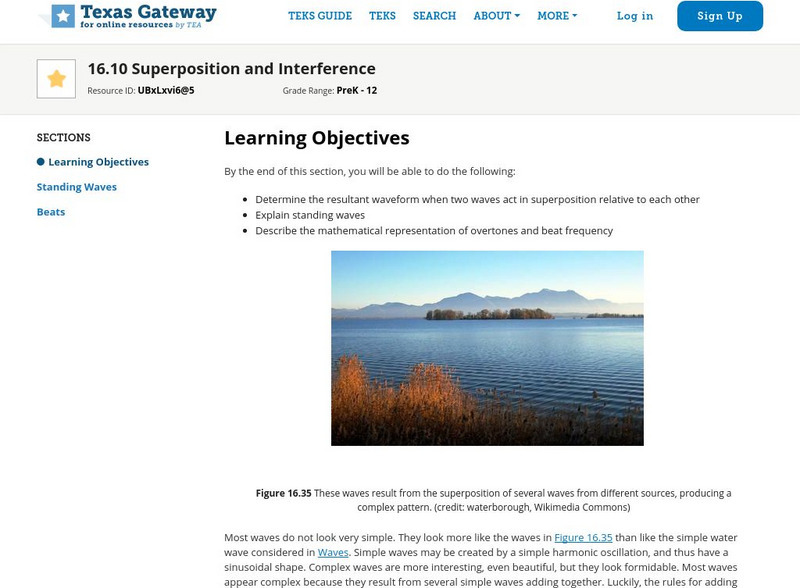
By the end of this section, you will be able to determine the resultant waveform when two waves act in superposition relative to each other, explain standing waves, and describe the mathematical representation of overtones and beat frequency.

3 Views 0 Downloads

Concepts

standing waves, waves

Additional Tags

constructive interference, destructive interference, fundamental frequency, overtones and beat frequency, superposition, ap physics, beats, superposition and interference, texas gateway, characteristics of waves

Classroom Considerations

  • Knovation Readability Score: 4 (1 low difficulty, 5 high difficulty)
  • The intended use for this resource is Instructional|practice

See similar resources:

Unit Plan

Texas Gateway: Satellites and Kepler's Laws: An Argument for Simplicity

Texas Education Agency
By the end of this section, you will be able to state Kepler's laws of planetary motion, derive Kepler's third law for circular orbits, and discuss the Ptolemaic model of the universe.
11th - 12th Science
Unit Plan

Texas Gateway: Viscosity and Laminar Flow: Poiseuille's Law

Texas Education Agency
By the end of this section, you will be able to define laminar flow and turbulent flow, explain what viscosity is, calculate flow and resistance with Poiseuille's law, and explain how pressure drops due to resistance.
11th - 12th Science
Unit Plan

Texas Gateway: Forces and Torques in Muscles and Joints

Texas Education Agency
By the end of this section, you will be able to explain the forces exerted by muscles; state how a bad posture causes back strain; discuss the benefits of skeletal muscles attached close to joints; and discuss various complexities in the...
11th - 12th Science
Website

Texas Gateway: Atomic and Molecular Explanation of Pressure and Temperature

Texas Education Agency
Learn how to calculate the kinetic energy of a gas molecule, describe the relationship between the temperature of a gas and the kinetic energy of atoms and molecule, and describe the distribution of speeds of molecules in a gas. The...
11th - 12th Science
Website

Texas Gateway: Atomic and Molecular Explanation of Pressure and Temperature

Texas Education Agency
We gain a better understanding of pressure and temperature from the kinetic theory of gases, which assumes that atoms and molecules are in continuous random motion. Learn more about Kinetic Theory with the following detailed resource...
10th - 12th Science
Unit Plan

Texas Gateway: Heat and Heat Transfer Methods: Conduction

Texas Education Agency
By the end of this section, you will be able to calculate thermal conductivity, observe conduction of heat in collisions, and study thermal conductivities of common substances.
11th - 12th Science
Unit Plan

Texas Gateway: Force and Newton's Laws: Conceptual Questions

Texas Education Agency
This page offers 27 questions to test students' knowledge of the major concepts in each section of Chapter 4: Dynamics: Force and Newton's Laws of Motion from the AP Physics online text.
11th - 12th Science
Unit Plan

Texas Gateway: Force and Newton's Laws: Section Summary

Texas Education Agency
This page summarizes each section of Chapter 4: Dynamics: Force and Newton's Laws of Motion in the AP Physics online text. These include Newton's three laws of motion and application of those and other forces.
11th - 12th Science
Study Guide

Texas Gateway: Force and Newton's Laws: Problems and Exercises

Texas Education Agency
This page offers 57 problems/exercises based on the content of Chapter 4: Dynamics: Force and Newton's Laws from the AP Physics online text.
11th - 12th Science
Handout

Texas Gateway: Heat and Heat Transfer Methods: Glossary

Texas Education Agency
This is a glossary of terms and definitions used in Chapter 14: Heat and Heat Transfer Methods from the AP Physics online text.
11th - 12th Science
Try It Free
© 1999-2026 Learning Explorer, Inc.
Teacher Lesson Plans, Worksheets and Resources

Sign up for the Lesson Planet Monthly Newsletter

Open Educational Resources (OER)

  • Health
  • Language Arts
  • Languages
  • Math
  • Physical Education
  • Science
  • Social Studies
  • Special Education
  • Visual and Performing Arts
View All Lesson Plans

Discover Resources

  • Our Review Process
  • How it Works
  • How to Search
  • Create a Collection

Manage Curriculum

  • Edit a Collection
  • Assign to Students
  • Manage My Content
Contact Us Site Map Privacy Policy Terms of Use