Lesson Planet
Search educational resources
  • Sign In Try It Free
  • AI Teacher Tools
    • Discover Resources Search reviewed educational resources by keyword, subject, grade, type, and more
    • Curriculum Manager (My Content) Manage saved and uploaded resources and folders To Access the Curriculum Manager Sign In or Join Now
    • Browse Resource Directory Browse educational resources by subject and topic
    • Curriculum Calendar Explore curriculum resources by date
    • Lesson Planning Articles Timely and inspiring teaching ideas that you can apply in your classroom
    • Our Story
    • Frequently Asked Questions
    • Testimonials
    • Contact Us
  • Pricing
  • School Access
    • Your school or district can sign up for Lesson Planet — with no cost to teachers
      Learn More
  • Sign In
  • Try It Free

Hi, what do you want to do?

Create a lesson plan
Generate resources with 80+ AI teacher tools
Search 200,000 instructional videos
Find a teaching resource
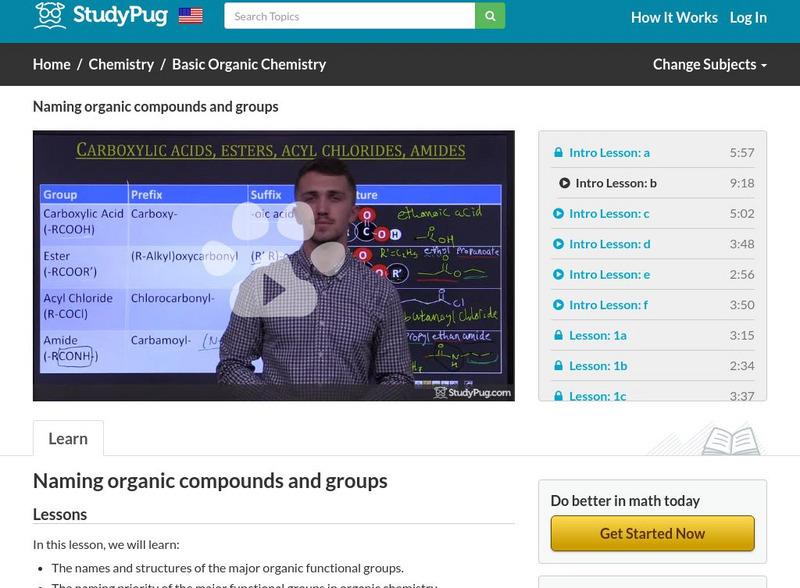
Study Pug: Naming Organic Compounds and Groups Instructional VideoStudy Pug: Naming Organic Compounds and Groups Instructional Video
Publisher
Study Pug
Resource Details
Curator Rating
Educator Rating
Not yet Rated
Grade
11th - 12th
Subjects
Science
2 more...
Resource Type
Instructional Videos
Audiences
For Administrator Use
2 more...
Lexile Measures
1180L
Instructional Video

Study Pug: Naming Organic Compounds and Groups

Curated by ACT

This video will go through some of the most common functional groups you will encounter in organic chemistry. [15:28]

3 Views 1 Download

Concepts

alkenes, functional groups

Additional Tags

amides, aromatic compounds, benzene rings, carbon chain, carboxylic acid, esters, iupac systematic naming, acyl chlorides, acylic

Classroom Considerations

  • Knovation Readability Score: 3 (1 low difficulty, 5 high difficulty)
  • The intended use for this resource is Instructional

See similar resources:

Worksheet

Review of Ionic and Covalent Compounds and Transitioning from Ionic to Covalent Compounds

Curated OER
Here is a unique assigment: compare and contrast ionic and covalent compounds in an extensive data table and then analyze Lewis dot structures in antoher. Three columns are to befilled in: "characteristic or feature," "applies to ionic...
9th - 12th Science
Lesson Plan

Fibers, Dyes, and the Environment

Cornell University
Nanofibers can be made through electrospinning or force spinning in order to reduce the negative impact on the environment. Pupils study the role of fibers and dye on the environment through a series of five hands-on activities. Then,...
6th - 12th Science
CCSS: Adaptable
Lesson Plan

Cystic Fibrosis: A DNA Case Study

K20 LEARN
Around six percent of babies are born with serious genetic disorders. Young scientists learn more about what causes these disorders and the effect they have. They begin with a case study of cystic fibrosis before expanding to research...
9th - 12th Science
CCSS: Adaptable
Instructional Video

Why Mars Rovers Don't Study Water

SciShow
Is it possible to contaminate the planets our astronauts or rovers visit? With current technology, it is impossible to send a completely sterile rover to Mars, and there could be up to 30,000 different microbes on the space traveler!...
4 mins 9th - Higher Ed Science
Instructional Video

Aromatic Compounds and Huckel's Rule

Khan Academy
Sal gives a good recap of the pi electron behavior in aromatic compounds originating from a benzene ring. He diagrams the hybridization leading to a conjugated system of pi electrons and compares their stability.
10 mins 10th - Higher Ed Science
Instructional Video

Chemistry Lesson: Naming Ionic Compounds

Get Chemistry Help
Continue leading your class through the ionic journey as they learn additional ways to name ionic compounds. Pupils focus on deriving compound names from their formulas, including fixed charge metal ions, variable charge metal ions,...
13 mins 9th - 12th Science
Instructional Video

How Do We Study Living Brains?

TED-Ed
Out of all vertebrates, the largest brain when compared to body size belongs to humans. Studying the working brain presents challenges to scientists. Learn about three of the most common tests used to understand how the living brain...
5 mins 6th - 12th Science
CCSS: Adaptable
Instructional Video

Why Study Soil?

Learning Games Lab
Some scientists spend their entire careers analyzing and learning about soils. An interesting video lesson provides an overview of what soil scientists do and why. Pupils learn how soil analysis connects to other branches of science...
4 mins 9th - 12th Career & Technical Education
CCSS: Adaptable
Lesson Plan

Using Vegetation, Precipitation, and Surface Temperature to Study Climate Zones

Curated OER
Using NASA's Live Access Server, earth scientists compare the temperature, precipitation, and normalized difference vegetation index for four different locations. They use the data to identify the climate zone of each location using...
6th - 12th Science
Interactive

Using the Scientific Process to Study Human Evolution

Howard Hughes Medical Institute
Did humans and dinosaurs coexist? How do we know? Scholars dig in to the tools and methods researchers used to study the process of human evolution by watching a slideshow with embedded video clips. Pupils learn the importance of asking...
9th - 12th Science
CCSS: Adaptable
Try It Free
© 1999-2026 Learning Explorer, Inc.
Teacher Lesson Plans, Worksheets and Resources

Sign up for the Lesson Planet Monthly Newsletter

Open Educational Resources (OER)

  • Health
  • Language Arts
  • Languages
  • Math
  • Physical Education
  • Science
  • Social Studies
  • Special Education
  • Visual and Performing Arts
View All Lesson Plans

Discover Resources

  • Our Review Process
  • How it Works
  • How to Search
  • Create a Collection

Manage Curriculum

  • Edit a Collection
  • Assign to Students
  • Manage My Content
Contact Us Site Map Privacy Policy Terms of Use