Lesson Planet
Search educational resources
  • Sign In Try It Free
  • AI Teacher Tools
    • Discover Resources Search reviewed educational resources by keyword, subject, grade, type, and more
    • Curriculum Manager (My Content) Manage saved and uploaded resources and folders To Access the Curriculum Manager Sign In or Join Now
    • Browse Resource Directory Browse educational resources by subject and topic
    • Curriculum Calendar Explore curriculum resources by date
    • Lesson Planning Articles Timely and inspiring teaching ideas that you can apply in your classroom
    • Our Story
    • Frequently Asked Questions
    • Testimonials
    • Contact Us
  • Pricing
  • School Access
    • Your school or district can sign up for Lesson Planet — with no cost to teachers
      Learn More
  • Sign In
  • Try It Free

Hi, what do you want to do?

Create a lesson plan
Generate resources with 80+ AI teacher tools
Search 200,000 instructional videos
Find a teaching resource
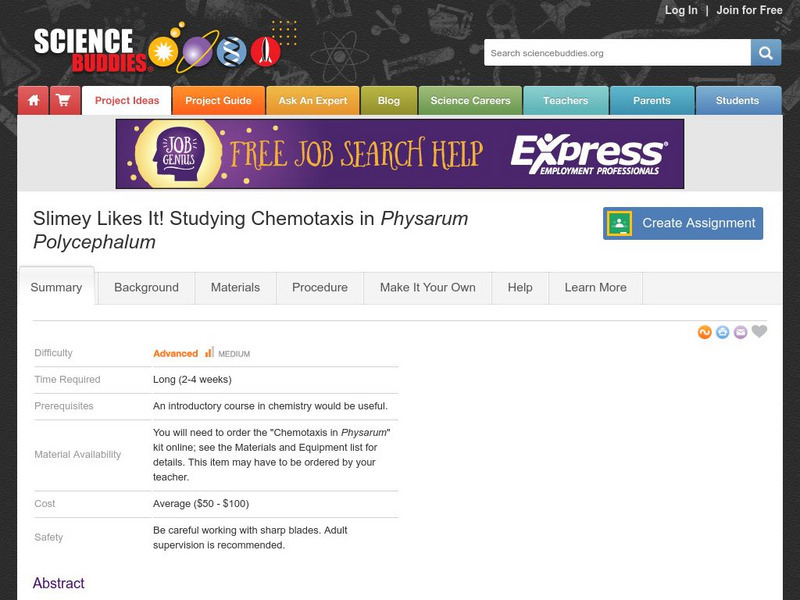
Science Buddies: Slimey Likes It! Studying Chemotaxis in Physarum Polycephalum ActivityScience Buddies: Slimey Likes It! Studying Chemotaxis in Physarum Polycephalum Activity
Publisher
Science Buddies
Resource Details
Curator Rating
Educator Rating
Not yet Rated
Grade
6th - 9th
Subjects
Science
3 more...
Resource Types
Activities & Projects
1 more...
Audiences
For Administrator Use
2 more...
Lexile Measures
1020L
Activity

Science Buddies: Slimey Likes It! Studying Chemotaxis in Physarum Polycephalum

Curated by ACT

In this biology science fair project, test various amounts of glucose to see which ones attract and which repel (chemotaxis) growing Physarum polycephalum slime mold.

3 Views 0 Downloads

Additional Tags

chemotaxis, plant response, science fair projects, slime mold, p. polycephalum, physarum, physarum polycephalum, science buddies, response

Classroom Considerations

  • Knovation Readability Score: 3 (1 low difficulty, 5 high difficulty)

See similar resources:

Lesson Plan

Cystic Fibrosis: A DNA Case Study

K20 LEARN
Around six percent of babies are born with serious genetic disorders. Young scientists learn more about what causes these disorders and the effect they have. They begin with a case study of cystic fibrosis before expanding to research...
9th - 12th Science
CCSS: Adaptable
Instructional Video

Why Mars Rovers Don't Study Water

SciShow
Is it possible to contaminate the planets our astronauts or rovers visit? With current technology, it is impossible to send a completely sterile rover to Mars, and there could be up to 30,000 different microbes on the space traveler!...
4 mins 9th - Higher Ed Science
Instructional Video

Why Study Soil?

Learning Games Lab
Some scientists spend their entire careers analyzing and learning about soils. An interesting video lesson provides an overview of what soil scientists do and why. Pupils learn how soil analysis connects to other branches of science...
4 mins 9th - 12th Career & Technical Education
CCSS: Adaptable
Instructional Video

How Do We Study Living Brains?

TED-Ed
Out of all vertebrates, the largest brain when compared to body size belongs to humans. Studying the working brain presents challenges to scientists. Learn about three of the most common tests used to understand how the living brain...
5 mins 6th - 12th Science
CCSS: Adaptable
Activity

Science Buddies: How Sweet It Is! Measuring Glucose in Your Food

Science Buddies
You know that sugar makes food sweet. But did you know that there are different kinds of sugar? Sucrose is the granulated sugar that you usually use for baking. Another kind of sugar, which is found in honey and in many fruits, is...
9th - 10th Career & Technical Education
Lesson Plan

Peer Review Meets D.I.Y.: Publishing a Student Science Journal

Curated OER
Peer review of science laboratory reports? You bet! First, learners work in pairs to review a scientific article. Then they trade lab reports for peer review. The end result is the publication of a classroom scientific journal!
7th - 12th Science
Interactive

Study Jams! The Rock Cycle

Scholastic
Rock out with a song, video, and quiz about the rock cycle. Learn how it is similar to recycling, the different kinds of rocks, and how they form. There is a karaoke feature that allows learners to sing along, helping to cement the...
3 mins 5th - 8th Science
Interactive

Study Jams! The Senses: Hearing

Scholastic
How does this sound? It's a rockin' video starring two teenage girls talking about music, hearing, and the ear. Listeners hear that the ear does not only gather sound waves, but also helps us maintain balance. They also will get an...
3 mins 4th - 9th Science
CCSS: Adaptable
Interactive

Study Jams! Energy & Matter

Scholastic
After Sam knocks a glass off the lunchroom table, he uses it as a springboard for explaining kinetic and potential energy. He mentions that sound is a type of kinetic energy and introduces the different forms of energy: thermal,...
4 mins 4th - 8th Science
CCSS: Adaptable
Interactive

Study Jams! Population Growth

Scholastic
Along came a spider, who sat down beside her. She screamed, but RJ wouldn't smash it because spiders are a limiting factor for other insects in an ecosystem. In this video, other common limiting factors for populations are listed....
3 mins 6th - 9th Science
CCSS: Adaptable
Try It Free
© 1999-2026 Learning Explorer, Inc.
Teacher Lesson Plans, Worksheets and Resources

Sign up for the Lesson Planet Monthly Newsletter

Open Educational Resources (OER)

  • Health
  • Language Arts
  • Languages
  • Math
  • Physical Education
  • Science
  • Social Studies
  • Special Education
  • Visual and Performing Arts
View All Lesson Plans

Discover Resources

  • Our Review Process
  • How it Works
  • How to Search
  • Create a Collection

Manage Curriculum

  • Edit a Collection
  • Assign to Students
  • Manage My Content
Contact Us Site Map Privacy Policy Terms of Use