Lesson Planet
Search educational resources
  • Sign In Try It Free
  • AI Teacher Tools
    • Discover Resources Search reviewed educational resources by keyword, subject, grade, type, and more
    • Curriculum Manager (My Content) Manage saved and uploaded resources and folders To Access the Curriculum Manager Sign In or Join Now
    • Browse Resource Directory Browse educational resources by subject and topic
    • Curriculum Calendar Explore curriculum resources by date
    • Lesson Planning Articles Timely and inspiring teaching ideas that you can apply in your classroom
    • Our Story
    • Frequently Asked Questions
    • Testimonials
    • Contact Us
  • Pricing
  • School Access
    • Your school or district can sign up for Lesson Planet — with no cost to teachers
      Learn More
  • Sign In
  • Try It Free

Hi, what do you want to do?

Create a lesson plan
Generate resources with 80+ AI teacher tools
Search 200,000 instructional videos
Find a teaching resource
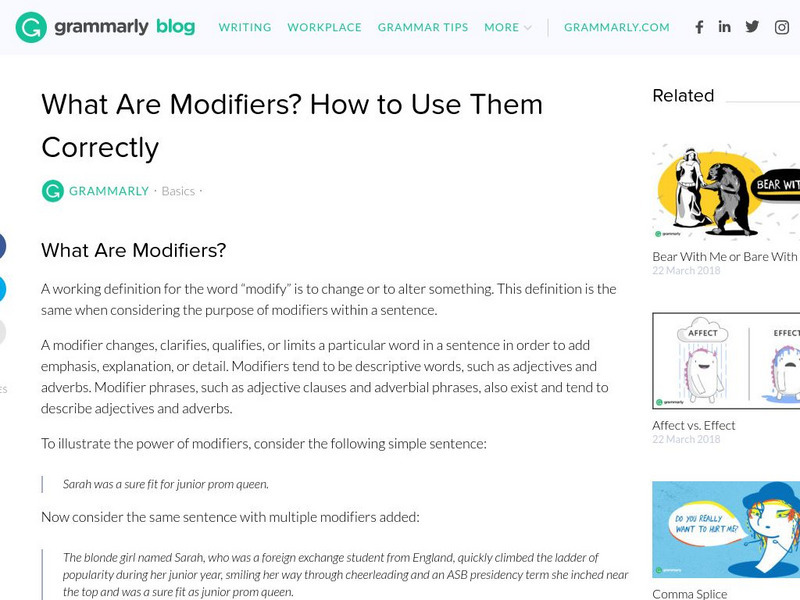
Grammarly Blog: What Are Modifiers? How to Use Them Correctly HandoutGrammarly Blog: What Are Modifiers? How to Use Them Correctly Handout
Publisher
Grammarly
Resource Details
Curator Rating
Educator Rating
Not yet Rated
Grade
9th - 10th
Subjects
English Language Arts
3 more...
Resource Type
Handouts & References
Audiences
For Administrator Use
2 more...
Lexile Measures
1000L
Handout

Grammarly Blog: What Are Modifiers? How to Use Them Correctly

Curated by ACT

This page focuses on modifiers including what modifiers are -- adjectives, adverbs, and descriptive phrases and clauses; misplaced modifiers and how to correct them; and limiting modifiers and how to use them. Examples are provided.

3 Views 1 Download
CCSS: Designed

Concepts

adjectives, adverbs, misplaced modifiers, modifiers

Additional Tags

descriptive phrases, grammar handbook, limiting modifiers, grammarly, what are modifiers

Classroom Considerations

  • Knovation Readability Score: 3 (1 low difficulty, 5 high difficulty)
  • The intended use for this resource is Instructional

Common Core

L.7.1.c L.3.1.g

See similar resources:

Writing

Like Water for Chocolate: How-to Narrative Essay

Curated OER
Connect Laura Esquivel's Like Water for Chocolate to student experience with this how-to narrative essay. Writers weave the instructions from their own family recipe into a narrative using sensory details. This assignment sheet includes...
10th English Language Arts
Handout

Grammarly Blog: Quotation Marks: Rules How to Use Them Correctly

Grammarly
This page focuses on the rules for using quotation marks correctly including general rules, when to use quotation marks; run-in and block quotations; quotation mark rules: quotations and capitalization, quotation marks and other...
9th - 10th English Language Arts
CCSS: Adaptable
Unit Plan

Ted: Ted Ed: How to Use a Semicolon

TED Talks
It may seem like the semicolon is struggling with an identity crisis. It looks like a comma crossed with a period. Maybe that's why we toss these punctuation marks around like grammatical confetti; we're confused about how to use them...
9th - 10th English Language Arts
CCSS: Adaptable
Instructional Video

How to Recognize a Dystopia

TED-Ed
Viewers need not be fans of dystopian literature to be engaged by a short video that traces the development of the genre from Plato to the present. Gulliver's Travels, The Time Machine, The Iron Heel, Brave New World, Animal...
6 mins 9th - 12th English Language Arts
Handout

Grammarly Blog: Blog: Adverbs: What Do Adverbs Modify?

Grammarly
This blog focuses on adverbs, including what they modify, how to find them in sentences, degrees of adverbs, and examples of each.
9th - 10th English Language Arts
CCSS: Adaptable
Handout

Literacy Education Online: How to Use a Thesaurus

The Write Place
A good overview of what a thesaurus is and how best to use one. Also includes the difference between the two forms of thesauri and explains how to choose the correct synonym to use. L.9-10.4c References
9th - 10th English Language Arts
CCSS: Adaptable
Unit Plan

Ted: Ted Ed: How to Write Descriptively

TED Talks
The point of fiction is to cast a spell, a momentary illusion that you are living in the world of the story. But how do writers suck readers into stories in this way? Nalo Hopkinson shares some tips for how to use language to make your...
9th - 10th English Language Arts
CCSS: Adaptable
Lesson Plan

Study.com: How to Use Descriptive Details & Sensory Language in Your Writing

Other
When you write a narrative, you can draw your reader into your experiences by adding specific, concrete details and sensory language to your storytelling. This lesson tells you exactly how to do it. W.9-10.3d Precise/sensory details,...
9th - 10th English Language Arts
CCSS: Adaptable
Instructional Video

How Miscommunication Happens (And How to Avoid It)

TED-Ed
The transactional model of communication is used in this short video to explain how miscommunication happens and to offer suggestions for how to improve listening and communication skills.
5 mins 7th - 12th English Language Arts
Handout

The Write Site: Why & How to Use Sources

University of Sydney (Australia)
This University of Sydney reference explains the importance of using reputable sources in academic writings. Then the site provides steps to follow to assist students with using bibliographic sources. Click on the sections list to...
9th - 10th English Language Arts
CCSS: Adaptable
Try It Free
© 1999-2026 Learning Explorer, Inc.
Teacher Lesson Plans, Worksheets and Resources

Sign up for the Lesson Planet Monthly Newsletter

Open Educational Resources (OER)

  • Health
  • Language Arts
  • Languages
  • Math
  • Physical Education
  • Science
  • Social Studies
  • Special Education
  • Visual and Performing Arts
View All Lesson Plans

Discover Resources

  • Our Review Process
  • How it Works
  • How to Search
  • Create a Collection

Manage Curriculum

  • Edit a Collection
  • Assign to Students
  • Manage My Content
Contact Us Site Map Privacy Policy Terms of Use