Lesson Planet
Search educational resources
  • Sign In Try It Free
  • AI Teacher Tools
    • Discover Resources Search reviewed educational resources by keyword, subject, grade, type, and more
    • Curriculum Manager (My Content) Manage saved and uploaded resources and folders To Access the Curriculum Manager Sign In or Join Now
    • Browse Resource Directory Browse educational resources by subject and topic
    • Curriculum Calendar Explore curriculum resources by date
    • Lesson Planning Articles Timely and inspiring teaching ideas that you can apply in your classroom
    • Our Story
    • Frequently Asked Questions
    • Testimonials
    • Contact Us
  • Pricing
  • School Access
    • Your school or district can sign up for Lesson Planet — with no cost to teachers
      Learn More
  • Sign In
  • Try It Free
Edutopia: Teaching Your Students How to Have a Conversation Professional DocEdutopia: Teaching Your Students How to Have a Conversation Professional Doc
Publisher
Edutopia
Resource Details
Curator Rating
Educator Rating
Not yet Rated
Grade
Pre-K - 1st
Subjects
English Language Arts
4 more...
Resource Type
Professional Documents
Audiences
For Administrator Use
1 more...
Lexile Measures
1250L
Professional Doc

Edutopia: Teaching Your Students How to Have a Conversation

Curated by ACT

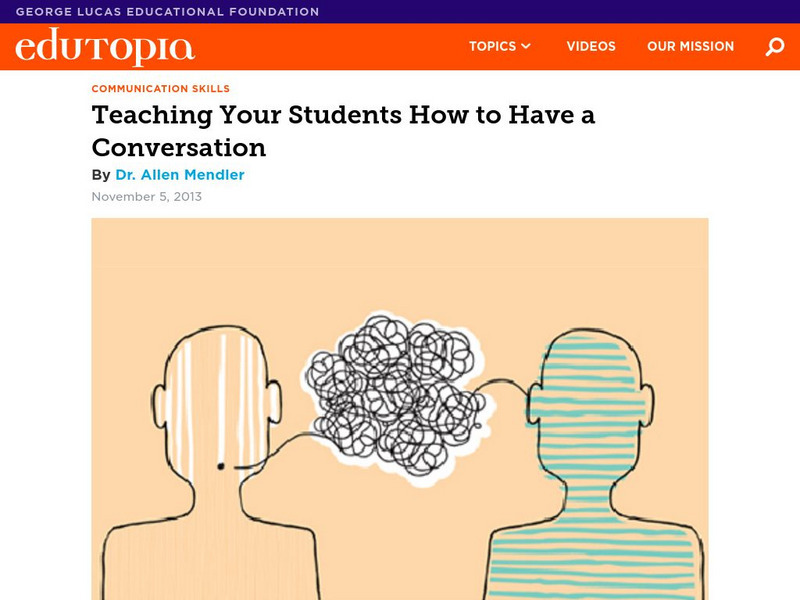
While it is impossible to know all of the reasons, there is no doubt that learning to listen and talk is an extremely important way to broaden knowledge, enhance understanding and build community. Perhaps this is why the core standards in English-language arts include an important emphasis on developing speaking and listening, the basic tools for conversation. This article discusses 8 tips for speaking and listening that can be used regularly to help your kids learn good conversational skills. CCSS.ELA-Literacy.CCRA.SL.1

3 Views 2 Downloads
CCSS: Adaptable

Additional Tags

conversation, discussion, follow agreed-upon rules for discussions and carry out assigned roles, pose and respond to specific questions by making comments that contribute to the discussion and elaborate on the remarks of others, 2.2.1 engage in extended, reciprocal conversations with familiar adults., ccss.ela, ccss.ela-literacy.ccra.sl.1, edutopia, edutopia: teaching your students how to have a conversation css.ela-literacy.ccra.sl.1, edutopia: teaching your students how to have a conversation sl.5.1.b, sl.5.1.c, sl.6.1.c, oh.ela-literacy.sl.k.1b continue a conversation through multiple exchanges., sl.5.1.b, sl.5.1.c, sl.6.1.c, teaching your students how to have a conversation, teaching your students how to have a conversation css.ela-literacy.ccra.sl.1, eight tips for conversation, having a conversation

Classroom Considerations

  • Knovation Readability Score: 4 (1 low difficulty, 5 high difficulty)
  • The intended use for this resource is Instructional

Common Core

SL.3.1.b SL.5.1.b SL.5.1.c SL.6.1.c CCRA.SL.1 SL.2.1.a SL.2.1.b SL.K.1.a SL.1.1.a SL.1.1.c SL.2.1.c SL.K.1.b SL.7.1.c

View 2,244 other resources for Pre-K - 1st Grade Classroom Support

© 1999-2026 Learning Explorer, Inc.
Teacher Lesson Plans, Worksheets and Resources

Sign up for the Lesson Planet Monthly Newsletter

Open Educational Resources (OER)

  • Health
  • Language Arts
  • Languages
  • Math
  • Physical Education
  • Science
  • Social Studies
  • Special Education
  • Visual and Performing Arts
View All Lesson Plans

Discover Resources

  • Our Review Process
  • How it Works
  • How to Search
  • Create a Collection

Manage Curriculum

  • Edit a Collection
  • Assign to Students
  • Manage My Content
Contact Us Site Map Privacy Policy Terms of Use