Hi, what do you want to do?






Khan Academy
Khan Academy: Alkane and Cycloalkane Nomenclature I
A video introducing the IUPAC Nomenclature System to understand how to name organic molecules. [12:40]

Khan Academy
Khan Academy: Conformations of Alkanes: Newman Projections
Learn about three-dimensional representations of conformational relationships call Newman Projections in this video. Video will give several examples of how to draw these structure. [14:22]

Khan Academy
Khan Academy: Chair and Boat Shapes for Cyclohexane
A video lecture that discovers what a cyclohexane molecule would look like in three dimensions. [12:28]

Khan Academy
Khan Academy: Functional Groups
Learn about the common functional groups found in organic chemistry in this video. Understand that functional groups are group of atoms that have predictable chemical behavior. [7:22]

Khan Academy
Khan Academy: Introduction to Chirality
In this video lecture learn the meaning of chiral and how molecules and atoms are chiral. [6:45]

Khan Academy
Khan Academy: Stereochemistry: Drawing Enantiomers
A video lecture exploring how to draw enantiomers. Understand that enantiomers are chiral molecules that are mirror images of each other. [9:29]

Khan Academy
Khan Academy: Stereochemistry
A video dedicated to looking at how pair of molecules are related. This video will define and give examples of the following terms: stereoisomers, enantiomers, diastereomers, constitutional isomers, and meso compounds. [13:35]

Khan Academy
Khan Academy: Substitution and Elimination Reactions: Free Radical Reactions
Investigate atoms, molecules or ions that have an unpaired valence electrons called free radicals in this video. Learn how this unpaired electron makes them highly reactive. [13:44]
Khan Academy
Khan Academy: Substitution and Elimination Reactions: Nucleophilicity
A video exploring the definition of nucleophilicity. Learn that nucleophilicity is the ability of an atom, ion, or molecule to lose their extra electron and bond. Also the video explains how to find the strength of the nucleophile. [13:54]

Khan Academy
Khan Academy: Substitution and Elimination Reactions: E2 Reactions
Learn about the one-step organic reaction in this video lecture. Lecture reviews how two substituents are removed from the molecule. [8:52]

Khan Academy
Khan Academy: Comparing E2, E1, Sn2, Sn1 Reactions
A video showing you how you can classify a reaction as either E2, E1, Sn2 or Sn1. Video compares the reactions as well as suggests a mechanism by which the reaction may occur. [12:25]

Khan Academy
Khan Academy: Nucleophile/electrophile and the Swartz Rules
A video lecture introduction to the definition of nucleophile, electrophile, and the Swartz Rule. Learn how nucleophile and electrophile interact. Also described is Swartz Rule's which lists the five most important concepts to understand...
Khan Academy
Khan Academy: Alkenes and Alkynes: Naming Alkenes Examples
A video giving examples of how to name alkenes. [8:26]
Khan Academy
Khan Academy: Introduction to Reaction Mechanisms
A video lecture explaining what happens in an addition reaction to an alkene. [11:21]
Khan Academy
Khan Academy: Alkene Intro and Stability
Learn about the organic molecule that contains at least one carbon-carbon double bond called alkene in this video. Understand what this stable molecule looks like with the examples in this video. [8:48]
Khan Academy
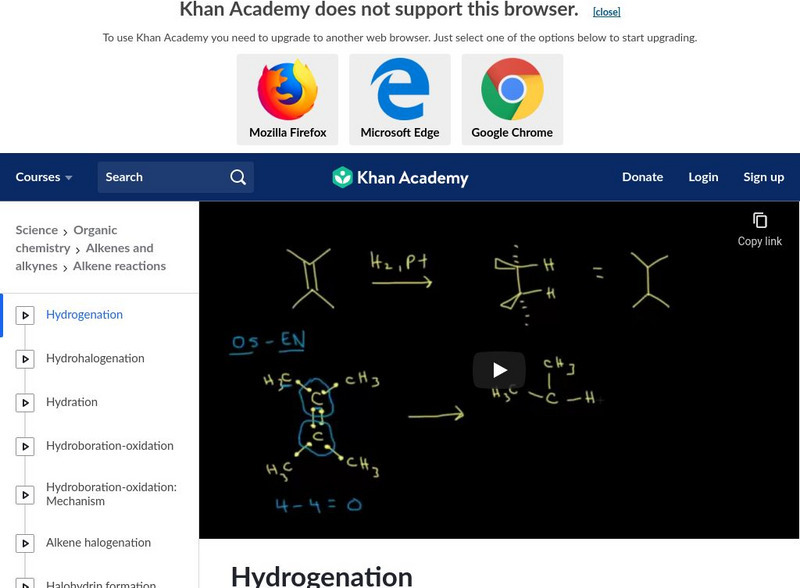
Khan Academy: Alkenes and Alkynes: Alkene Reactions: Hydrogenation
Get an inside look at the reaction to hydrogenate an alkene in this video. Learn how this reaction is a syn addition of hydrogen. Also look at the oxidation numbers and stereochemistry that result. [11:41]

Khan Academy
Khan Academy: Preparation of Alcohols Using Na Bh4
Understand the general reaction of a carbonyl compound, sodium borohydride, to prepare alcohols with this video. Video gives you several examples to show how alcohols are produced and whether the reaction is oxidized or reduced. [12:35]
Khan Academy
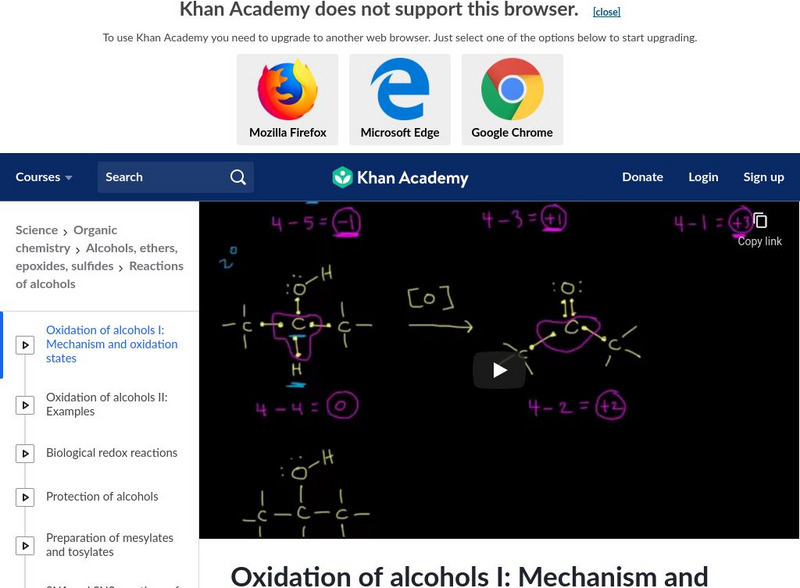
Khan Academy: Oxidation of Alcohols I: Mechanism and Oxidation States
A video investigation of what it takes to oxidize alcohols. Video gives examples of how to calculate oxidation states by using electronegativity differences. Also learn what is formed as alcohols are oxidized. [12:37]

Khan Academy
Khan Academy: Ether Naming and Introduction
This video gives examples of how to name ether. [10:58]

Khan Academy
Khan Academy: Williamson Ether Synthesis
Video gives an example for how the Williamson Ether Synthesis works. Learn how by starting with an alcohol and adding a strong base to deprotonate it then adding an alkyl halide an ether is form. [7:08]

Khan Academy
Khan Academy: Ring Opening Reactions of Epoxides: Strong Nucleophiles
Understand the ring opening reactions of epoxides using a strong nucleophile in this video. Video will give several examples of this reaction to allow you to understand the steps. [14:06]

Khan Academy
Khan Academy: Preparation of Sulfides
A video showing how to prepare sulfides from thiols. [6:58]

Khan Academy
Khan Academy: Diels Alder Reaction
Learn how to draw the products of a Diels-Alder reaction in this video. [8:01]

Khan Academy
Khan Academy: Naming Benzene Derivatives
Did you know that 99 % of the aromatic compounds are either benzene or derived from benzene? This video will help you become familiar with the naming of the benzene molecules. [8:39]