Hi, what do you want to do?






NOAA
Please Pass the Salt
Salinity is the focus of two experimenters that work to answer the question, How does salt change the physical properties of water? Super scientists compare the freezing rate of salt and fresh water, combine the two waters to...

US Environmental Protection Agency
Aquifer in a Cup
Young scientists create their very own aquifers in this science lesson on ground water. After learning about how some people get their drinking water from underground wells, young learners use sand, modeling clay, and aquarium rocks to...

Illustrative Mathematics
Make 9
Learning how numbers are put together as parts and wholes is a big step in building the foundational number sense of young mathematicians. Here, children are given a number less than 10 and are asked to find as many pairs of numbers as...

Teach Engineering
Preconditioning Balloons: Viscoelastic Biomedical Experiments
What does stretching a balloon have to do with equilibrium? Groups explore preconditioning by stretching a balloon to a point of equilibrium. They then measure the amount of force required to stretch the balloon to the same point several...

Illustrative Mathematics
Rectangle Perimeter 3
This activity looks at writing expressions to represent perimeter of a rectangle and then considers the concept of equivalent expressions and the distributive property in more detail.

Learning Wave Communications
Learning Wave: Additive Property of Zero
Properties of zero are presented in detail, with a word problem that demonstrates the additive inverse property and the additive identity property of zero.
The Math League
The Math League: Whole Numbers & Basic Properties
Here is a nice resource for students and teachers about whole numbers and their basic properties. It provides links to information on place value, expanded form, and rounding numbers are just a few of the topics on this page.
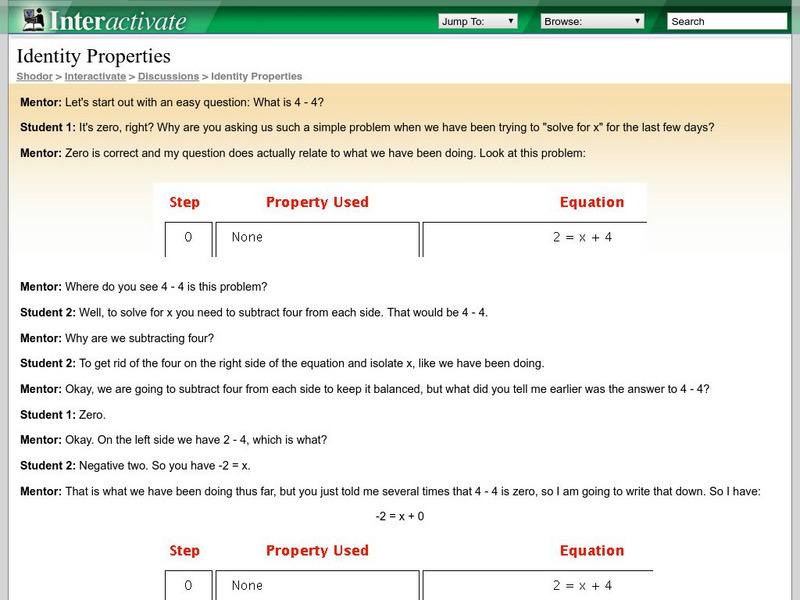
Shodor Education Foundation
Shodor Interactivate: Identity Properties
The resource consists of a discussion between a mentor and two students about how to use additive and multiplicative identity and inverse properties. Examples and explanations of each are included.
Purple Math
Purplemath: Basic Number Properties: Associative, Commutative, and Distributive
This Purplemath lesson includes many different number properties explained by using examples.