Hi, what do you want to do?





University of Colorado
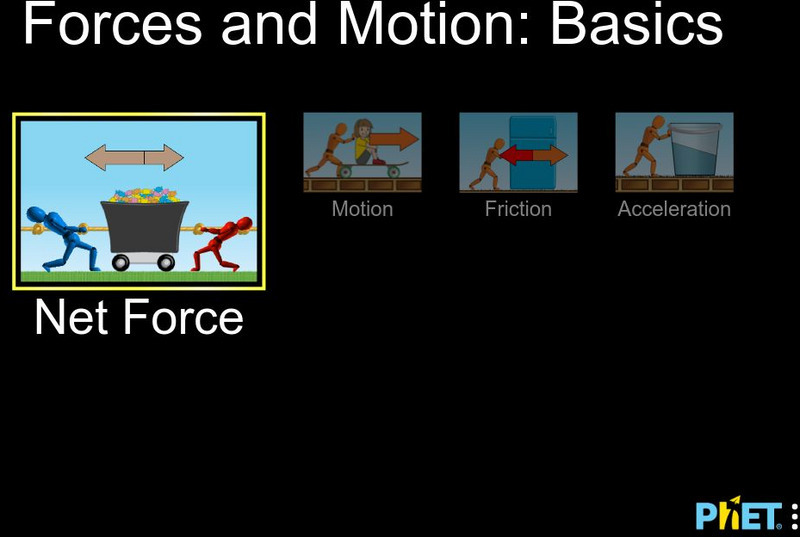
University of Colorado: Ph Et Interactive Simulations: Forces and Motion: Basics
Explore the forces at work when pulling against a cart, and pushing a refrigerator, crate, or person. Create an applied force and see how it makes objects move. Change friction and see how it affects the motion of objects.
University of Colorado
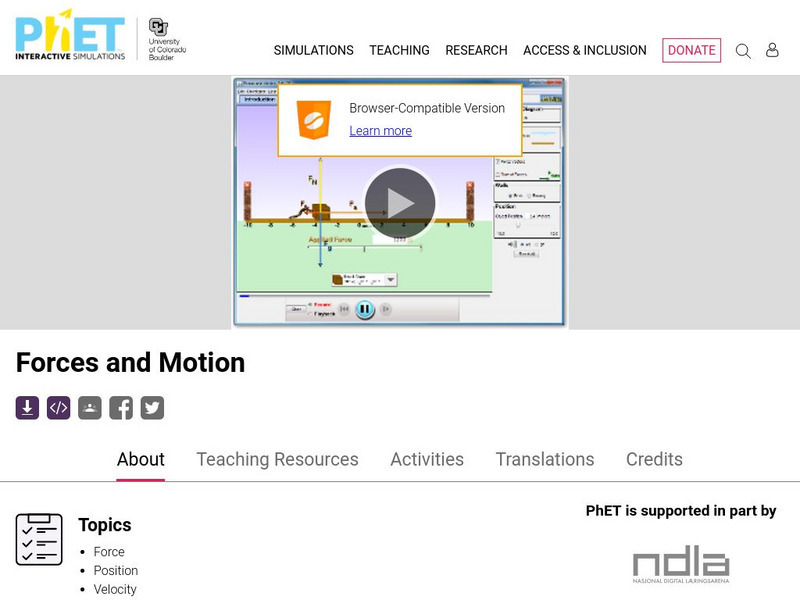
University of Colorado: Ph Et Interactive Simulations: Forces and Motion
Explore the forces at work when you try to push a filing cabinet. Create an applied force and see the resulting friction force and total force acting on the cabinet. Charts show the forces, position, velocity, and acceleration vs. time.
OpenStax
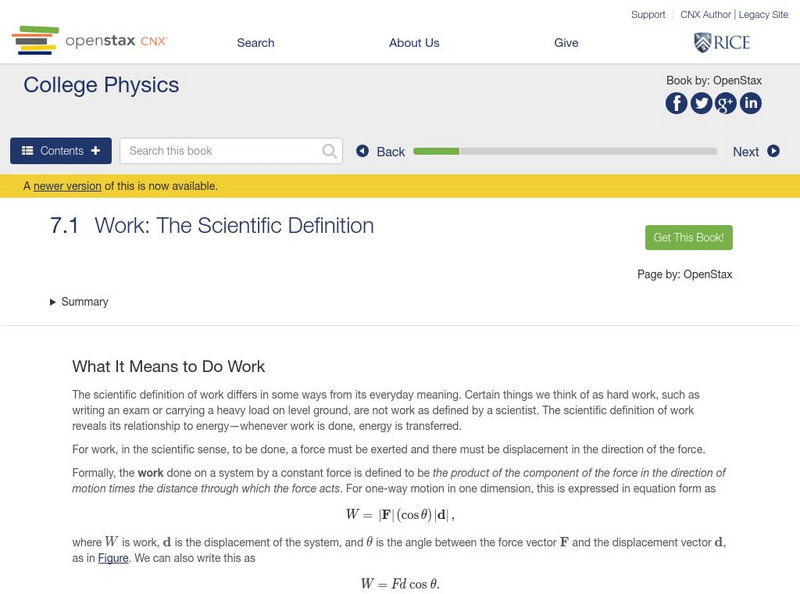
Open Stax: Work: The Scientific Definition
In the following interactive students will begin to explain how an object must be displaced for a force on it to do work. They will also explain how relative directions of force and displacement determine whether the work done is...

Scholastic
Scholastic: Study Jams! Science: Force and Motion: Simple Machines
A slideshow and a short quiz on simple machines and how they reduce the amount of work or effort needed to complete a task.
OpenStax
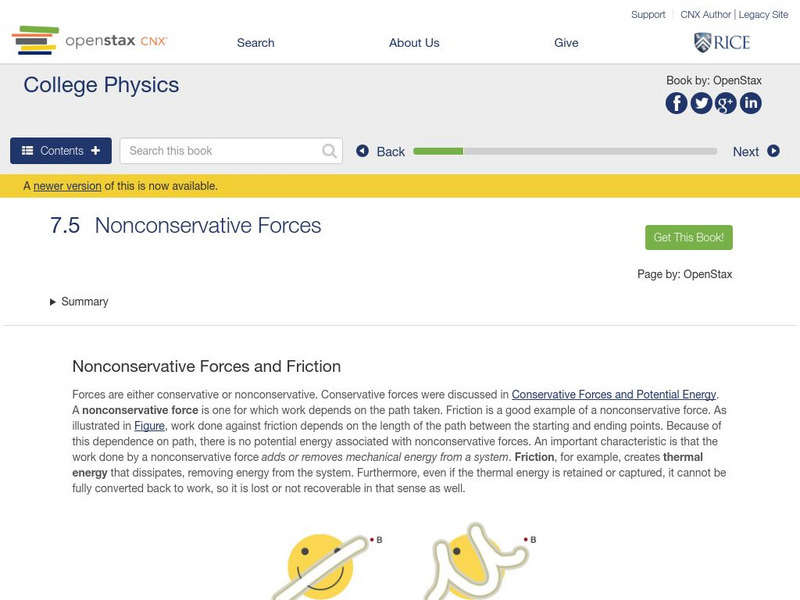
Open Stax: Nonconservative Forces
In the following interactive students will begin to define nonconservative forces and explain how they affect mechanical energy. They will show how the principle of conservation of energy can be applied by treating the conservative...

Physics Classroom
The Physics Classroom: Work, Energy, and Power: Application/practice Questions
Through illustrated examples and practice problems, students apply the relationship between work and mechanical energy change to a variety of motion scenarios in order to test our understanding.
Concord Consortium
The Concord Consortium: Molecular Workbench: Forces and Systems
See how motion is converted and the energy associated with the motion is used to do work.
Physics Classroom
The Physics Classroom: Work, Energy, and Power: Mechanical Energy Is Conserved
In this interactive exercise, explore the quantitative relationship between work and mechanical energy in situations in which there are no external forces doing work.

Ducksters
Ducksters: Physics for Kids: Motion Glossary and Terms
Kids learn about glossary and terms in the science of physics and motion. Definitions for words such as momentum, force, work, energy, gravity, scalar, vector, power, and more.
PBS
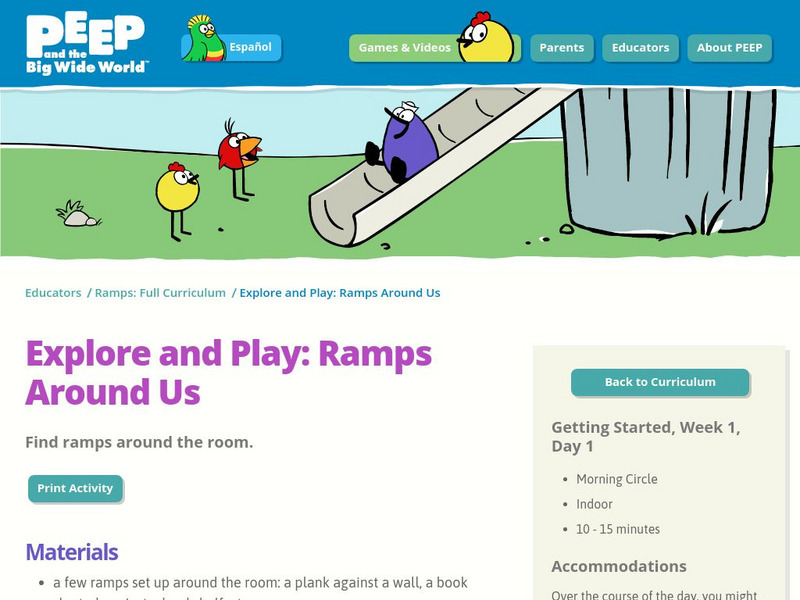
Wgbh: Peep and the Big Wide World: Explore and Play: Ramps Around Us
Set up several ramps around the room and allow the students to explore and investigate how they work.
Texas Education Agency
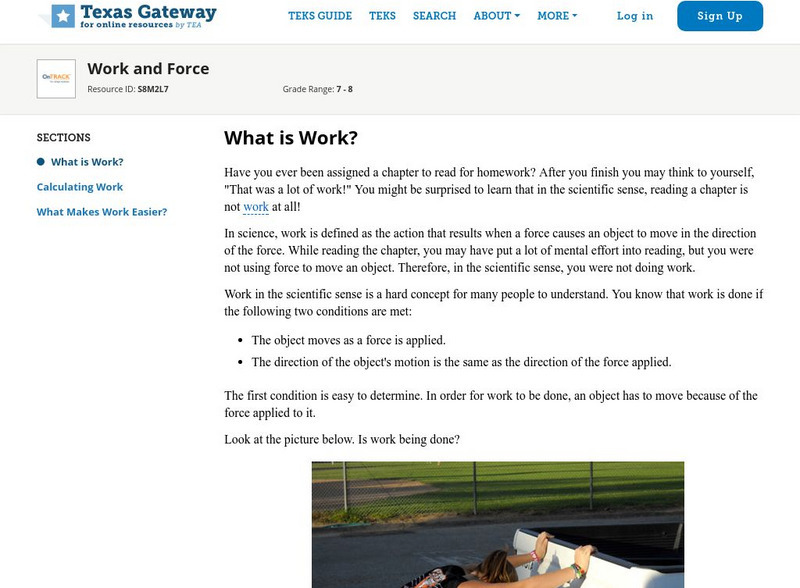
Texas Gateway: What Is Work?
Have you ever been assigned a chapter to read for homework? After you finish you may think to yourself, "That was a lot of work!" You might be surprised to learn that in the scientific sense, reading a chapter is not work at all!In...
Texas Education Agency
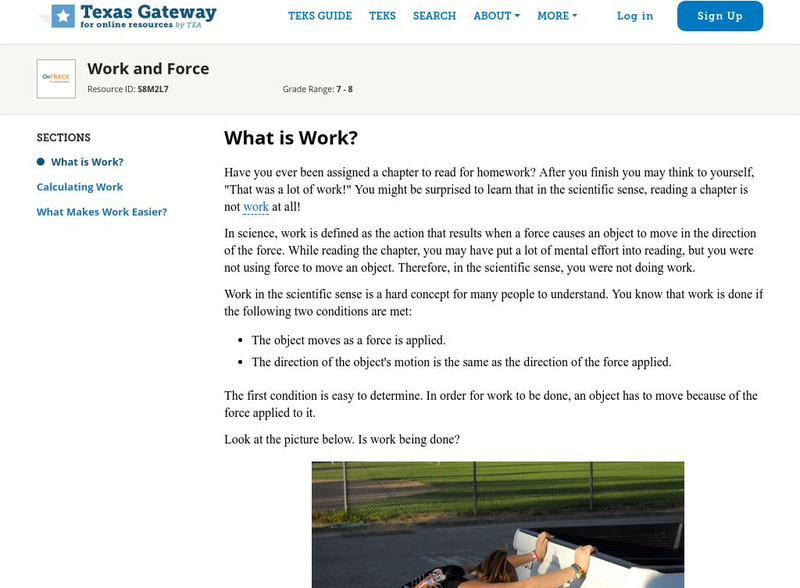
Texas Gateway: Work and Force
Given descriptions, illustrations, graphs, or charts, students will contrast situations where work is done with different amounts of force to situations where no work is done, such as moving a box with a ramp and without a ramp or...
SRI International
Performance Assessment Links in Science: Observing Objects
This is a performance task for Grade Four students where they observe two different pendulums and compare the two types of motion. The activity is designed for a lab setting where students work at individual stations. A rubric and...
TeachEngineering
Teach Engineering: Energy of Motion
By taking a look at the energy of motion all around us, students learn about the types of energy and their characteristics. They first learn about the two simplest forms of mechanical energy: kinetic and potential energy, as illustrated...
Sophia Learning
Sophia: Work & Impulse
This lesson explains the similarities and differences between work and impulse.

Scholastic
Scholastic: Study Jams! Science: Our Solar System: Gravity & Inertia
A video and a short multiple-choice quiz on the topic of gravity and inertia, and how they work together to keep objects from floating off into space.
CK-12 Foundation
Ck 12: Work
[Free Registration/Login may be required to access all resource tools.] In this online lesson students will learn to calculate work and explain how it relates to the overarching idea of energy.
Science Education Resource Center at Carleton College
Serc: Using Your Marbles: Making Energy Work for You
This activity is based on the common experiment of running a marble down a ramp to do work on a cup. Young scholars will be able to see the relationship between mass and energy of the marble and the ramp height.

Other
Pdn and Kodak Professional: Migrations: Humanity in Transition
Displays images by photojournalist, Sebastian Salgado, on immigrants in motion "seeking survival and a better life - one individual at a time, one family at a time, from field to town to city, and across national boundaries"....

Concord Consortium
Concord Consortium: Stem Resources: Building a Bungee Jump
Students are asked to create a bungee jump that will protect a hard-boiled egg from breaking. A force sensor is needed to measure the push/pull forces on the egg. Data is inserted into force-time graphs. After completing three...
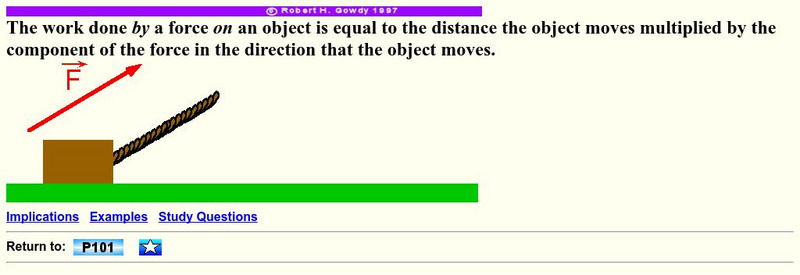
Virginia Commonwealth University
Virginia Commonwealth Univ.: Work Definitions
This site from the Virginia Commonwealth University gives good information on the definition of work using nice graphics and interactive questions. Immediate feedback on student answers is provided.
Cornell University
Cornell University: Cornell Center for Materials Research: Friction
A collection of experiments where learners can learn about how friction works and affects the physical world. At the end, students design a tortoise to win by slowing it down using friction. Lesson includes explanation of the concept of...

Khan Academy
Khan Academy: What Is Newton's Second Law?
Learn about the fact that forces cause acceleration in this article about Newton's Second Law. Includes examples and worked examples of problems.
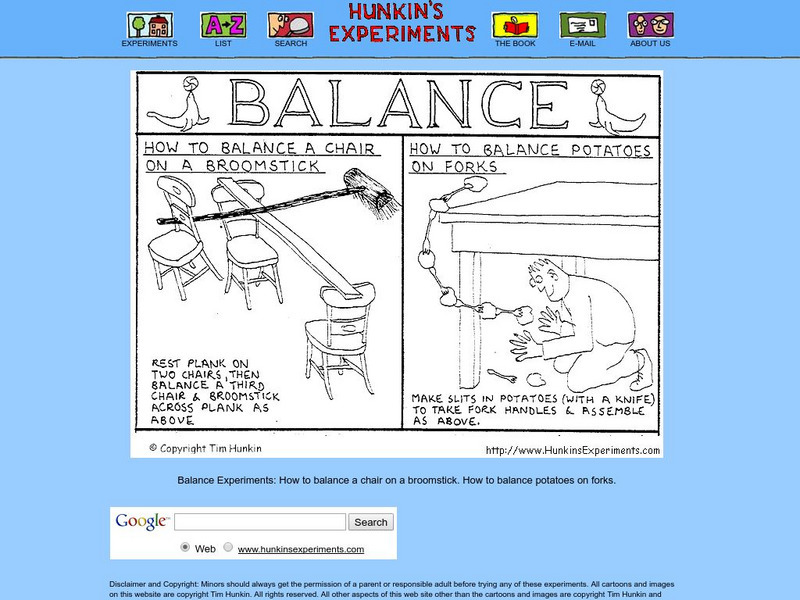
Hunkins Experiments
Hunkin's Experiments: Balance
Hunkin's Experiments is a group of simple cartoon illustrations of scientific principles. Some would work well in the classroom, but others have little value beyond entertaining students. All of the projects are easy to do. This pair of...