Hi, what do you want to do?






Ducksters
Ducksters: Physics for Kids: Simple Machines
Kids learn about the science behind simple machines such as levers, wheels, pulleys, inclined planes, and screws. How they work together to make complex machinery.
TeachEngineering
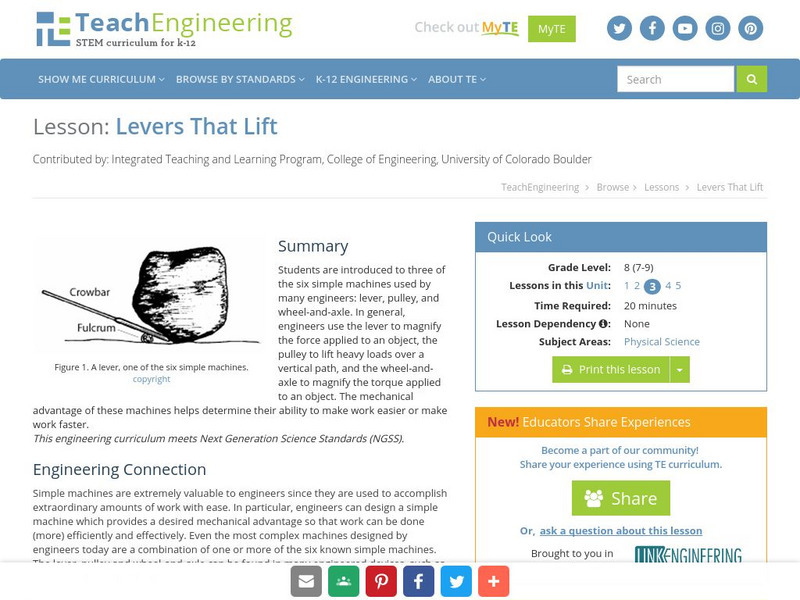
Teach Engineering: Levers That Lift
This lesson introduces students to three of the six simple machines used by many engineers: the lever, the pulley, and the wheel-and-axle. In general, engineers use the lever to magnify the force applied to an object, the pulley to lift...

Science Struck
Science Struck: Simple Machines: The Wedge
Explains how a wedge works, the formula for calculating its mechanical advantage, and some common applications of wedges.
Science Struck
Science Struck: Simple Machine: Levers
Explains what a lever is, its history, how it works, the formula for calculating its mechanical advantage, classes of levers, and uses of levers.
Science Struck
Science Struck: Simple Machines: Pulley Systems
Describes some history of the pulley, how it works, the formula for calculating its mechanical advantage, types of pulley systems, and some applications of pulleys.
Science Struck
Science Struck: Simple Machine: All About the Wheel and Axle
Describes some history of the wheel and axle, how it works, the formula for calculating its mechanical advantage, and some applications of the wheel and axle.
Read Works
Read Works: Machines Can Move
[Free Registration/Login Required] An informational text about simple machines people use every day. A question sheet is available to help students build skills in reading comprehension.
Read Works
Read Works: Machines Can Move!
[Free Registration/Login Required] An informational text about simple machines used in daily life such as: a pulley, a screw, an inclined plane, a wheel and axle, a wedge, and a lever. A question sheet is available to help students build...
TeachEngineering
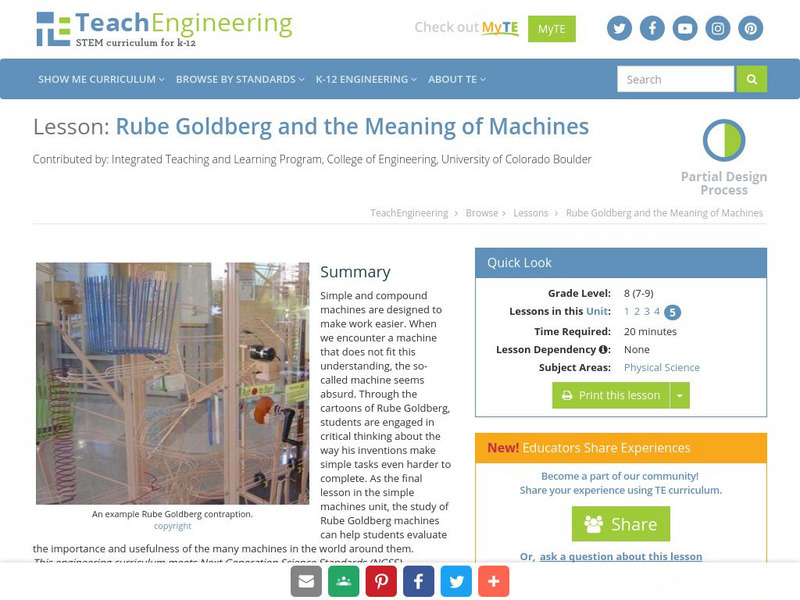
Teach Engineering: Rube Goldberg and the Meaning of Machines
Simple and compound machines are designed to make work easier. When we encounter a machine that does not fit this understanding, the so-called machine seems absurd. For this lesson, the cartoons of Rube Goldberg are introduced and engage...
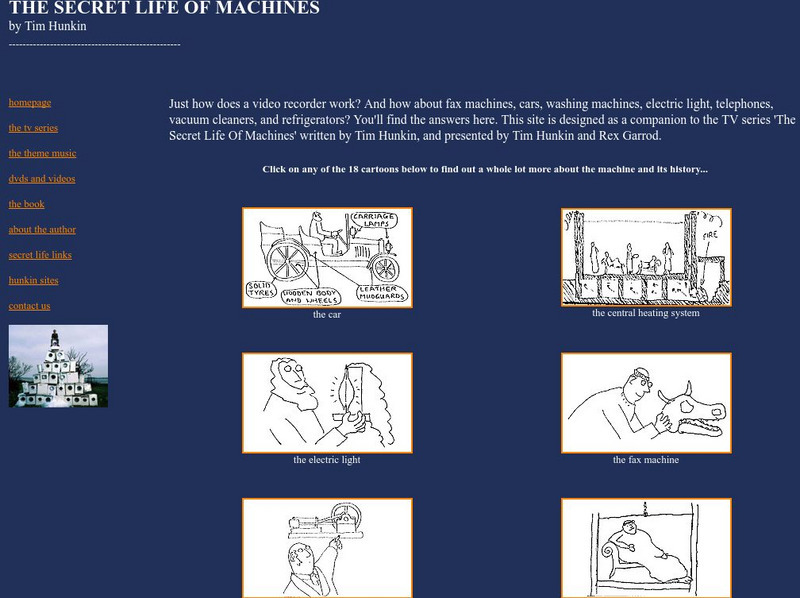
Hunkins Experiments
The Secret Life of Machines
An entertaining site that communicates ideas through cartoon drawings. Discover how simple machines and gadgets operate, such as fax machines and washing machines.
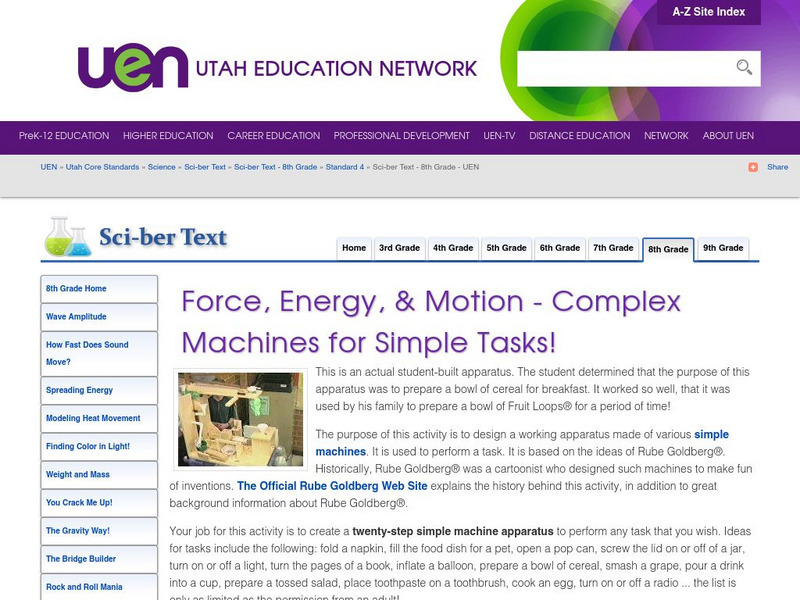
Utah Education Network
Uen: Force, Energy, and Motion: Complex Machines for Simple Tasks!
Designed for Grade Eight, this collection of lessons provides information, examples and quizzes related to simple machines. Elementary students studying this topic will find this site informative as well.
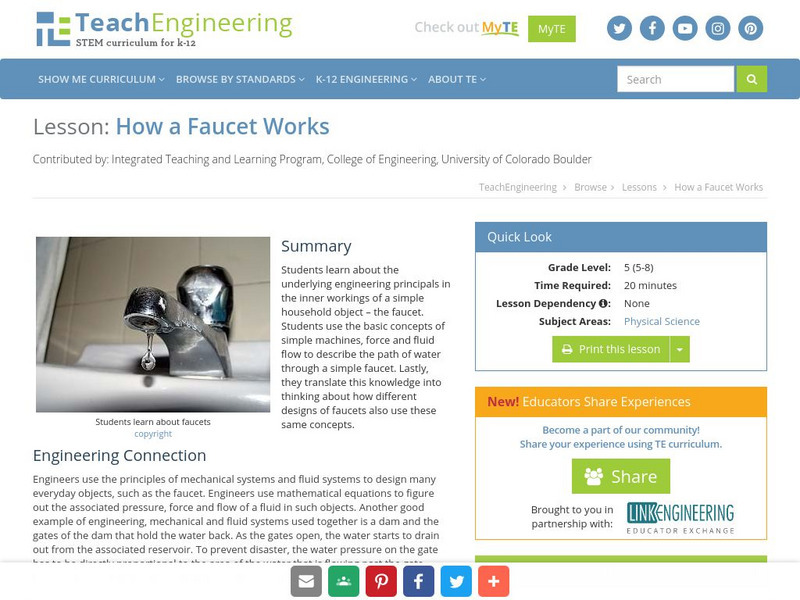
TeachEngineering
Teach Engineering: How a Faucet Works
Students learn about the underlying engineering principals in the inner workings of a simple household object - the faucet. Students use the basic concepts of simple machines, force and fluid flow to describe the path of water through a...
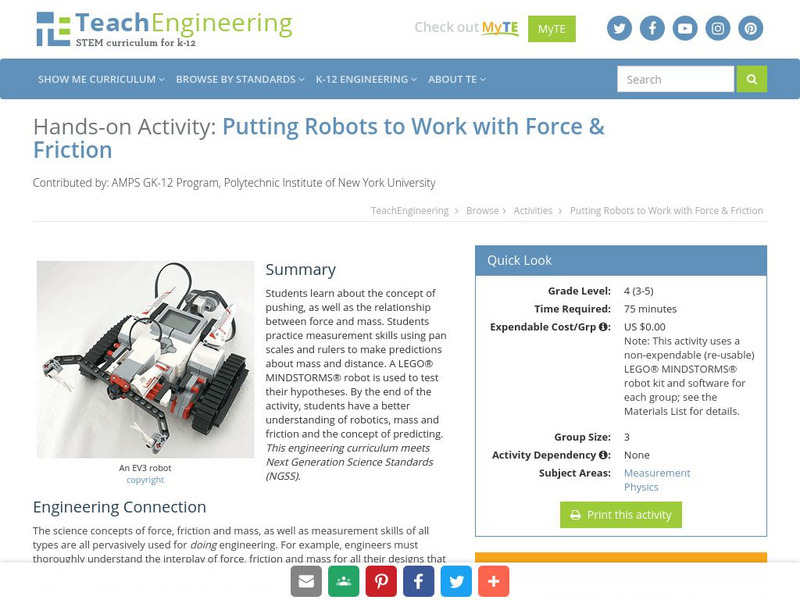
TeachEngineering
Teach Engineering: Putting Robots to Work With Force & Friction
Students learn about the concept of pushing, as well as the relationship between force and mass. Students practice measurement skills using pan scales and rulers to make predictions about mass and distance. A LEGO MINDSTORMS NXT robot is...
Museum of Science
Museum of Science and Industry: Online Science: Build a Lever
Step-by-step illustrated instructions for an experiment investigating how a lever works. An explanation of the science involved is given at the end.

Scholastic
Scholastic: Dirtmeister's Science Reporters: Simple Machines
Simple machines are listed and defined. The page is part of a larger science investigation project.
Other
Mechanical Systems
A collection of resources on how humans use machines and tools to meet their needs. Covers simple and complex machines, subsystems that transfer forces, mechanical advantage, speed ratio, the effect of friction, efficiency, the science...
TeachEngineering
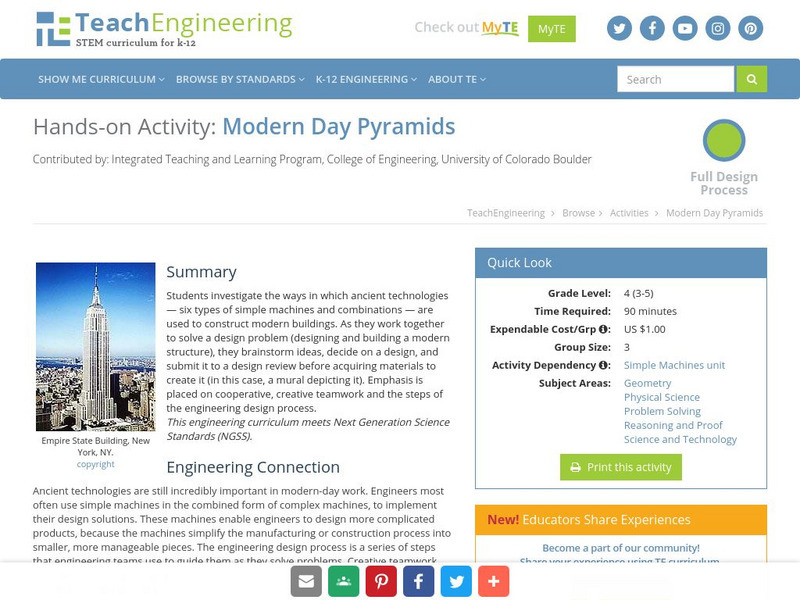
Teach Engineering: Modern Day Pyramids
Students investigate the ways in which ancient technologies - six types of simple machines and combinations - are used to construct modern buildings. As they work together to solve a design problem (designing and building a modern...
Utah Education Network
Uen: Trb 3:3 Investigation 3 Weighty Mistakes
Understand the concept of "work" and the use of levers.
TryEngineering
Try Engineering: Simple Kitchen Machines
Team lesson plan focuses on the different types of simple machines, how they work, and how they can be found in daily life.

ClassFlow
Class Flow: Simple Machines
[Free Registration/Login Required] Simple machines are all around and make many of the jobs we do easier. Investigate the six simple machines and how they help you work. Discover how they reduce the amount of force we use or can change...
Science and Mathematics Initiative for Learning Enhancement (SMILE)
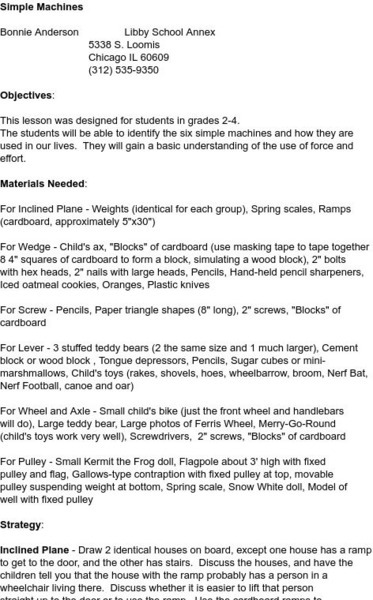
Smile: Simple Machines
Good combination of teacher demonstration and student interaction for this simple machine lesson. Great for talking about force and work. Plans are for grades 2-4, yet are adaptable.
Scholastic
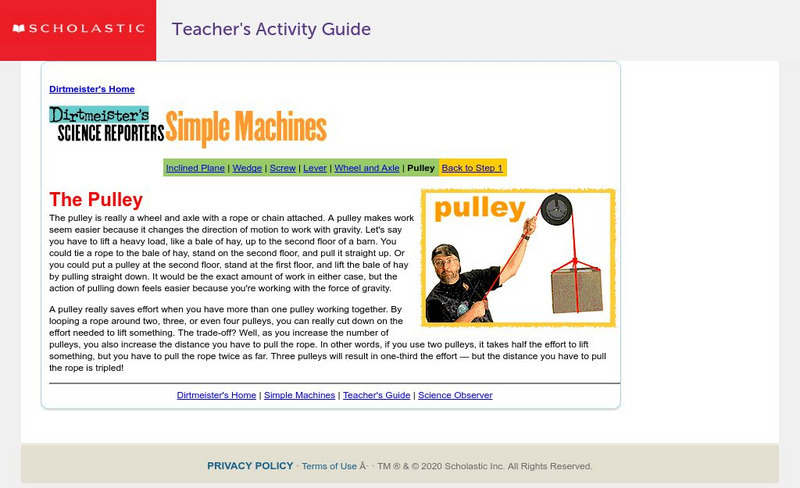
Scholastic: Dirtmeister's Science Reporters: Simple Machines: Pulley
With-it explanation of how the pulley works, where it's found. Most interesting, as Scholastic material usually is.
TeachEngineering
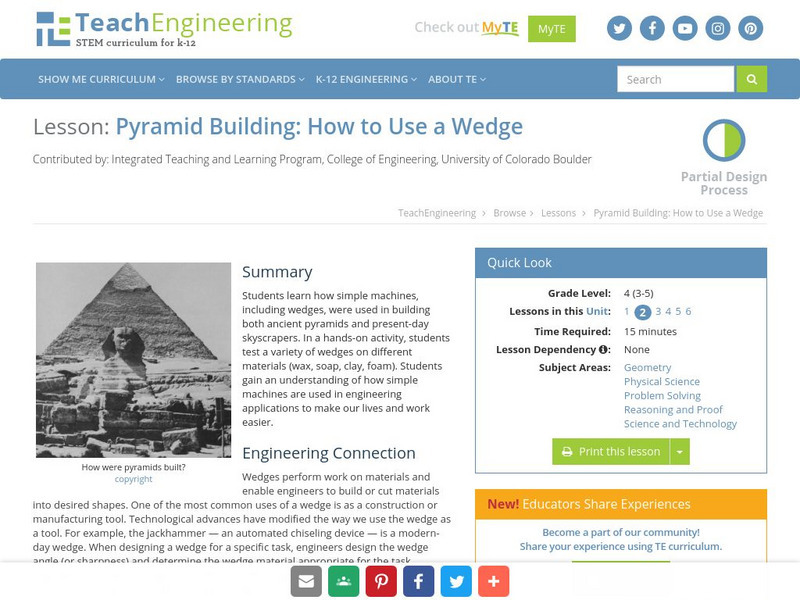
Teach Engineering: Pyramid Building: How to Use a Wedge
Students learn how simple machines, including wedges, were used in building both ancient pyramids and present-day skyscrapers. In a hands-on activity, students test a variety of wedges on different materials (wax, soap, clay, foam)....

Science Education Resource Center at Carleton College
Serc: Construction of a Complex Machine Through Classroom Collaboration
Students take a simple task and make it much more complicated using a cardboard box. Each group must use a minimum of six simple machines utilizing at least four types of simple machines. The goal is to keep the initial impulse moving...