
Curated OER
Mechanically Inclined
Eighth graders examine the mechanical advantage of an inclined plane through experimentation.

Curated OER
Picture a Business
Young scholars create helpful books about local businesses to show what resources are available to their community.

TryEngineering
Try Engineering: Simple Machines
The purpose of this lesson is to learn about the different types of simple machines and their uses. PDF (requires Adobe Reader) and RTF (requires Word or Notebook).
TeachEngineering
Teach Engineering: Just Plane Simple
This lesson introduces young scholars to three of the six simple machines used by many engineers. These machines include the inclined plane, the wedge and the screw. In general, engineers use the inclined plane to lift heavy loads, the...
TeachEngineering
Teach Engineering: Engineering: Simple Machines
Simple machines are devices with few or no moving parts that make work easier. Students are introduced to the six types of simple machines - the wedge, wheel and axle, lever, inclined plane, screw, and pulley - in the context of the...
TeachEngineering
Teach Engineering: Not So Simple
Students expand upon their understanding of simple machines with an introduction to compound machines. A compound machine - a combination of two or more simple machines - can affect work more than its individual components. Engineers who...
Other
Ontario Council for Technology Education: Designing and Testing a Crane [Pdf]
By the end of this project, students will be familiar with the 6 different simple machines and will be able to identify how these machines are used in products and tools they use on a daily basis. They will investigate how mechanical...
TeachEngineering
Teach Engineering: The Advantage of Machines
In this lesson, students learn about work as defined by physical science and see that work is made easier through the use of simple machines. Already encountering simple machines everyday, students will be alerted to their widespread...
NASA
Nasa: Simple Machines
A lesson plan site that contains activities designed to give grades 3 and 4 experiences in using simple machines.
TeachEngineering
Teach Engineering: Levers That Lift
This lesson introduces young scholars to three of the six simple machines used by many engineers: the lever, the pulley, and the wheel-and-axle. In general, engineers use the lever to magnify the force applied to an object, the pulley to...
TeachEngineering
Teach Engineering: Rube Goldberg and the Meaning of Machines
Simple and compound machines are designed to make work easier. When we encounter a machine that does not fit this understanding, the so-called machine seems absurd. In this lesson, the cartoons of Rube Goldberg are introduced and engage...
TeachEngineering
Teach Engineering: How a Faucet Works
Students learn about the underlying engineering principals in the inner workings of a simple household object - the faucet. Students use the basic concepts of simple machines, force and fluid flow to describe the path of water through a...
Utah Education Network
Uen: Trb 3:3 Investigation 3 Weighty Mistakes
Understand the concept of "work" and the use of levers.
TryEngineering
Try Engineering: Simple Kitchen Machines
Team lesson focuses on the different types of simple machines, how they work, and how they can be found in daily life.
Science and Mathematics Initiative for Learning Enhancement (SMILE)
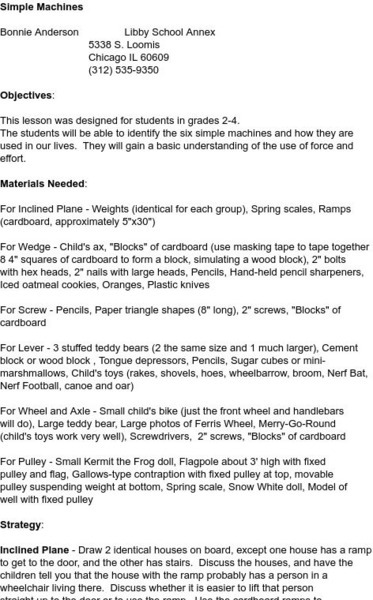
Smile: Simple Machines
Good combination of teacher demonstration and student interaction for this simple machine lesson plan. Great for talking about force and work. Plans are for grades 2-4, yet are adaptable.
TeachEngineering
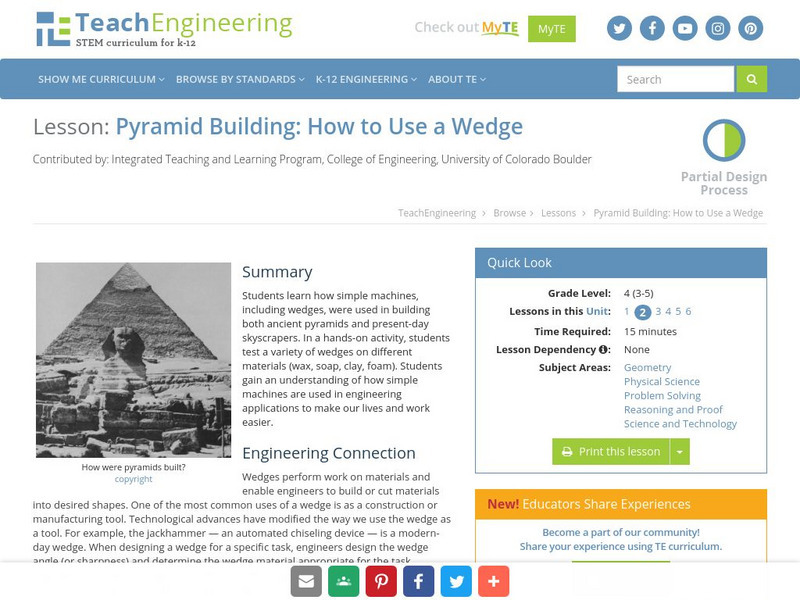
Teach Engineering: Pyramid Building: How to Use a Wedge
Students learn how simple machines, including wedges, were used in building both ancient pyramids and present-day skyscrapers. In a hands-on activity, students test a variety of wedges on different materials (wax, soap, clay, foam)....

Science Education Resource Center at Carleton College
Serc: Construction of a Complex Machine Through Classroom Collaboration
Young scholars take a simple task and make it much more complicated using a cardboard box. Each group must use a minimum of six simple machines utilizing at least four types of simple machines. The goal is to keep the initial impulse...
Science Education Resource Center at Carleton College
Serc: The Physics and Engineering of a Trebuchet
In this simple machines lab young scholars investigate how the trebuchet works using their prior knowledge of simple machines. Students then build a trebuchet and analyze the physics and engineering that goes into building and launching it.
TryEngineering
Try Engineering: Engineering Ups and Downs
Engineering design lesson examines the principles behind working elevators. Teams of students explore how elevators work, then design, build, and evaluate their own elevator to service a toy car garage.
Alabama Learning Exchange
Alex: Levers Weight Lifters
During this lesson, students will have the opportunity to explore levers through hands-on experiences and by navigating the Internet. This lesson allows students to use their experiences to determine how levers and other simple machines...
Other
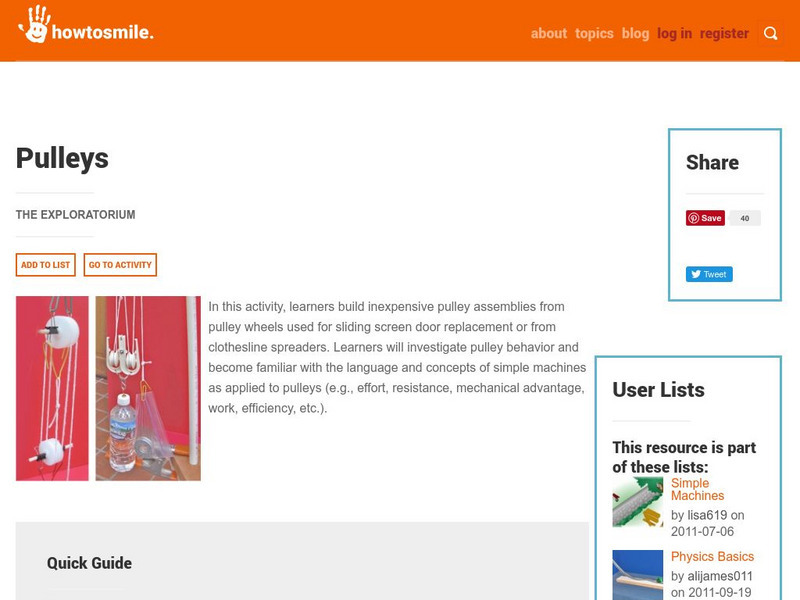
How to smile.org: Building Pulleys
An activity where students use pulley systems to pick up a paint can and move an eraser from the ground to the top of a desk. After completing this activity, students will understand how pulley systems can help us do work.
Science Education Resource Center at Carleton College
Serc: First Class Levers
Through observation and inquiry, young scholars are given various objects to investigate how levers work and why they might be useful.
Science Education Resource Center at Carleton College
Serc: Investigating the Inclined Plane Through Inquiry
For this activity, students will use different materials to find the most effective way to use an inclined plane (in other words, moving an object with as little force as possible). This is a guided inquiry. Although the students will be...
Science Education Resource Center at Carleton College
Serc: Levers:relationship of Force of Effort & Resistance Fulcrum Placement
Students investigate the relationship between the two forces and the location of the fulcrum in a first class lever. Students work in cooperative groups of approximately three to make observations that they can then generate a formula...