Hi, what do you want to do?






Curated OER
Children's Realism
Learners use a leading question in order to create context for the lesson plan. The problem of paying attention to students is discussed in groups. An answer to the problem appears that adults should know the desire of children of being...

Curated OER
The Big Blue
Third graders create paper mache globes with balloons. They label the 4 oceans on their balloons with reference to large wall map, classroom globe, and Encarta Virtual Globe CD-ROM projected on large screen TV with Tvator or other...

Curated OER
Biology and the Digital Atlas
Students participate in a scavenger hunt on the internet. Using a digital atlas, they find answers to specific questions related to plants found in Idaho. To end the lesson, they share their results to the class to discover what happens...

Curated OER
Center Stage -- Focus on the Elderly
Pupils role play and identify the perspectives of senior citizens. They develop a plan on how to interact with the elderly successfully. They examine children's books on how to relate to the elderly.

Curated OER
The Voice of the Individual
Students examine the role of the individual in society as a whole. Individually, they design and create their own calling card as used in the past. They put together an art kit in which they are able to use outdoors. To end the...

Curated OER
In the Scheme of Things
Fifth graders examine the food webs of different animals. They discuss the characteristics of those animals as well. They work together to develop their own definition for the word niche.

Curated OER
What It Is, What It Isn't
Third graders classify and sort different types of beans to be introduced to the classification system in science. As a class, they identify the characteristics of living and non-living organisms and make a chart in their journal to ...

Curated OER
Revolutionary War
Students examine the role of Virginia during the Revolutionary War. Using an inflatable ball, they toss the ball around the room and answer questions related to sayings on the ball. In groups, they play a game to reinforce topics...


Curated OER
Whales
Learners compare and contrast the two types of whales. In this biology lesson, students research the characteristics of their assigned whale. They compile their findings in a folder.
![Texas Memorial Museum: Who Am I? [Pdf] Activity](https://static.lp.lexp.cloud/images/attachment_defaults/resource/large/FPO-knovation.png "Texas Memorial Museum: Who Am I? [Pdf] Activity")
University of Texas at Austin
Texas Memorial Museum: Who Am I? [Pdf]
An activity where students use the discovery drawers at the Texas Natural Science Center to read clues and identify the organisms.
Other
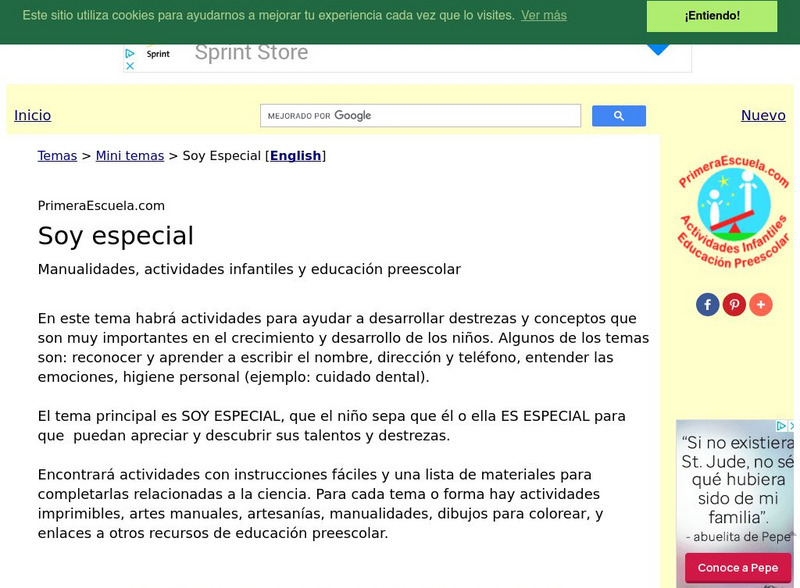
I Am Special: Yo Soy Especial
Dynamic site for teachers who have Spanish ESL students. Activities for students to strengthen basic concepts such as writing their own name, address and telephone number. It offers Spanish and English capability. Downloads provided.
Science Education Resource Center at Carleton College
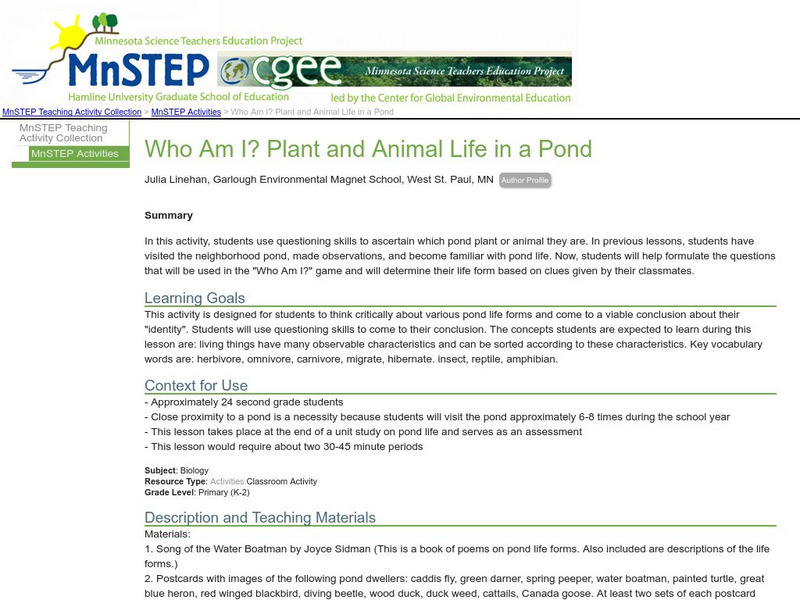
Serc: Mn Step: Who Am I? Plant and Animal Life in a Pond
After learning about pond life, students play a game where they must ask questions to discover the name of an animal or a plant displayed on a card placed on their backs. A set of images, a questioning sheet, and a list of vocabulary...
Charlotte Mecklenburg Library
Story Place: Who Am I?
This interactive tool allows readers to select an animal by picture and the name of the animal is said and shown on the screen in both English and Spanish.
US National Archives
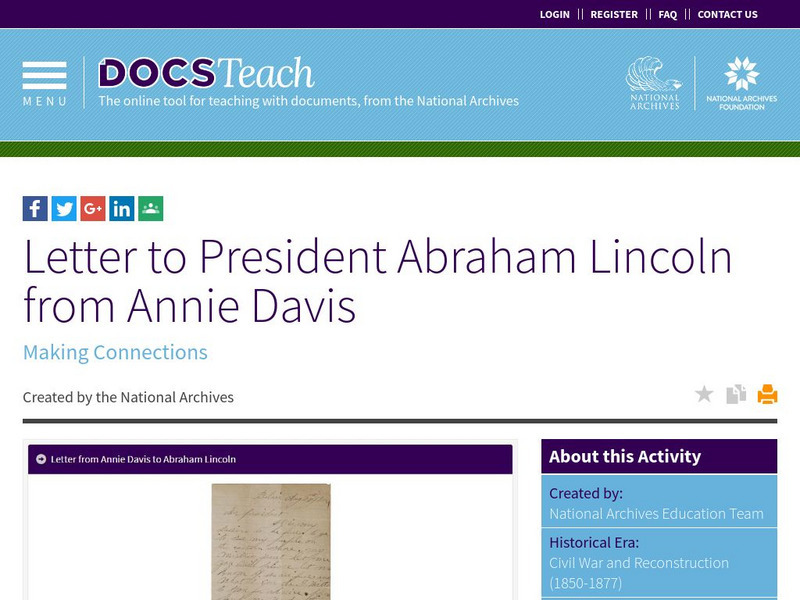
National Archives: Letter to President Abraham Lincoln From Annie Davis
"Will you please let me know if I am free?" wrote Annie Davis. Annie Davis was a slave who wrote this letter to President Lincoln 20 months after the Emancipation Proclamation. To understand her confusion, examine the following documents...
Chateau Meddybemps
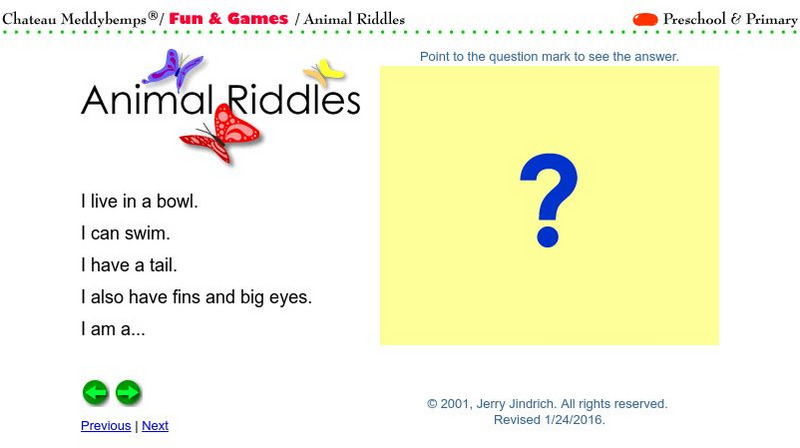
Chateau Meddybemps: Animal Riddles
Who-am-I riddles that have young learners using clues to figure out what kind of animal is being described. "I have wings but I'm not a bird." "I can breathe through a hole in the top of my head." Simple language and colorful...
Success Link
Success Link: Characters, Setting, Plot, Conclusion, and Summarizing a Story
This lesson plan offers a step-by-step procedure for teaching learners how to identify story elements and to summarize a story. It explains how to use a "Who Am I" activity, as well as a linkage activity in identifying characters and...