Hi, what do you want to do?






US Geological Survey
Usgs: The Usgs Water Science School
Use this site as a resource to learn about the many aspects of water.
US Geological Survey
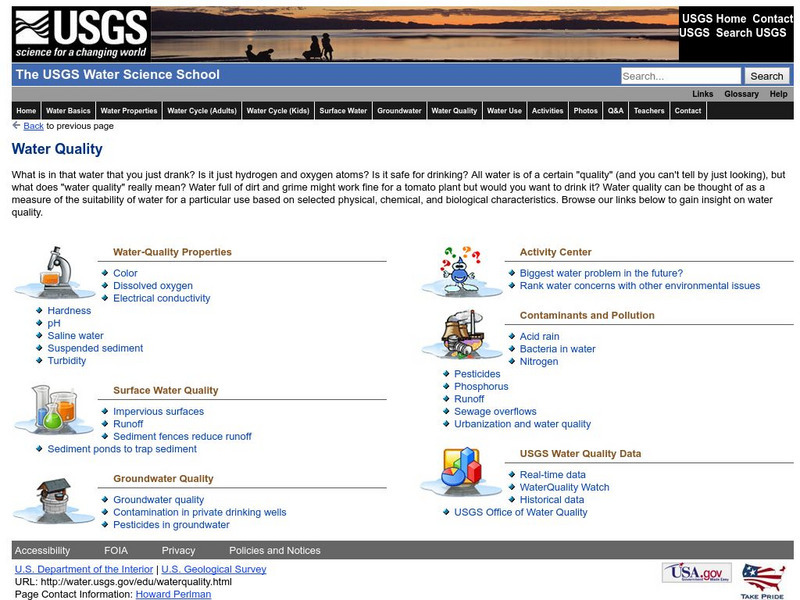
Usgs: Water Science School:water Quality
Learn about the importance of water quality and environmental influences that reduce it.
Science Buddies
Science Buddies: Got Iron? Measure the Concentration of Iron in Water
Iron is an important mineral essential for good health. Iron deficiency can be a problem. In this science fair project, use a simple iron test kit to measure the concentration of iron in water. This experiement is explained clearly and...
Science Buddies
Science Buddies: Can Water Float on Water?
Of course it can, you say: ice is water and ice floats. And you're right. But we're talking about water in the liquid phase Can liquid water float on water? The goal of this project is to investigate what happens to layers of water with...
Science Buddies
Science Buddies: Supercooling Water and Snap Freezing
Can water remain liquid below its normal freezing point? If it does, that water is supercool(-ed). This project shows you a method for supercooling water. You can test water from different sources to see whether or not it can be...
Science Buddies
Science Buddies: Project Ideas: How Much Water Is Required to Cook Pasta?
In this cooking and food science fair project, determine if you really need 6 quarts of water to cook a pound of pasta. The Science Buddies project ideas are set up consistently beginning with an abstract, objective, and introduction,...
Science Buddies
Science Buddies: Measuring the Surface Tension of Water
Did you know that when you dip your finger in water and pull it out, the water is actually pulling back on you? Here's a way you can measure how much.
Science Buddies
Science Buddies: Measuring Surface Tension of Water With a Penny
Have you ever wondered what makes water 'bead' up on a freshly waxed car? In this project you'll investigate the chemistry of surface tension by measuring how many drops of water a penny can hold.
Science Buddies
Science Buddies: Build a Motorboat Powered by Surface Tension
If you look carefully, you could find dozens of similar interesting phenomena that are all linked to the surface tension of water. Here is a project that will help you understand and measure the properties of water surface tension.

Science Buddies
Science Buddies: I'm Trying to Breathe Here! Dissolved Oxygen vs. Temperature
To survive, we need oxygen in the air we breathe. Oxygen is also essential for most aquatic organisms, but there is much less oxygen available in water than in air. Learn how to measure dissolved oxygen and then see how oxygen...
Science Buddies
Science Buddies: Put Some Energy Into It! Use a Calorimeter to Measure
In this science fair project, use a calorimeter with an attached heating element to measure how water responds to added thermal energy.
PBS
Pbs News Hour Extra: Understanding Your Water: From Source to Tap and Back Again
In this lesson plan young scholars will learn about water treatment and what happens to water when it goes down a toilet and drains into sewers. Through further investigation students will understand the relationship between water...
Globe
The Globe Program: Water Module
Learning activities allow students to learn about tools for making science observations such as a magnifying lens and ruler. Then students describe how macroinvertebrates are adapted to their aquatic environment.

Teachnology
Teachnology: Science Lesson Plans
Great lesson plans covering a wide-range of science-related subjects. A wonderful resource for wonderful teachers!
US Geological Survey
Usgs: Water Science for Schools Why Is the Ocean Salty?
This U.S. Geological Survey website offers one explanation of why the ocean is salty. Click Home to access the site in Spanish.
US Geological Survey
U.s. Geological Survey: Where Is Earth's Water Located?
Find out how much of the water on Earth is actually usable by humans, and where the rest of it is located. Learn where our water comes from and why it never runs out. Click Home to access the site in Spanish.
US Geological Survey
Usgs: The Water Cycle
Learn about the movement of water from Earth's surface to the atmosphere with this site. Site describes the water cycle in words and with a diagram. Also explored on the page is the distribution of Earth's global water supply.
US Geological Survey
Earth's Water: Rivers and Streams
The USGS explains the definition of a river and how a river is supplied with water. Included is a cross section of a river. Click Home to access the site in Spanish.

Science Buddies
Science Buddies: What's the Point of Boiling?
You know that water can exist in three separate phases: solid (ice), liquid (water), and vapor (steam). To change from one phase to another, you simply add (or remove) heat. When water boils, what happens to molecules (for example sugar...
Science Buddies
Science Buddies: Suck It Up: Capillary Action of Water in Plants
We know that plants, and even bouquets of cut flowers need water to survive, but we often do not think about how water moves within a plant. In this science project, you will use colored water and carnations to discover how water travels...
Science Buddies
Science Buddies: Are You in Hot Water? Use Solar Energy to Heat Your Own Water
The goal of this science fair project is to build batch solar collectors from different colors of plastic bags and see which collector is the most efficient in heating water.
Science Buddies
Science Buddies: What a Drag!
What makes some objects more streamlined than others? Find out which ordinary objects around your house are made to move smoothly through the water in this easy experiment. Which objects will produce the most drag when pulled through the...
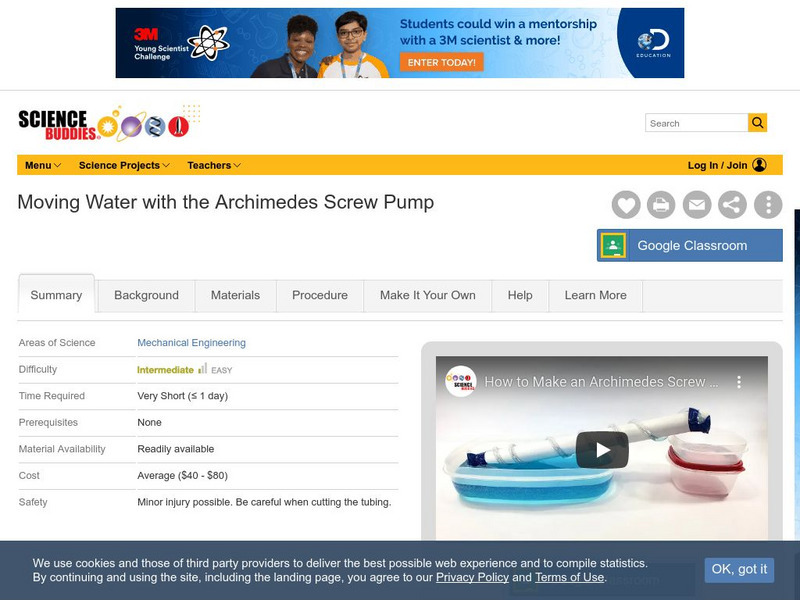
Science Buddies
Science Buddies: Moving Water With the Archimedes Screw Pump
Amaze your friends and family by moving water with just a few turns of your wrist, this is known as an Archimedes screw. In this science project, you will build a very simple Archimedes screw, to transfer water from a low-lying location...
Science Buddies
Science Buddies: Just Keep Cool How Evaporation Affects Heating and Cooling
When we get hot, we sweat. The physiological role of sweat is to cool us down. When the water evaporates, it removes energy from our bodies. This sort of evaporative cooling can also be used to cool homes, using what are referred to as...
Other popular searches
- Science Properties of Water
- Water Science Project Ideas
- Science Water Use
- Water Science Glaciers
- Science Everyday Water Use
- Science Water Cycle
- Earth Science Inquiry Water
- Science Water
- Water Science Properties
- Water +Science Glaciers
- Water Science Phosphorous
- Science Water Clarity