Hi, what do you want to do?





TeachEngineering
Teach Engineering: Snow vs. Water
Engineers work in many fields associated with precipitation. Engineers study glaciers to better understand their dates of formation and current demise. They deal with issues of pollution transport and water yield, and they monitor...
Science Education Resource Center at Carleton College
Serc: Monitoring Pollution in a Freshwater Environment
During this research project, students will choose either the direct method or the indirect method to monitor and measure pollution while manipulating one variable. They will develop a research question to work on and present their...

Read Works
Read Works: Ryan's Well
[Free Registration/Login Required] Students read about 15-year-old Ryan Hreljac who created a foundation that has raised over $1.5 million to build wells in Africa. A question sheet is available to help students build skills in comparing...
US Environmental Protection Agency
Epa: Water Resources: Water Bodies
Learn about EPA's work to protect and manage water resources and what you can do to help.
TeachEngineering
Teach Engineering: Microbes Know How to Work!
Students design systems that use microbes to break down a water pollutant (in this case, sugar). They explore how temperature affects the rate of pollutant decomposition.
Read Works
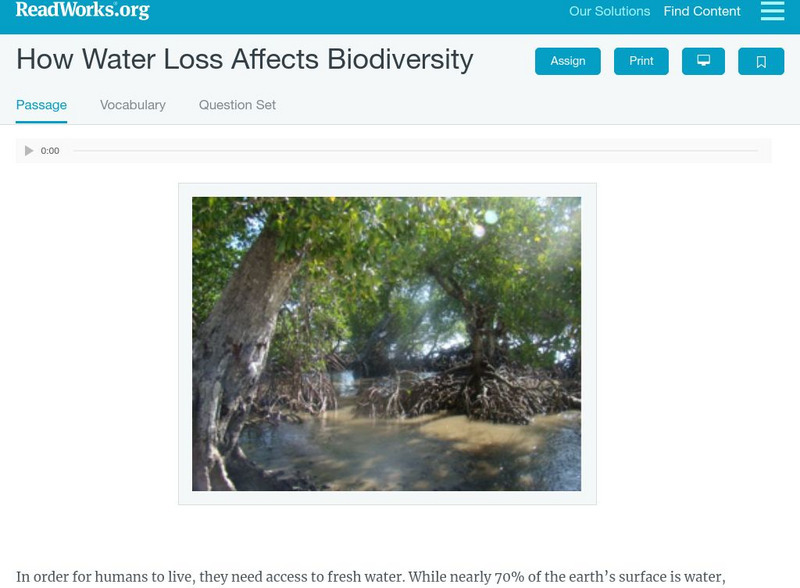
Read Works: How Water Loss Affects Biodiversity
[Free Registration/Login Required] Students read about how varying amounts of fresh water can affect biodiversity in a region. A question sheet is available to help students build skills in reading comprehension.
TeachEngineering
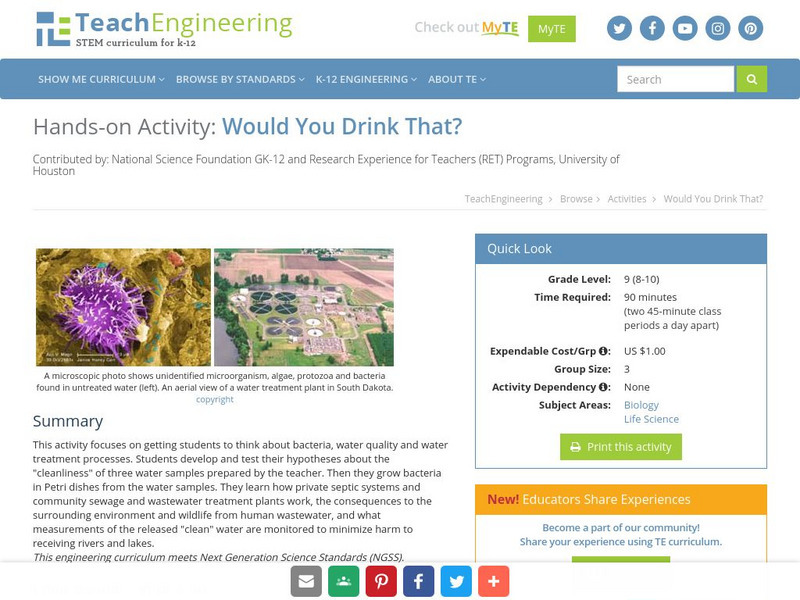
Teach Engineering: Would You Drink That?
This activity focuses on getting students to think about bacteria, water quality and water treatment processes. Students develop and test their hypotheses about the "cleanliness" of three water samples prepared by the teacher. Then they...
Read Works
Read Works: Dead Zone
[Free Registration/Login Required] Students read about the "dead zone," an area in the Guld of Mexico where no fish can live due to pollution from fertilizer. A question sheet is available to help students build skills in cause and effect.

Other
Catawba Riverkeeper: Threats to Our Lake and Water
The most common problem on the Catawba River and its lakes is sedimentation. Sediment carried by stormwater runoff from construction sites in North Carolina has been documented as the leading source of non-point source pollution to...
Province of British Columbia
Government of b.c.: Teacher's Guide to Clean Air: The Clean Air Crusaders [Pdf]
The 'Clean Air Crusaders' help teachers work with students to educate them about all kinds of air pollution and ways to improve our environment.
Other
Coalition of Oregon School Administrators (Cosa): Microbeads, Mega Problem [Pdf]
A textbook activity where students work in teams to design a device or technique that will prevent plastic microbeads from entering local lakes and streams. They will use the engineering process to design a solution and then present...
TeachEngineering
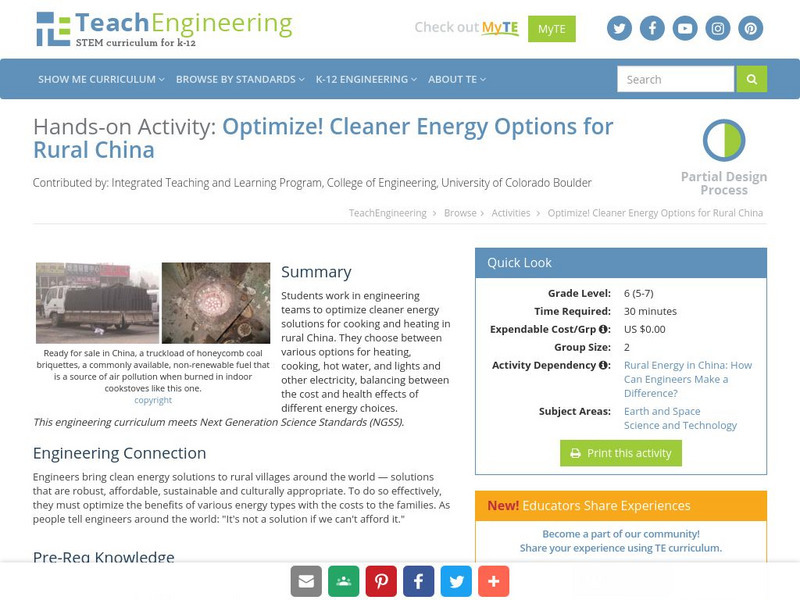
Teach Engineering: Optimize! Cleaner Energy Options for Rural China
Students work in engineering teams to optimize cleaner energy solutions for cooking and heating in rural China. They choose between various options for heating, cooking, hot water, and lights and other electricity, balancing between the...
Read Works
Read Works: A Day to Celebrate Earth
[Free Registration/Login Required] Students read about Earth Day and ways students can help the Earth. A question sheet is available to help students build skills in author's purpose.
Other
Pipeline: Soil Characteristics Demystifying Dirt [Pdf]
Soil is the foundation of conventional on site wastewater treatment.The drainfields used with on site systems work because the soil around the trenches acts as a filter and removes organic matter, some of the nutrients present in...