Hi, what do you want to do?






Utah Education Network
Uen: Water Pollution Graphing: Bugs Don't Bug Me
Activity shows the link between land use activities within a watershed and water quality.
TeachEngineering
Teach Engineering: The Dirty Water Project
In this activity, students investigate different methods (aeration and filtering) for removing pollutants from water. They will design and build their own water filters.
BioEd Online
Bio Ed Online: Why Is Water So Important?
In this post assessment activity students review points covered in the attached unit and reach conclusions regarding the importance of water to human health. Student sheets are provided in English and in Spanish.
TeachEngineering
Teach Engineering: How Clean Is That Water?
This lesson plan helps students understand the factors that affect water quality and the conditions that allow for different animals and plants to survive. Students will look at the effects of water quality on various water-related...
Other
Safe Water Science: Lesson Downloads
A collection of downloadable, ready-to-use lessons and student worksheets aimed to raise awareness of the need for safe drinking water. Lessons are investigative in nature and utilize inexpensive materials that can be purchased at most...
TeachEngineering
Teach Engineering: What's Gotten Into You?
In this activity, students use models to investigate the process and consequences of water contamination on the land, groundwater, and plants. This is a good introduction to building water filters found in the associated activity, The...
Utah Education Network
Uen: Macroinvertebrate Graphing Activity
Students will learn about water quality indicators.
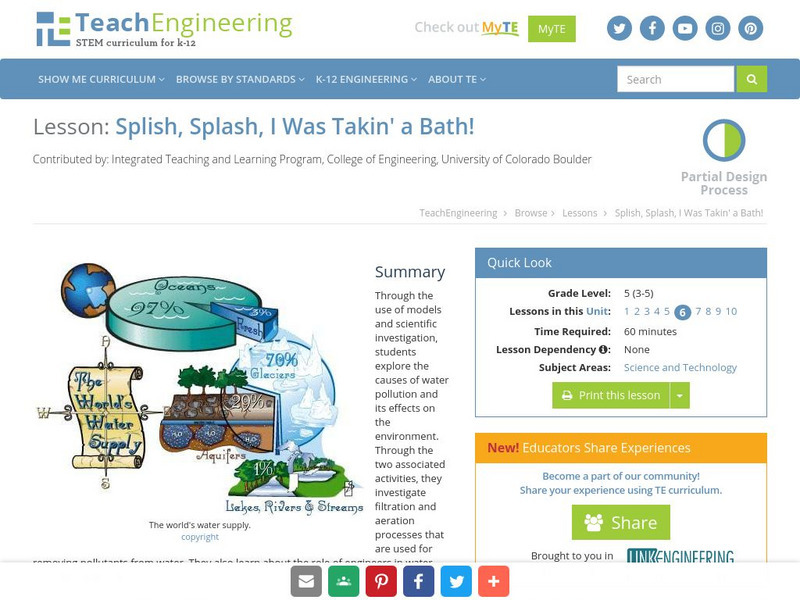
TeachEngineering
Teach Engineering: Splish, Splash, I Was Takin' a Bath!
In this lesson, students will explore the causes of water pollution and its effects on the environment through the use of models and scientific investigation. In the accompanying activities, they will investigate filtration and aeration...
HotChalk
Hot Chalk: Lesson Plans Page: Causes of Pollution
This lesson plan is designed to teach young children identify the types of pollution, the sources of the pollution, and how they can protect the environment from further pollutants.
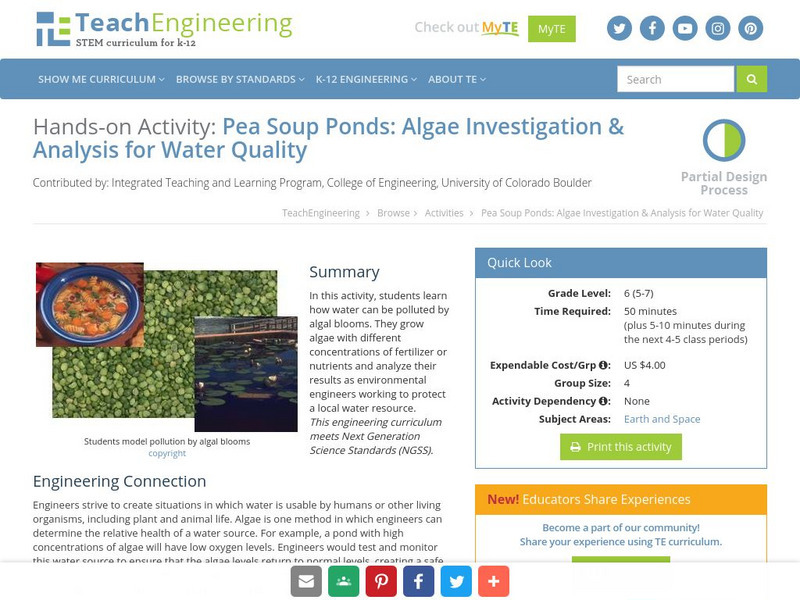
TeachEngineering
Teach Engineering: Pea Soup Ponds
In this activity, students will learn how water can be polluted by algal blooms. They will grow algae with different concentrations of fertilizer or nutrients and analyze their results as environmental engineers working to protect a...
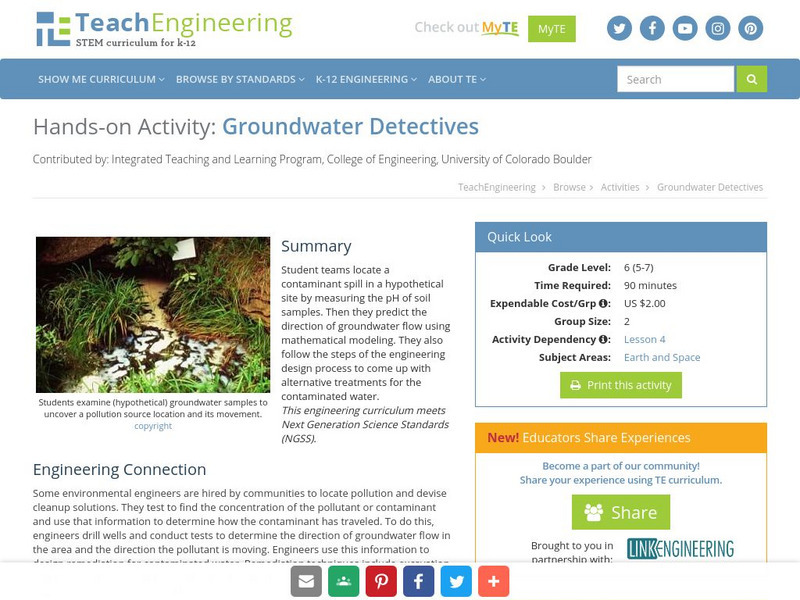
TeachEngineering
Teach Engineering: Groundwater Detectives
Student teams locate a contaminant spill in a hypothetical site by measuring the pH of soil samples. Then they predict the direction of groundwater flow using mathematical modeling. They also use the engineering design process to come up...
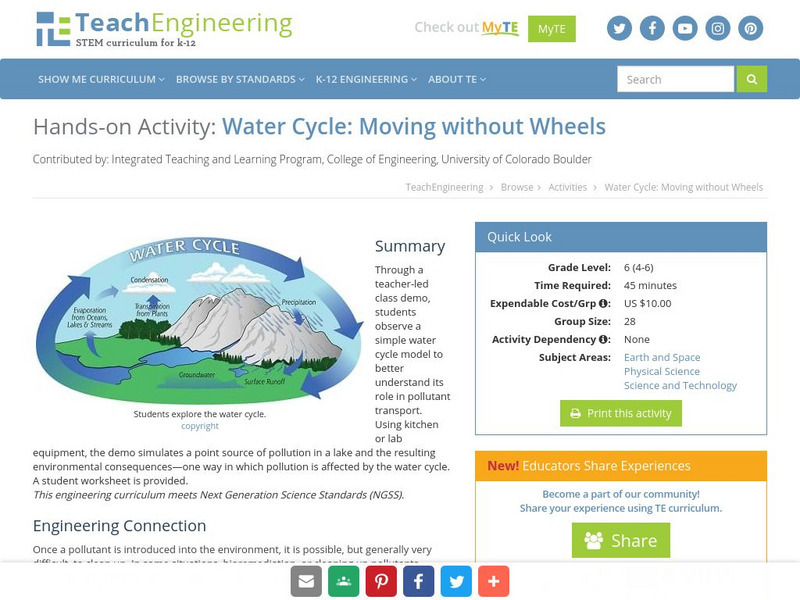
TeachEngineering
Teach Engineering: Moving Without Wheels
In a class demonstration, students observe a simple water cycle model to better understand its role in pollutant transport. This activity shows one way in which pollution is affected by the water cycle; it simulates a point source of...
US Environmental Protection Agency
Epa: Build Your Own Watershed
How can you learn to build your own watershed? This site features an activity to illustrate the basic properties of a watershed. Don't miss out.
NOAA
Noaa: Estuaries 101 Curriculum: Estuary and the Watershed San Francisco Bay
In this activity, students investigate a large watershed, look for sources of pollution in the watershed, and study the impacts of a rain storm on a watershed and estuary, without going on a field trip. Students investigate the nature of...
TeachEngineering
Teach Engineering: What's Down the Well?
This activity looks at physical models of groundwater and how environmental engineers determine possible sites for drinking water wells. During this activity, students will create their own groundwater well model using a coffee can and...
TeachEngineering
Teach Engineering: Stream Consciousness
During this activity, students will learn how environmental engineers monitor water quality in resource use and design. They will employ environmental indicators to assess the water quality of a nearby stream. Students will make general...
TeachEngineering
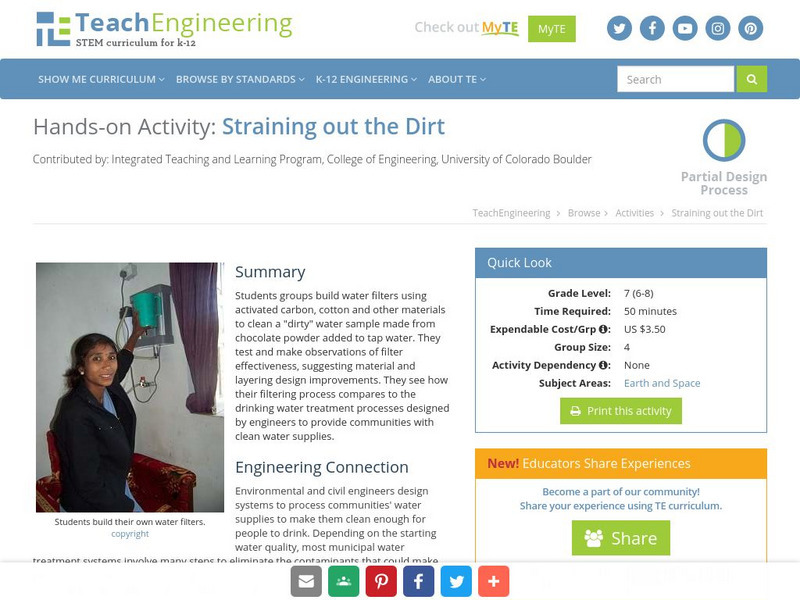
Teach Engineering: Straining Out the Dirt
In this activity, students build a water filter with activated carbon, cotton and other materials to remove chocolate powder from water.
TeachEngineering
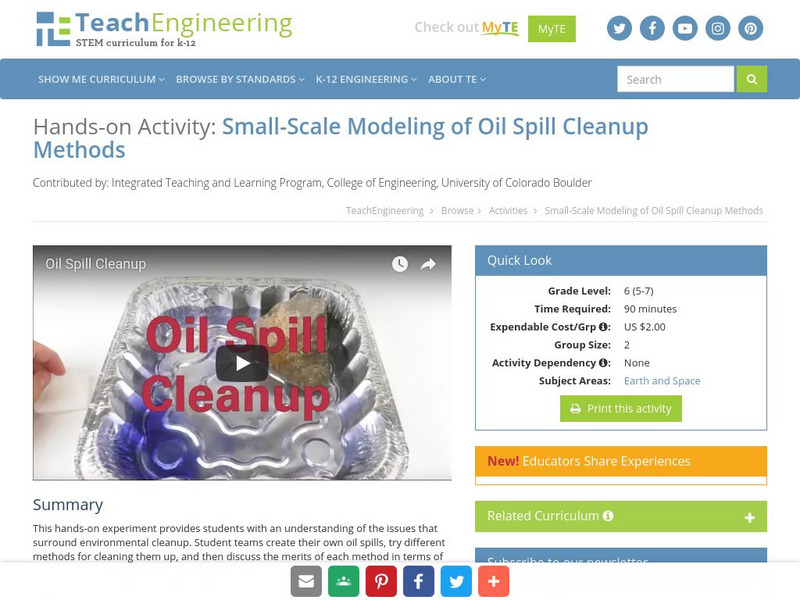
Teach Engineering: Oil Spill Cleanup
This hands-on experiment will provide students with an understanding of the issues that surround environmental cleanup. Students will create their own oil spill, try different methods for cleaning it up, and then discuss the merits of...