Hi, what do you want to do?






US Geological Survey
U.s. Geological Survey: Water Cycle
An in-depth explanation of the Earth's water cycle, including a hyperlinked diagram that provides direct access to information about each phase in the cycle.
US Geological Survey
Usgs: The Water Cycle
Learn about the movement of water from Earth's surface to the atmosphere with this site. Site describes the water cycle in words and with a diagram. Also explored on the page is the distribution of Earth's global water supply.

Open Curriculum
Open Curriculum: Water and Water Cycle
An illustrated article helps learners understand the water cycle and the distribution of Earth's water.
US Geological Survey
U.s. Geological Survey: The Water Cycle: The Oceans
Through pictures, diagrams, and charts, learn how the ocean serves as a storehouse of water.
Science Buddies
Science Buddies: From Brine to Beverage: Solar Powered Salt Removal
In this science fair project you'll discover how to turn the ocean into a source of freshwater by using the power of the Sun, and the water cycle. You will ultimately find just how salinity affects this process.
Science Struck
Science Struck: Water Cycle Project Ideas
A collection of ideas for creating a science fair project on the water cycle.
Science Struck
Science Struck: A Simple Guide to the Steps of the Water Cycle
The steps in the water cycle and the processes that occur are explained in this resource.
American Geosciences Institute
American Geosciences Institute: Earth Science Week: Water: A Never Ending Story
Students carry out a number of activities that demonstrate the concepts of evaporation, condensation, precipitation, and soil moisture and runoff. Then students construct a terrarium as a way to observe the water cycle. Immediately...
Science Buddies
Science Buddies: Just Keep Cool How Evaporation Affects Heating and Cooling
When we get hot, we sweat. The physiological role of sweat is to cool us down. When the water evaporates, it removes energy from our bodies. This sort of evaporative cooling can also be used to cool homes, using what are referred to as...
Science Buddies
Science Buddies: Keep Your Candy Cool With the Power of Evaporation!
Did you know that your body has a built-in cooler? And it might not be what you think. Sweat is produced when you are hot, but its purpose is actually to cool your body as the water in it evaporates from your skin. In this science fair...
US Geological Survey
Usgs: How Much Water Is There on (And In) the Earth?
The USGS gives an overview of the amount of water on Earth and where it is located. It gives a few interesting facts about the Earth's supply of water. Click Home to access the site in Spanish.
US Geological Survey
U.s. Geological Survey: Where Is Earth's Water Located?
Find out how much of the water on Earth is actually usable by humans, and where the rest of it is located. Learn where our water comes from and why it never runs out. Click Home to access the site in Spanish.
Exploratorium
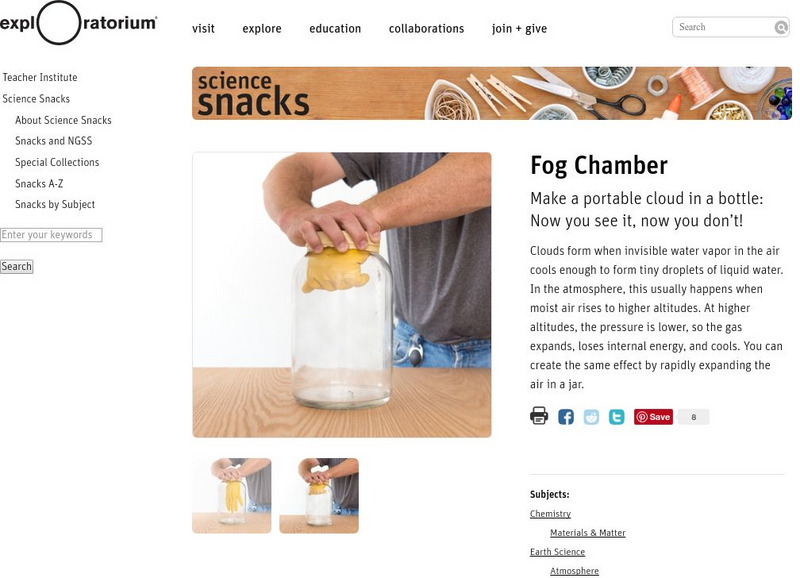
Exploratorium: Science Snacks: Fog Chamber
Create a fog chamber by rapidly expanding air in a jar in this activity. This activity uses a match in a jar to bunch water into tiny droplets.
PBS
Pbs Learning Media: Ways of Watersheds
Learn about the four phases of the water cycle, the ways in which watersheds are crucial to healthy water, and the best ways to manage local watersheds with this interactive lesson.
US Geological Survey
Usgs: Water Science for Schools Uses of Saline Water
This U.S. Geological Survey website explains a variety of uses for saline water. Pie graphs and bar graphs are used to illustrate the various uses. Click Home to access the site in Spanish.

Science Buddies
Science Buddies: Timing the Tides
Have you ever been to a tide pool during low tide? Some intertidal animals in the low tide zone are left in a tiny pool of water when the tides go out. Other intertidal animals that live in high tide zones may be left to dry out during...

The Wonder of Science
The Wonder of Science: Ms Ess2 4: Cycling of Water Through Earth's Systems
Work samples, phenomena, assessment templates, and videos that directly address standard MS-ESS2-4: cycling of water through earth's systems.

Alabama Learning Exchange
Alex: Seeds: How They Grow
The students will be collecting, germinating and planting seeds to show the process of plant growth. The students will be recording the information in their science journal. In addition, the students will be observing the water cycle as...
American Geosciences Institute
American Geosciences Institute: Earth Science Week: What's Down There?
Students build a model to learn about the cycle of erosion and deposition by water and wind which deposits layer upon layer of rock, soil, and organic material to the surface.
US Geological Survey
Us Geological Survey: Groundwater: What Is Groundwater?
What is groundwater? Where does it fit into the water cycle? With the aid of a simple illustration, one is able to learn more about this topic. Includes link to a true-and-false quiz.

Alabama Learning Exchange
Alex: How Clouds Form
Cloud formation results when warm, humid air rises and cools, causing the water vapor in the air to condense and form clouds. In this lesson, students will conduct an activity that demonstrates how this occurs.This lesson plan was...
University Corporation for Atmospheric Research
Ucar: Introduction to the Atmosphere
A detailed overview of the Earth's atmosphere, with explanations about atmospheric properties, the structure of the atmosphere, its four layers, atmospheric processes, energy heat transfer, conduction and convection, and radiation. All...
Other popular searches
- Science Water Cycles
- Science Water Cycle Activity
- Earth Science Water Cycle
- 5 Science Water Cycle
- Science Water Cycle
- Water Cycle Science Inquiry
- Earth Science, Water Cycle
- Science Water Cycle