Hi, what do you want to do?






National Institute of Open Schooling
Water Pollution
Fifteen million children under the age of five die each year due to diseases in their drinking water. Water pollution is the topic of lesson 34 in the series of 36. Scholars, through reading and discussing, study numerous aspects of...

It's About Time
Elements and Compounds
Young scientists use electrolysis to separate water into its elements before experimenting with fire to learn about their properties. A helpful resource provides a reading passage and analysis questions.

National Institute of Open Schooling
Environmental Concerns
Every year, more than 14 billion pounds of garbage is dumped into the oceans of the world, most of which is plastic and toxic to ocean life. Lesson 32 in the series of 36 focuses on environmental concerns, specifically pollution. Under...

National Institute of Open Schooling
Air Pollution
Seventy percent of the air pollution in China is due to car exhaust. Under the umbrella of environmental chemistry, learners extensively explore air pollution. From the makeup of our atmosphere to sources of major air pollutants, classes...

National Institute of Open Schooling
Solutions
Aqua regia, or royal water in Latin, is a solvent that can dissolve solid gold and platinum into a solution. Activity nine in a series of 36 allows classes to learn, through readings and answering questions, what a solution is and the...

National Institute of Open Schooling
Adsorption and Catalysis
Adsorption, not absorption, is when atoms stick to the surface of an object, like water sticking to a grain of sand. An informative lesson delves into adsorption, teaching physical and chemisorption and the factors that affect them....

National Institute of Open Schooling
Heavy Metal Contamination
An informative lesson focuses on heavy metal contamination of environments. Classes read about, discuss, and answer questions pertaining to sources of heavy metals in the environment. To finish the 35th installment of 36, individuals...

National Institute of Open Schooling
The Liquid State
Due to surface tension, dew — a liquid, is spherical in shape. Learners explore the properties of liquids in activity seven in this series of 36. Beginning with its basic properties such as boiling point and moving through to surface...

Beyond Benign
Daphnia Bioassay LD50
De-icing materials may have a harmful effect on our environment; have your class perform an experiment to test the nature of these effects. Scholars monitor the survival rate of a sample of daphnia as the concentration of a de-icing...

Curated OER
Rules for Balancing REDOX Equations: (Half-Reaction Method)
In this chemistry worksheet, students read the instructions of how to work with the following: acidic and basic solutions, total and net ionic equations, and how to relate these to each other.

Curated OER
First Land Plants Found on Earth
In this first land plants worksheet, students read about the major events that allowed plants to evolve on Earth. Students read about the primary and secondary atmospheres, the formation of the ozone layer to protect from UV light and...

It's About Time
Mass and Volume
Don't be so dense that light bends around you; study the relationship between mass and volume instead. Young chemists measure the density of a variety of liquids and solids. A reading passage and analysis questions introduce pupils to...

It's About Time
Identifying Matter
High schoolers test wood splints that have been soaked in mystery solutions to identify the different colors it produces when lit. The lesson concludes with a reading passage and analysis questions.

National Institute of Open Schooling
Hydrogen and s-Block Elements
Lesson 19 in the series of 36 analyzes the element hydrogen and the s-block elements. Through readings, answering questions, and discussion, learners write about and explain their occurrence, physical and chemical properties, and...

National Institute of Open Schooling
The Gaseous State
Sixth in a series of 36, this lesson focuses on gases and their behavior in given situations. Learners review the states of matter and then focus on gases, specifically learning Boyle's, Charles's, Avogadro's Laws, Dalton's, and Graham's...

It's About Time
Properties of Matter
Never trust an atom; they make up everything! Young chemists make modeling dough and add another ingredient to change the properties. Scholars then compare the properties of emulsion to composite materials. A reading passage and analysis...

National Institute of Open Schooling
Chemical Kinetics
Not all chemical reactions happen at the same rate because some, like explosions, occur quickly and some, like rusting, occur over time. Here, learners explore chemical reactions and their rates in the 16th lesson of 36. Through readings...

National Institute of Open Schooling
Colloids
Classes explore colloids through readings and questions in lesson 10 in a series of 36. They learn everything from methods of preparation and properties to how to classify colloids. They finish the lesson by seeing how to apply...

National Institute of Open Schooling
Chemical Arithmetics
Substances with the same empirical and molecular formula must be differentiated by their structural formula. Part two in a series of 36 has pupils using chemical formulas to calculate how much of a compound is present in a given...

National Institute of Open Schooling
Ionic Equilibrium
Scientific studies show the older we get, the more acidic we become. The activity extensively teaches high schoolers about acids and bases. By the end of the 14th installment of 36, they can define and explain three concepts of...

US Geological Survey
Usgs: Water Q & A
You will find this list of questions interesting and amusing. "Things like, "Is salt water used for anything in the U.S.?," and How can we have a 100-year flood two years in a row?", are found on this this. Click Home to access the site...
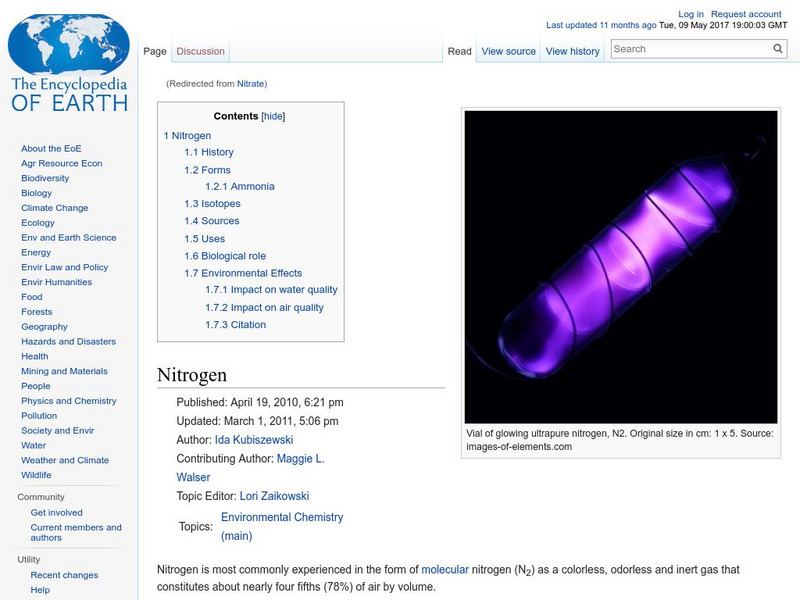
Encyclopedia of Earth
Encyclopedia of Earth: Physics & Chemistry: Nitrate
Discusses the chemistry of nitrate, the negative agricultural effects of too much nitrate in soil and in water sources, its toxicity to plants and livestock, and the impact on human health.
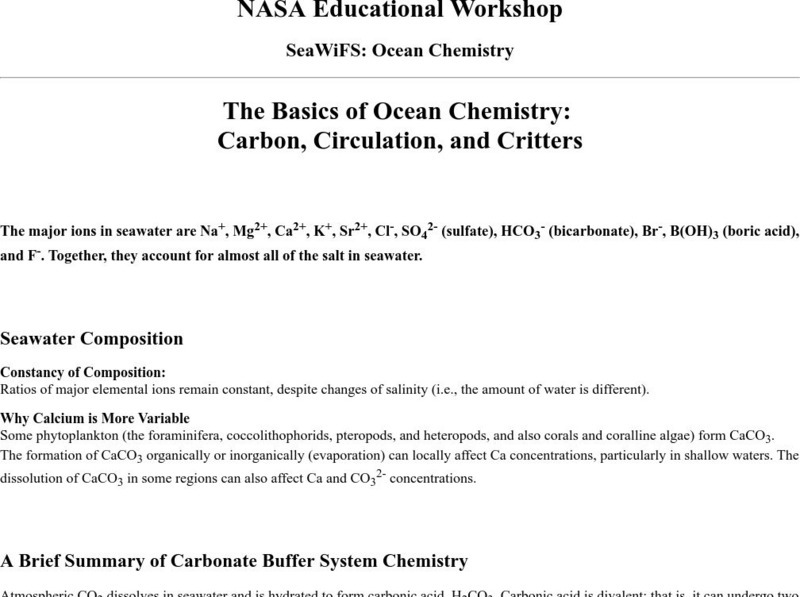
NASA
Nasa: The Basics of Ocean Chemistry: Carbon, Circulation, and Critters
An explanation of ocean chemistry, supported by illustrations, for example, of the global carbon cycle in the 1980s and the annual carbon dioxide flux. The concentration of nutrients in the ocean is discussed for its impact on marine...
Other
Water on the Web: The Chemistry of Oxygen Solubility
This resource provides a description of oxygen solubility in water as it relates to temperature and pressure with introductory definitions and sample data to analyze. Animations require Shockwave plugin.
Other popular searches
- Lake Water Chemistry
- Water Chemistry Ions
- Co2 Water Chemistry
- Water Chemistry Lesson Plans
- Ocean Water Chemistry
- Basic Water Chemistry
- Water Chemistry Properties
- Storm Water Chemistry
- Marine Water Chemistry
- Size vs. Water Chemistry
- Chemistry of Water
- Water Chemistry Nitrate