Hi, what do you want to do?






iCivics
I Civics: Students Power Elections
This guide will help kids learn about voting and elections independently and find ways to engage if they are not eligible to vote.
US Government Publishing Office
Ben's Guide to u.s. Government: Elections: Voter Registration
Can you vote in Election 2008? View this guide to see historical facts and where to register to vote in Federal elections. Includes links to further information.

Library of Congress
Loc: Today in History: November 4: Election Day
Learn about the history of November 4, which is an election day in the United States. Includes a discussion of presidential elections in the nineteenth century, and women's struggle to obtain the right to vote.
Center For Civic Education
Center for Civic Education: Fall Extended Lesson Plans on Voting
An in-depth set of lessons on voting. Topics covered include voting requirements, registering to vote, voting trends, voter self-education, setting up a polling station, and simulating an election polling site that coincides with a real...
Utah Education Network
Uen: Voting to Make Your Voice Heard
Understand the rights and responsibilities of voting in local, state, and national elections.

PBS
Why Vote?
This lesson plan is designed to help students identify, develop, and share their positions on 2008 election issues.
The White House
The White House: Elections & Voting
A brief discussion of Americans' right to vote and how federal elections happen.
Utah Education Network
Uen: Civics: Elections
Citizens of democratic countries consider voting one of their chief rights because it allows them to choose who will govern them. Learn about voting rights and the election process.
Council for Economic Education
Econ Ed Link: The Economics of Voting
Since the 1960s, many Americans eligible to vote have not bothered to do so- not even in presidential elections. Low rates of participation in voting have been worrisome to people interested in preserving our democratic traditions....
US Government Publishing Office
Ben's Guide to u.s. Government: Election of the President & Vice President: Electoral College
Provides information on the Electoral College and how we use this system to elect the President of the U.S. Features links to much more information on the election.
Council for Economic Education
Econ Ed Link: The Economics of Voting: What Do You Mean My Vote Doesn't Count?
This lesson explores the costs and benefits associated with voting in national elections. Specifically, the concepts of rational apathy, rational ignorance and expressive voting are explained.
PBS
Pbs Need to Know: Florida Ex Felon Voting Laws
Did you know that one in ten adults in Florida is currently not eligible to vote due to having been convicted of a felony? Find out how African Americans in particular are disproportionately affected. Article has particular emphasis on...
PBS
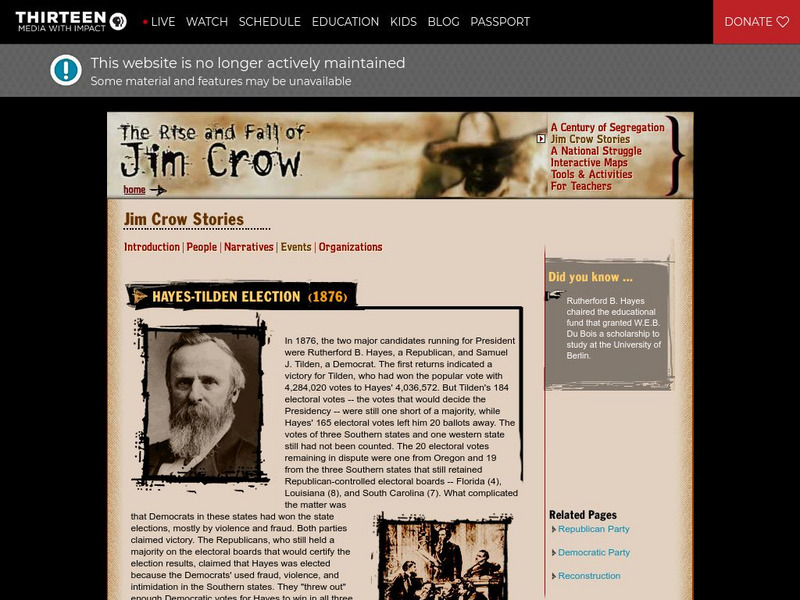
Wnet: Thirteen: The Rise and Fall of Jim Crow: Hayes Tilden Election
Read about the contested election of 1876. Was it decided behind close doors and with an understanding that Reconstruction would be ended in the South? Were votes fraudulently thrown out?

PBS
Election Day for Educators: Improving Elections
This lesson is designed to be used in conjunction with the film " Election Day" to examine the differences in the election process across the United States and to evaluate whether American election are carried out in a fair and effective...
John F. Kennedy Presidential Library & Museum
Jfk Presidential Library and Museum: Campaign of 1960
John F. Kennedy would be elected in November, 1960, as the youngest president ever voted into office. Here read about the Democratic convention, the debates between Kennedy and Richard Nixon, and find out about the issues of the...
270 To Win
270towin: 2012 Presidential Election
Provides a map and detailed electoral facts for the presidential election of 2012 won by Barack H. Obama who won a majority of both the popular vote and the Electoral College.
Digital History
Digital History: The Disputed Election of 2000
Online summary of the dispute over the presidential election of 2000 and the outcome.
Country Studies US
Country Studies: Lyndon Johnson and the Great Society
Lyndon B. Johnson ascended to the presidency after the assassination of President Kennedy in 1963. With a year to go until the election of 1964, LBJ appropriated Kennedy's "New Frontier" and transformed this agenda into his "Great Society."
The White House
The White House: Our Government
Overviews of the major elements of U.S. government, compiled and published by the White House: three branches of the federal government (executive, legislative, judicial), the Constitution, federal agencies and commissions, elections and...

Alabama Learning Exchange
Alex: What Do You Need to Know to Vote in Alabama?
Registering to vote, gathering information about the candidates, and casting a vote at the polls are vital parts of the process of selecting elected officials. Students will understand how the registration process works and how to cast...
New York Times
New York Times: The Voter Suppression Trail
[Free Registration/Login Required] Great learning "game" to help people understand the difficulties many people face when they want to vote in the United States. Based on the infamous Oregon Trail video game, see if your selected person...
New York Times
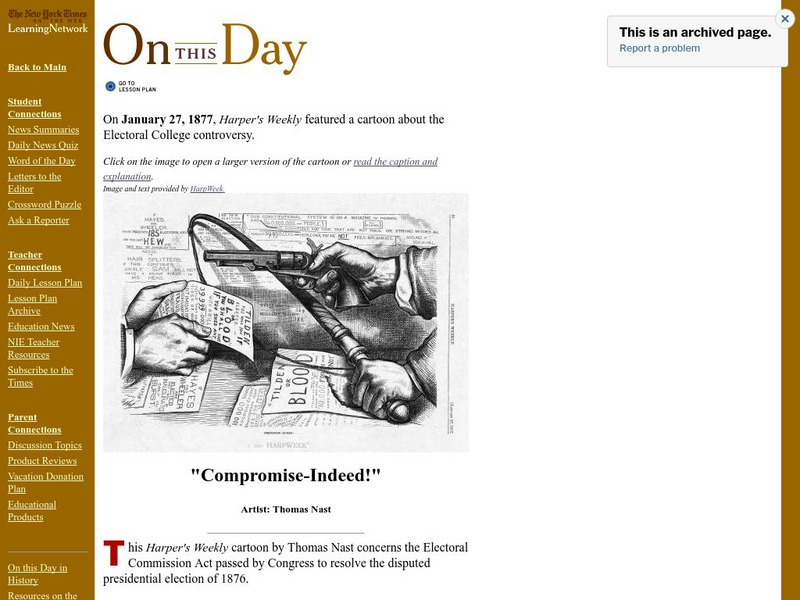
New York Times: On This Day: Electoral College Controversy 1876
Thomas Nast's political cartoon from a Harper's Weekly 1877 edition plus a description of the dispute over the election of 1876.
The Dirksen Congressional Center
Congress Link: Reform the Electoral College? Two Views From Congress
Two congressmen provide arguments for and against the Electoral College, a system that has been used for over 200 years to elect the president of the United States. Contains links to more information.
270 To Win
270towin: 2004 Presidential Election
Provides a map and detailed electoral facts for the presidential election of 2004 won by George W. Bush despite voting controversies and concerns of irregularities that emerged during and after the vote.