Hi, what do you want to do?






NASA
Nasa: Tour of the Electromagnetic Spectrum: Visible Light
Visible light waves are the only electromagnetic waves we can see. We see these waves as the colors of the rainbow. Each color has a different wavelength. Red has the longest wavelength and violet has the shortest wavelength. When all...
Physics Classroom
The Physics Classroom: The Electromagnetic and Visible Spectra
A tutorial on the electromagnetic and visible spectra. Discusses dispersion and how perceptions of white and black are related to the visible light spectrum.
Discovery Education
Discovery Education: The Em Spectrum: Waves of Energy
Students are introduced to the electromagnetic spectrum through this group research activity. Each group investigates a different wavelength range within the em spectrum and reports back to class. Discussion ideas also included.
Science Struck
Science Struck: Color Spectrum Chart With Frequencies and Wavelengths
Read about the visible light spectrum and learn the frequencies and wavelengths for each of the primary and secondary colors.
BioEd Online
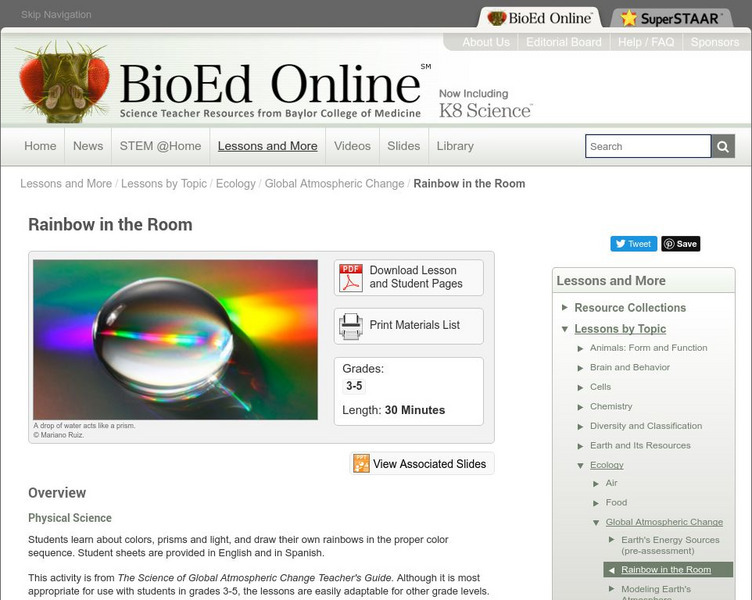
Bio Ed Online: Rainbow in the Room
Students investigate the properties of visible light and the sequence of colors in the spectrum using light shone through water and prisms. The instructional activity and accompanying slideshow can both be downloaded.
Georgia State University
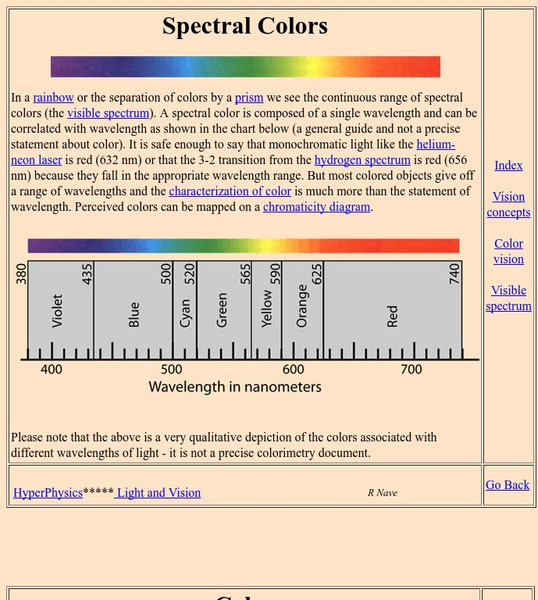
Georgia State University: Hyper Physics: Color
This site from Georgia State University discusses the location of visible light on the electromagnetic spectrum. Includes the wavelength values for various colors of light within the visible light spectrum.
PBS
Pbs Learning Media: The Electromagnetic Spectrum: Frontline
This video segment adapted from FRONTLINE introduces the electromagnetic spectrum and explains how the various types of electromagnetic waves are distinguished by the amount of energy each wave carries.
NASA
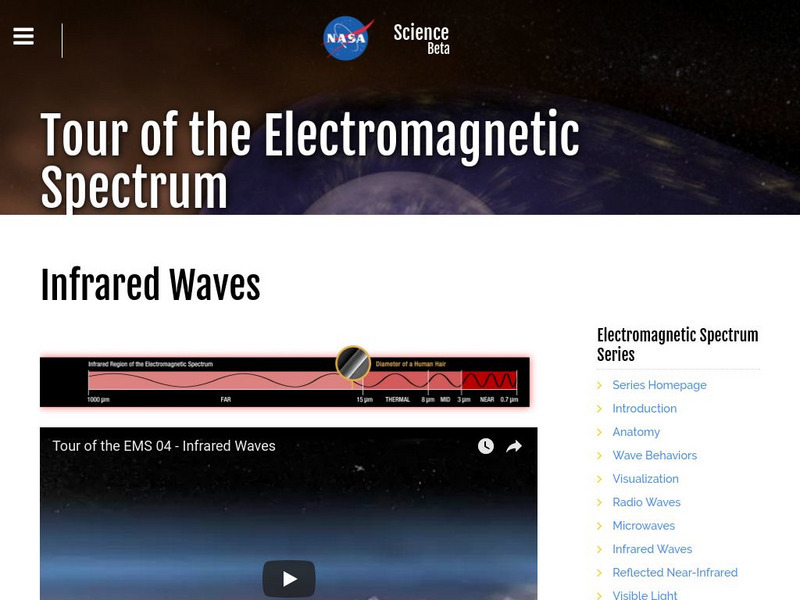
Nasa: Mission: Science: Electromagnetic Spectrum: Infrared Waves
Infrared light lies between the visible and microwave portions of the electromagnetic spectrum. Infrared light has a range of wavelengths, just like visible light has wavelengths that range from red light to violet.
CK-12 Foundation
Ck 12: Electromagnetic Spectrum
[Free Registration/Login may be required to access all resource tools.] Students learn what an electromagnetic wave is, gain a feel for the main parts of the spectrum, and work on problems involving basic properties of electromagnetic...
Science Struck
Science Struck: Visible Color Spectrum Wheel
A brief explanation of the visible color wheel.
Physics Classroom
The Physics Classroom: Light Waves and Color: Blue Skies and Red Sunsets
Students will focus on the interaction of sunlight with atmospheric particles to produce blue skies and red sunsets.
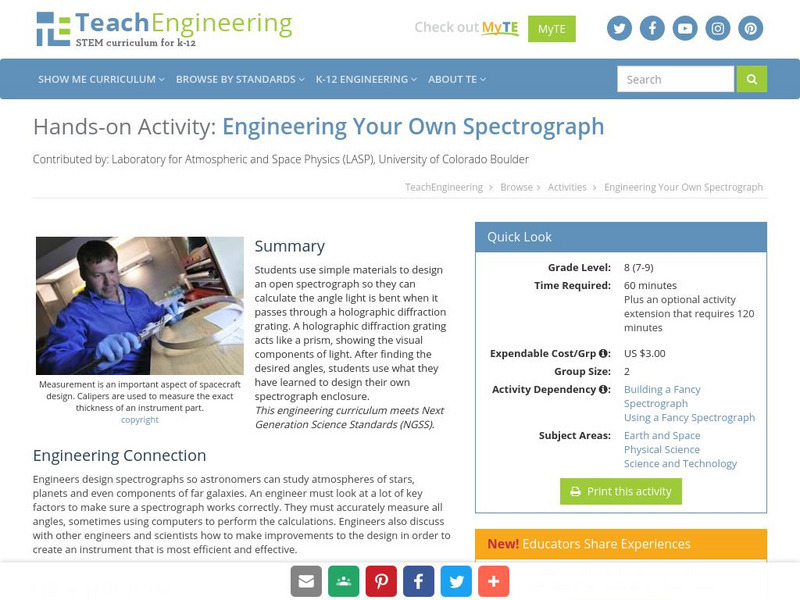
TeachEngineering
Teach Engineering: Engineering Your Own Spectrograph
Students use simple materials to design an open spectrograph so they can calculate the angle light is bent when it passes through a holographic diffraction grating. A holographic diffraction grating acts like a prism, showing the visual...
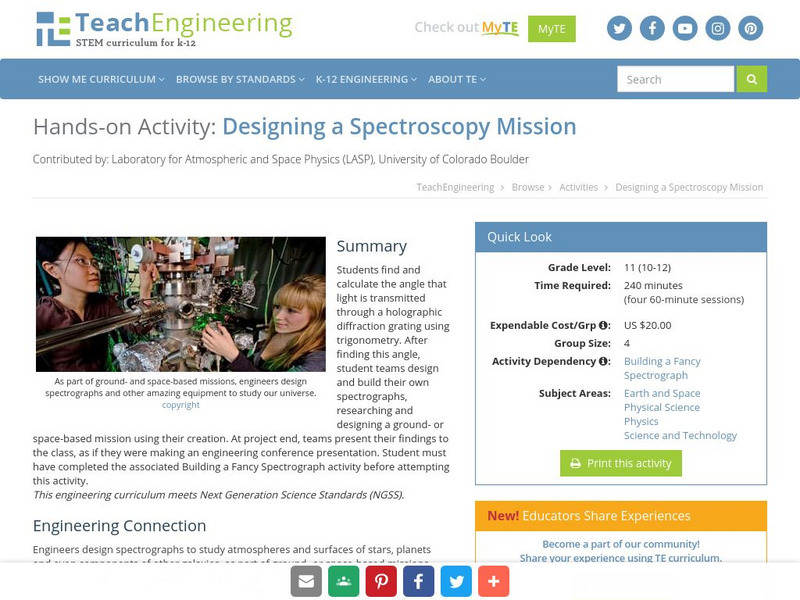
TeachEngineering
Teach Engineering: Designing a Spectroscopy Mission
Students find and calculate the angle that light is transmitted through a holographic diffraction grating using trigonometry. After finding this angle, student teams design and build their own spectrographs, researching and designing a...
Physics Classroom
The Physics Classroom: Blue Skies and Red Sunsets
This high school resource shows how the blue of the skies and the red of the sunsets can be explained by the interaction of sunlight with atmospheric particles which causes scattering of light.
TED Talks
Ted: Ted Ed: Light Waves, Visible and Invisible
Lucianne Walkowicz shows us the waves just beyond our perception: microwaves, radio waves, x-rays and more. [5:58]
TeachEngineering
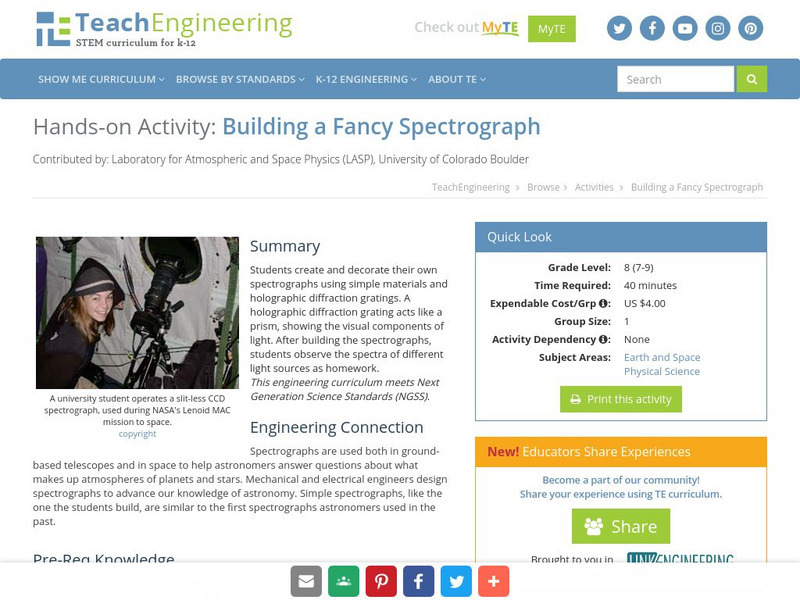
Teach Engineering: Building a Fancy Spectrograph
Students create and decorate their own spectrographs using simple materials and holographic diffraction gratings. A holographic diffraction grating acts like a prism, showing the visual components of light. After building the...
University of California
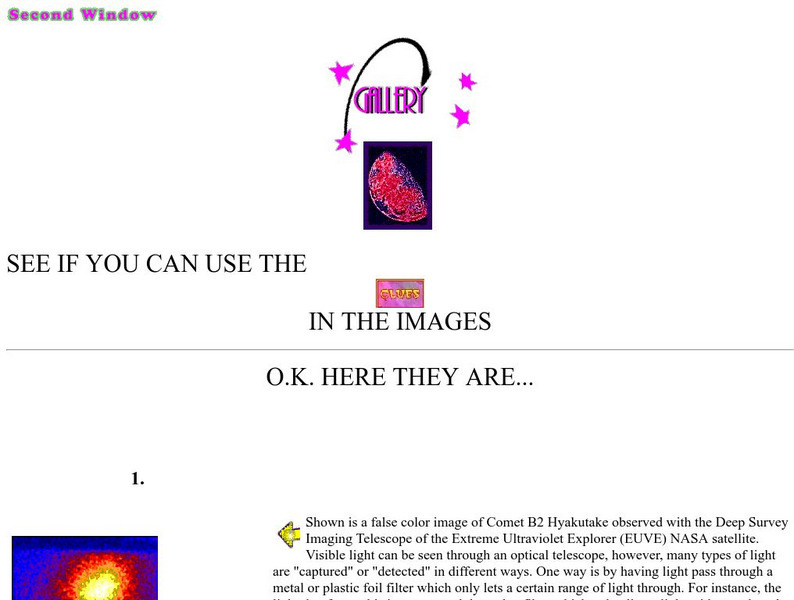
Center for Science Education: Gallery
A gallery of astronomy images which depict galaxies, comets, the moon, planets, nebulae, supernovae as seen in various regions of the electromagnetic spectrum. Each image in the gallery is described. Fascinating!
Science Buddies
Science Buddies: Absorption of Radiant Energy by Different Colors
In this science fair project, use an infrared thermometer to measure the temperature of differently colored paper exposed to sunlight, and calculate energy emission using the Stefan-Boltzmann equation. Find discussion questions, a list...
TeachEngineering
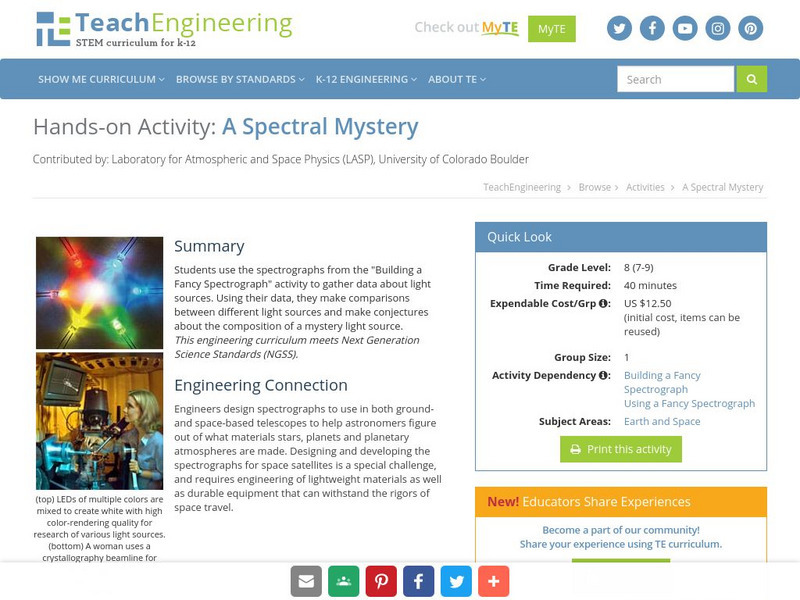
Teach Engineering: A Spectral Mystery
Students use the spectrograph from the "Building a Fancy Spectrograph" activity to gather data about light sources. Using their data, they make comparisons between different light sources and make conjectures about the composition of a...