Hi, what do you want to do?






Science Friday
Make a Model Eardrum to Detect Sound Waves
Make sound waves visible with an experiment that asks middle schoolers to build a model ear drum using plastic bottles, rubber bands, plastic wrap, and sand-like substances.

Exploratorium
Groovy Sounds
Make music. Class members construct a simple record player using a paper cone and a pin. The resource provides a description of what is happening and why listeners can hear the sounds through the cone.

Exploratorium
Straw Oboe
Trim the end of a straw to construct a vibrating wind instrument. Everyone in your class can make their own during a lesson on sound waves.

University of Waikato
Make and Use a Hydrophone
Using a home-built hydrophone, pupils investigate how things sound in water. Learners listen to sounds created in air and then compare that to the same sound picked up by the hydrophone. Individuals compare the loudness and the pitch of...

Exploratorium
Sound Bite
Learners use their teeth for more than just eating. The activity shows class members how to send sound through their teeth by using an electric motor connected to a radio to generate vibrations. Biting on the motor...

Teach Engineering
Acoustic Mirrors
Investigate sound waves with acoustic mirrors. Using audio software, groups make recordings of musical instruments, both with and without acoustic mirrors. They compare the recordings to see the effect of acoustic mirrors on sound...

DiscoverE
Slinky® Science
Toys are great for learning about physics. Scholars use Slinky® toys to study Newton's laws of motion and types of energy. After a little play, they then model longitudinal and transverse waves with the Slinky® toys.

Exploratorium
Vocal Visualizer
Make sound visible with an activity that provides directions for how to build a vocal visualizer meant to create light patterns. Making noise into the visualizer causes a mirror to vibrate, reflecting a laser beam, and creating...

Smithsonian Institution
What's the Code? Coding Robot Movements Using Sound
Tap into the desire to learn about computer codes. Pupils apply the Tap Code and the Polybius Square to send secret codes using sound. They design a code that tells a robot what movements to make and then test out their code using one of...

Exploratorium
Resonator
Construct a demonstration apparatus for your lesson on resonance. Instructions are provided here to assemble dowels and balls into swinging objects that have different frequencies. It is a neat visual to include during your lecture if...

Perkins School for the Blind
Name That Frequency
How cool! This plan uses old cassette tapes to show frequency from traveling vibrations. To prepare for the lesson, tactile frequency diagrams are made and then placed near the video tapes or dominoes that are already set up. When they...

TeachEngineering
Teach Engineering: Seeing and Feeling Sound Vibrations
Students examine the existence of sound by listening to and seeing sound waves while conducting a set of simple activities as a class or in pairs at stations. Students describe sound in terms of its pitch, volume and frequency. They use...
TeachEngineering
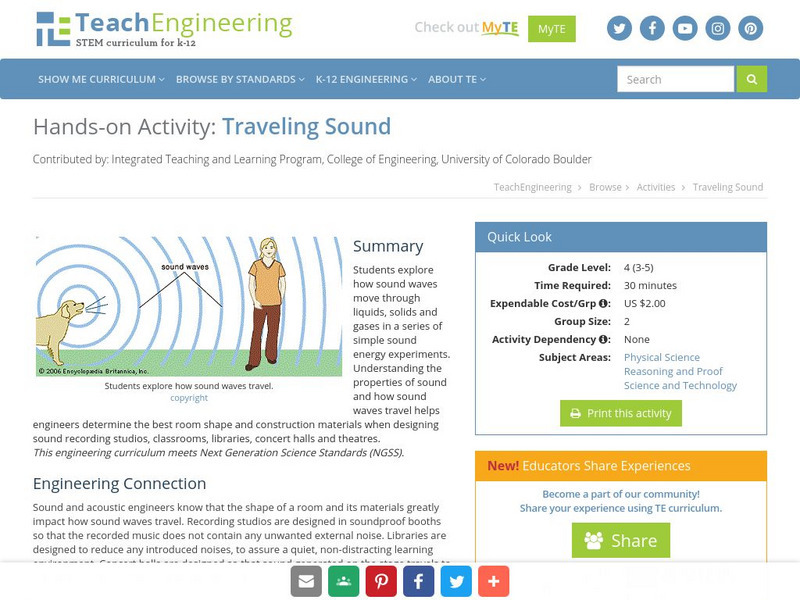
Teach Engineering: Traveling Sound
Students explore how sound waves move through liquids, solids and gases in a series of simple sound energy experiments. Understanding the properties of sound and how sound waves travel helps engineers determine the best room shape and...
Science Buddies
Science Buddies: Measuring Vibrational Frequency With Light
Strike a key on the piano, and you hear the string vibrating. Just about any object vibrates when it's knocked, but how much and how fast? This project helps you find out. You'll build a simple light-sensing circuit for measuring the...
Other
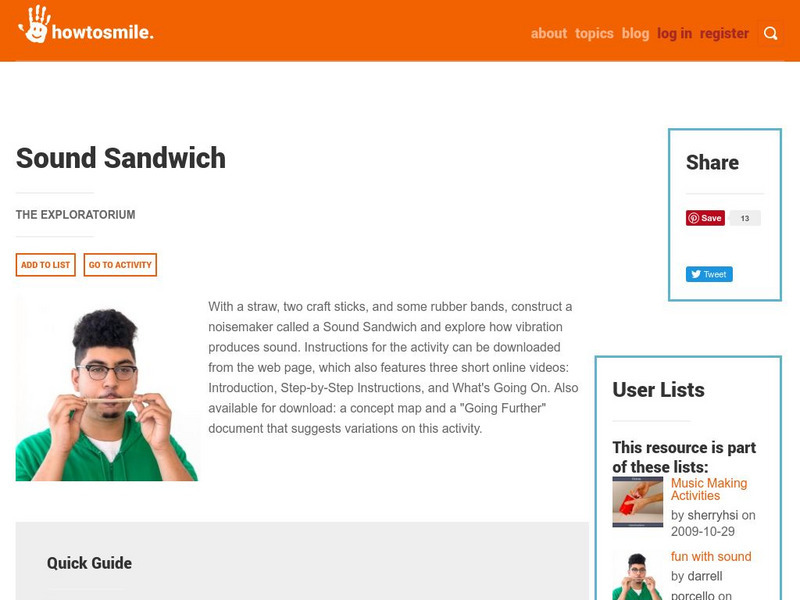
How to smile.org: Sound Sandwich
Students discover how vibrations produce sound by making this sound sandwich out of everyday materials. Lesson plans include three videos that give an introduction, step-by-step demonstration, and an explanation of the science behind the...
Scholastic
Scholastic: Dirtmeister's Science Lab: Good Vibrations
An experiment that explores the relationship between vibrations and pitch. This site includes web links, a challenge question, and notes to the teacher.
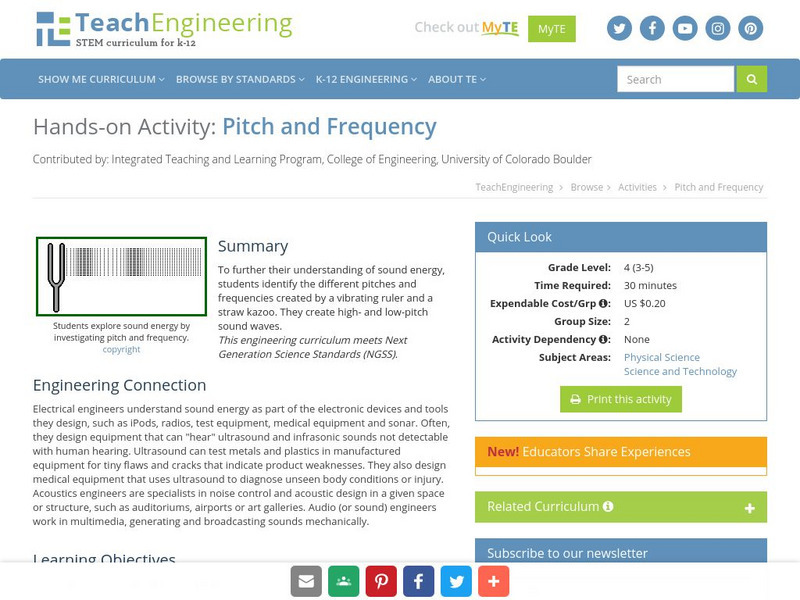
TeachEngineering
Teach Engineering: Pitch and Frequency
To further their understanding of sound energy, students identify the different pitches and frequencies created by a vibrating ruler and a straw kazoo. They create high- and low-pitch sound waves.

Museum of Science
Museum of Science and Industry: Online Science: Activities: Sound Like a Turkey
An activity where students investigate the sounds created by the friction of fingers moving along a wet string.
Science Education Resource Center at Carleton College
Serc: Investigation of Pitch and Rate of Vibration
An inquiry lesson where students explore pitch and the rate of vibration. Students will look at how the rate of vibration which creates pitch is affected by the size of the object studied.

PBS
Pbs Teachers: Make a Guitar, Vibration Experiment
Experience how vibrations make sound by constructing a guitar using rubber bands and a cereal box.
Teachers TryScience
Teachers Try Science: Musical Coat Hangers
From the National Science and Technology Centre in Australia comes this easy experiment that shows how sound waves travel and what materials are good conductors of sound.
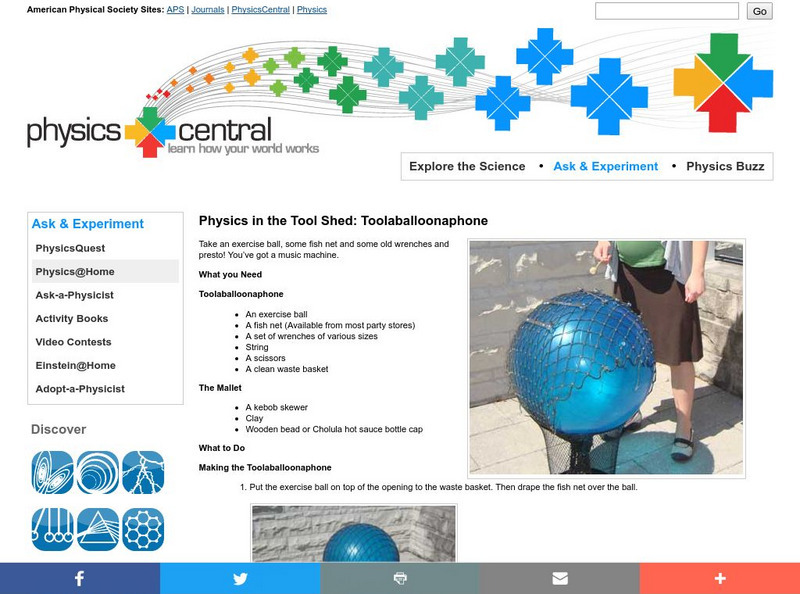
Physics Central
Physics Central: Physics in the Tool Shed: Toolaballoonaphone
Learn about compression waves and amplification through constructing a toolaballoonaphone! The toolaballoonaphone is made out an exercise ball, fish nets, wrenches, strings, scissors, and a clean waste basket that allows students to...
Michigan Reach Out
Michigan Reach Out!: Making a Shoe Box Guitar
This site provides an experiment where students create a guitar to discover what variables will change sound.

PBS
Pbs Teachers: String Telephone
Discover how sound vibrations travel across a string by making a telephone from paper cups, string and paper clips.