Hi, what do you want to do?






Curated OER
The Crusty Fossils
Students identify some of the different species of crabs and tell how they adapt themselves to their environment. They discuss the evolution and stages of development of the crabs. They identify the Phylum Arthropoda and the Class...

Curated OER
Utilizing Community Resources
Pupils gain an understanding of scientific methods and use process skills (such as observing, classifying, and predicting) to solve a problem. They develop an understanding of the need for natural preservation.

Curated OER
A Limnology Study of Drainage Ditches
Learners chemically test water, observe microscopic organisms in the classroom, and screen the sample for macroinvertebrates. They design a reporting sheet that list all the items to be tested and a space to record the results.

Curated OER
Ride the Tide
Students examine the cause-and-effect relationship between tides and the rocky coast ecosystem. They complete a worksheet that illustrates the intertidal zone.

Curated OER
Creature Features
Students examine why certain animals live in only specific places throughout the world. Using animals, they classify them based on their characteristics and identify their basic needs. They also observe and compare the life cycles of...

Curated OER
Diversity And Adaptations Of Organisms
Eighth graders study how and why animals are classified into eight groups in the animal kingdom. They work together to identify organisms. They use the key to determine the phylum for the included problems.

Curated OER
Bones and Muscles
Third graders are introduced to bones as the body's means of support and protection. They research bone facts and conduct an experiment with chicken bones. They identify and observe involuntary muscles at work.

Curated OER
Ocean Market
Pupils research how: The ocean is the source of many materials, from ores mined from its depths to relaxing mineral salts for a bath. Exquisite mother-of-pearl inlay, decorative shells, and pearl jewelry are found in gift shops...

Curated OER
Water,It's Special
Students describe the three forms of water. Students list reasons why water is necessary. Students access the Internet to complete Prediction lab report worksheets and FCAT-Style Questions worksheets.

Curated OER
Tucson Children's Museum Dino Crossword
In this crossword puzzle, middle schoolers complete a crossword puzzle related to dinosaurs, the era in which dinosaurs lived, and about other animals that lived during that time period.

Curated OER
Oddball Out: Animals
In this problem solving worksheet, learners analyze a row of pictures
of various animals to determine which creature is different from
the others pictured.

Curated OER
Pheed the World: Edible Phyla
Students discuss the contributions of different organisms to our world. In this biology activity, students research countries with limited food supply. They create an improvement plan for a fictitious country assigned to them.

Curated OER
Introduction to Paleontology Lab
Students engage in a lab which introduces them to fossils and paleontology. They examine eleven numbered boxes containing fossils which are related to the questions on this lab then answer questions on a lab sheet imbedded in this plan.
![Arts Now Learning: Dance With Vertebrates and Invertebrates [Pdf] Lesson Plan](https://static.lp.lexp.cloud/images/attachment_defaults/resource/large/FPO-knovation.png "Arts Now Learning: Dance With Vertebrates and Invertebrates [Pdf] Lesson Plan")
ArtsNow
Arts Now Learning: Dance With Vertebrates and Invertebrates [Pdf]
In this lesson, 5th graders use movement and dance composition to aid in the understanding of vertebrates and invertebrates.

Alabama Learning Exchange
Alex: Vertebrates or Invertebrates
During this lesson, students navigate the Internet to discover facts about vertebrates and invertebrates. They use the facts they learn to participate in several class activities.

Science Education Resource Center at Carleton College
Serc: Mn Step: Water Retention No Problem With the Key Investigation
Students go outside to a nearby pond or wet area, and collect vertebrates and invertebrates. These are identified using a classification key. Information is recorded using a digital camera and a science notebook. Students later prepare a...

Alabama Learning Exchange
Alex: Classification
This lesson plan will explain the reasons that society groups and classifies. The lesson plan has a hands-on component that helps students connect everyday grouping with the way that scientists group and classify all living organisms.
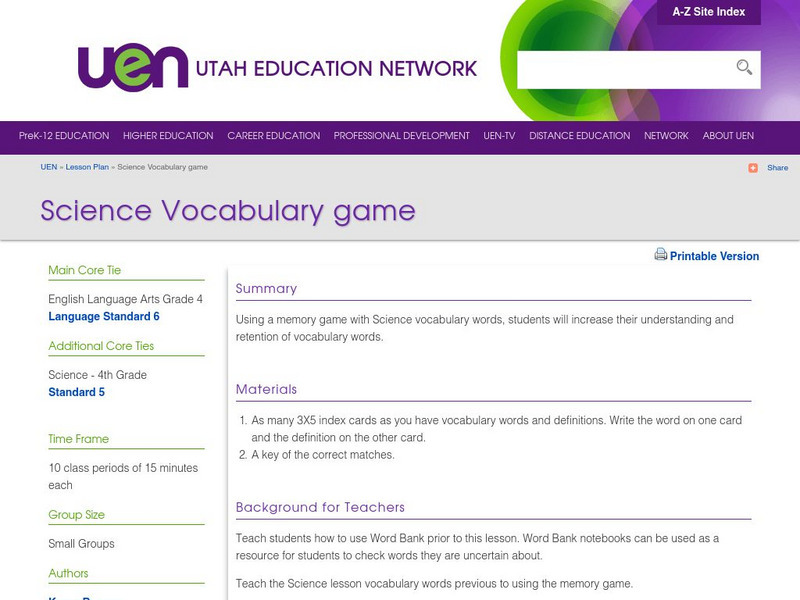
Utah Education Network
Uen: Science Vocabulary Game
Fourth graders will play a review memory game with Utah's Grade 4 Science Standard V vocabulary words during this lesson plan. Words associated with living things and classifications of living things are included in this lesson plan.