Hi, what do you want to do?





Open Door Team
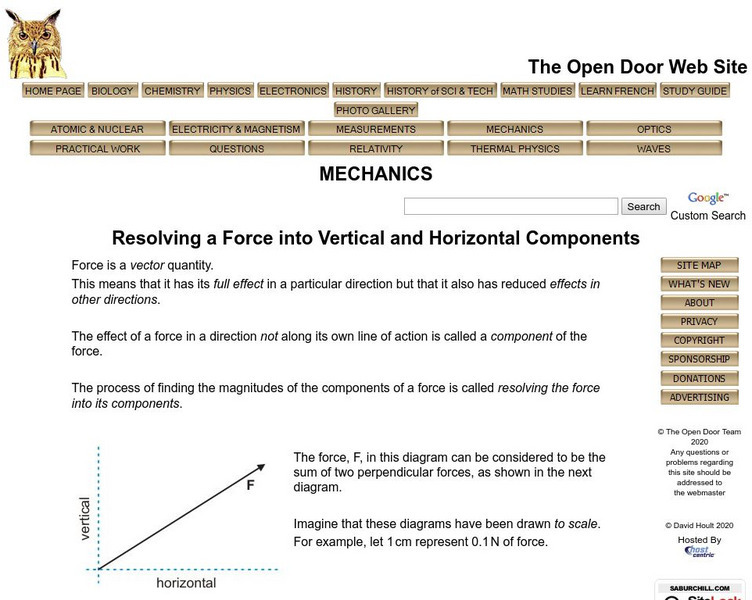
Open Door Web Site: Physics Equilibrium of Forces
The process of finding the magnitudes of the components of a force, called resolving the force, is explained at this site.

Physics Classroom
The Physics Classroom: Motion and Forces in Two Dimensions: What Is a Projectile
Students apply both kinematic principles and Newton's laws of motion to understand and explain the motion of objects moving in two dimensions, more specifically, the motion of projectiles.
Physics Classroom
The Physics Classroom: Motion/forces in Two Dimensions: Projectile's Trajectory
This illustrated tutorial discusses the horizontal and vertical components of a projectile's motion; specific attention will be given to the presence/absence of forces, accelerations, and velocity.
Curated OER
A Vector With Components Shadowed
An exceptional tutorial on the topic of vectors that offers many helpful graphics, some of which are interactive.
Physics4kids
Physics 4 Kids: Work Quiz
Take this ten question multiple choice quiz on the physics of work.

OpenStax
Open Stax: Kinematics in Two Dimensions: An Introduction
In this interactive module, students will observe that motion in two dimensions consists of horizontal and vertical components. They will understand the independence of horizontal and vertical vectors in two-dimensional motion.
Physics Classroom
The Physics Classroom: 1 D Kinematics: Speed and Velocity
Through illustrated examples and interactive practice problems, students examine the difference between speed and velocity.
Physics Classroom
The Physics Classroom: Newton's Laws: Drawing Free Body Diagrams
Students practice reading situations where forces are acting upon objects in all directions and magnitudes, and then draw free-body diagrams to represent the forces. Each problem has a self-checking key linked right on the page.
Texas Education Agency
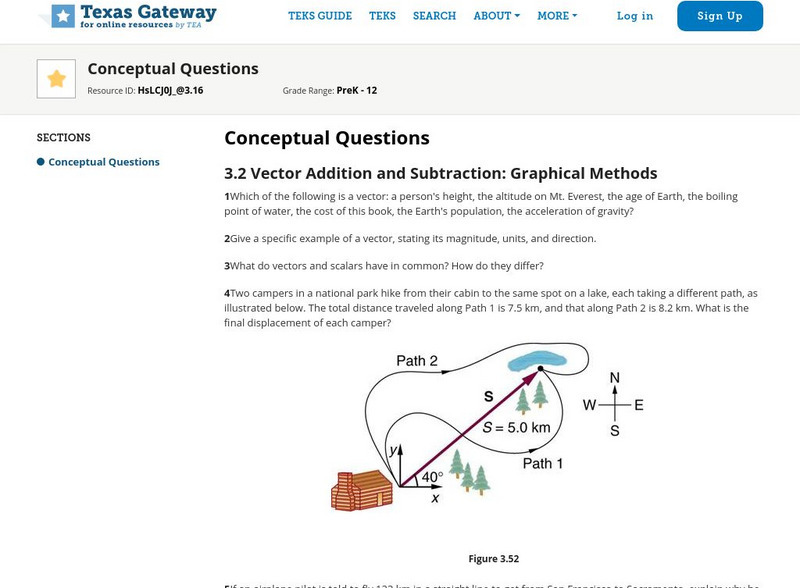
Texas Gateway: Kinematics in Two Dimensions: Conceptual Questions
This is a list of 21 questions focusing on the major concepts of each section of Chapter 3: Kinematics in Two Dimensions such as adding and subtracting vectors using different methods.
Texas Education Agency
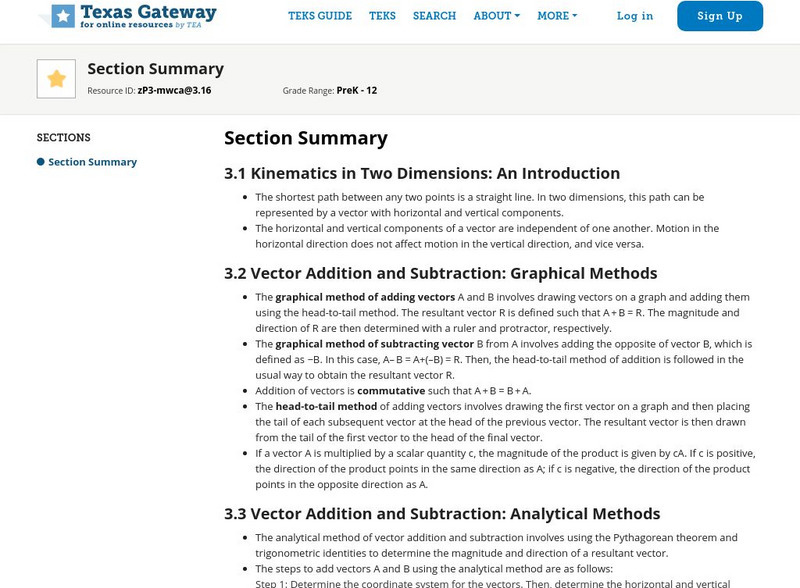
Texas Gateway: Kinematics in Two Dimensions: Section Summary
This is a summary of each of the sections in Chapter 3: Kinematics in Two Dimensions of the AP Physics online text.
Texas Education Agency
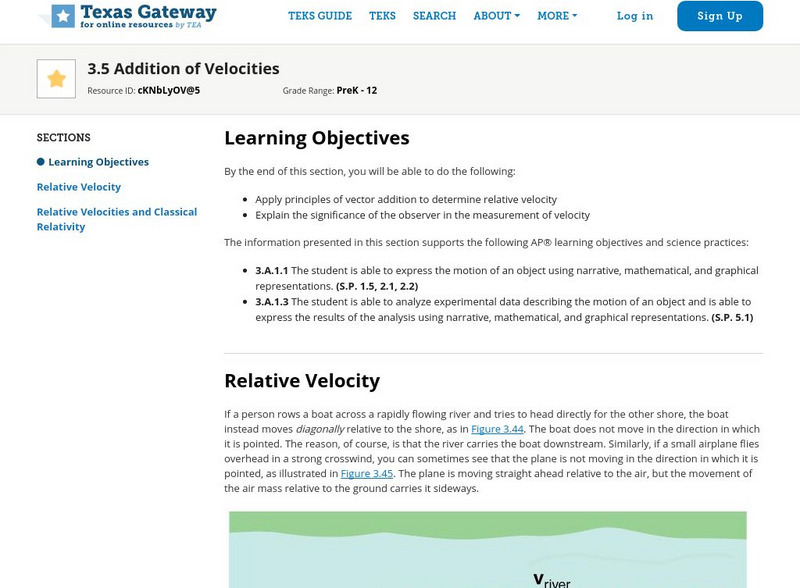
Texas Gateway: Kinematics in Two Dimensions: Addition of Velocities
By the end of this section, you will be able to apply principles of vector addition to determine relative velocity and explain the significance of the observer in the measurement of velocity.
Texas Education Agency
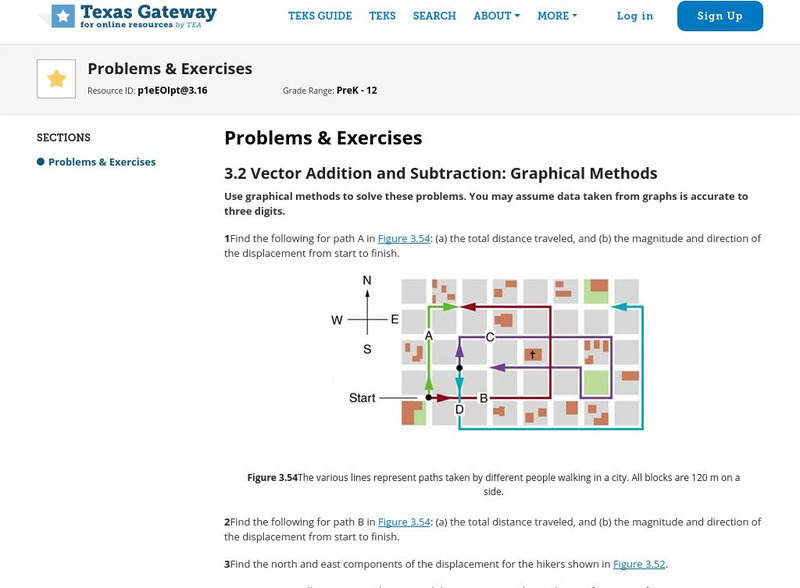
Texas Gateway: Kinematics in Two Dimensions: Problems & Exercises
This page provides and list of 70 problems and exercises focusing on the content of Chapter 3: Kinematics in Two Dimensions in the AP Physics online text.

Khan Academy
Khan Academy: What Are Velocity Components?
Learn how to simplify vectors by breaking them into parts.
Texas Education Agency
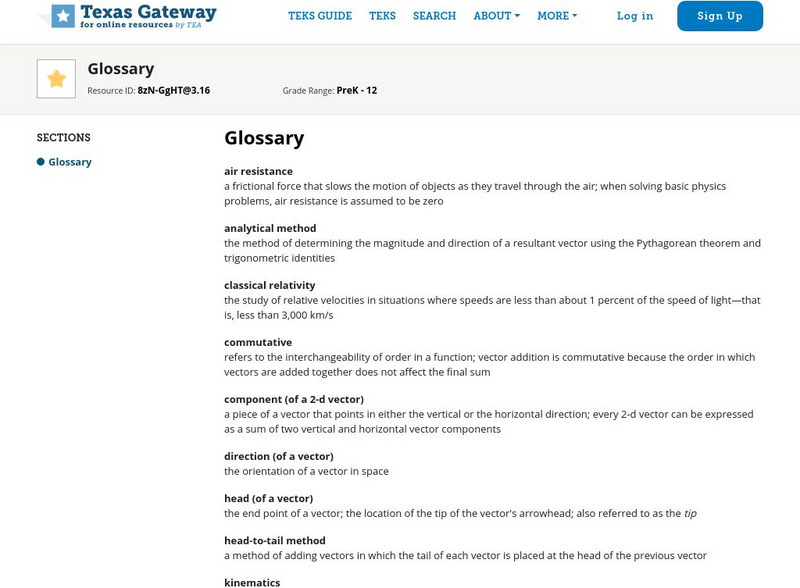
Texas Gateway: Glossary for Kinematics in Two Dimensions
This is a glossary of terms and definitions used in Chapter 3: Kinematics in Two Dimensions of the AP Physics online text.
Texas Education Agency
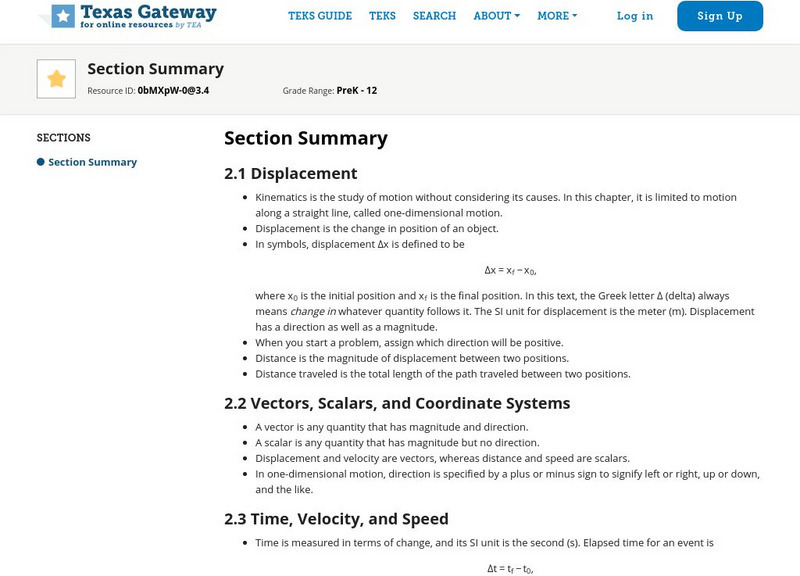
Texas Gateway: Kinematics Section Summary
This is a summary of the main topics for AP Physics Chapter 2 Kinematics. These include Displacement; Vectors, Scalars, and Coordinate Systems; Time, Velocity, and Speed; Acceleration; Motion Equations for Constant Acceleration in One...
Walter Fendt
Walter Fendt: Apps Zur Physik
This site, in German, offers numerous apps that illustrate common physics principles. Apps are organized into categories: mechanics, oscillations and waves, electrodynamics, optics, thermodynamics, the theory of relativity, physics of...
University of Minnesota
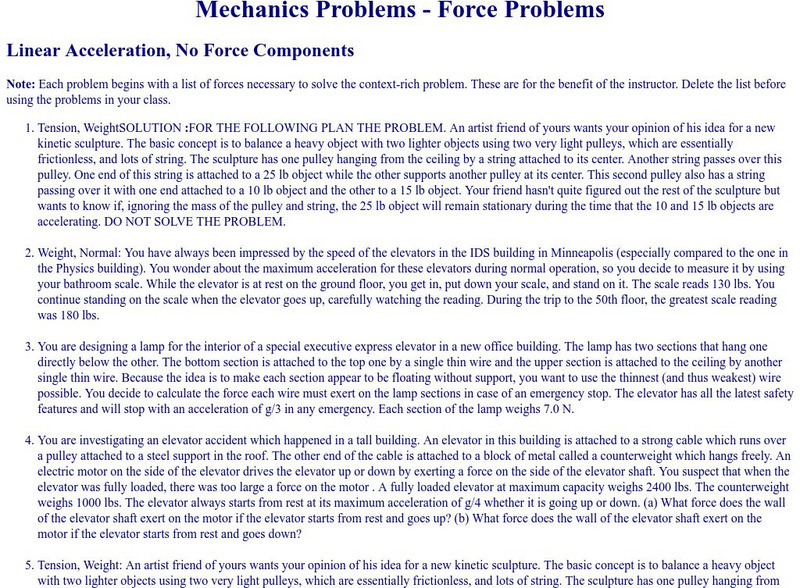
University of Minnesota: Mechanics Problems: Force Problems
This University of Minnesota site provides a series of contextually rich, real-world problems demonstrating force and Newton's second law of motion.

Alabama Learning Exchange
Alex: Jump!!! An Exploration Into Parametric Equations
Students will use vectors and parametric equations to determine the velocity that they should jump out of the window of a burning building in order to land safely into the rescue net. They will work in small groups and utilize graphing...
National Council of Teachers of Mathematics
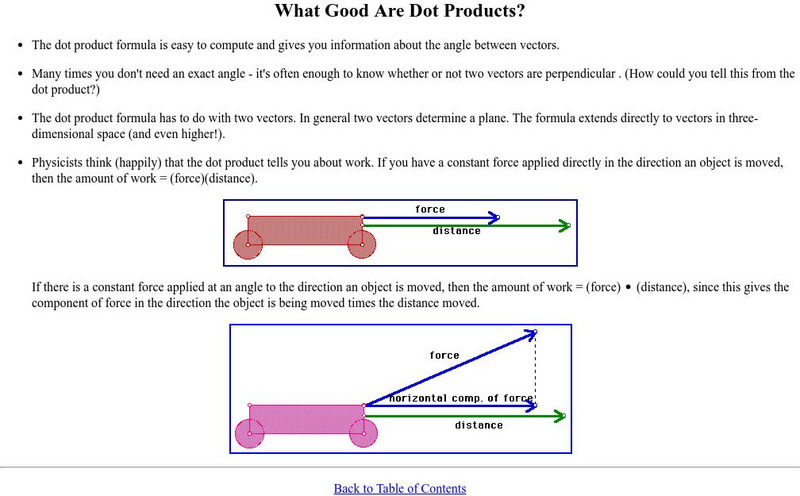
The Math Forum: What Good Are Dot Products?
Explanation and illustration of the use of dot products in physics.
Physics4kids
Physics 4 Kids: Motion/mechanics Overview Quiz
Take this ten question multiple choice quiz on motion and mechanics.
Physics4kids
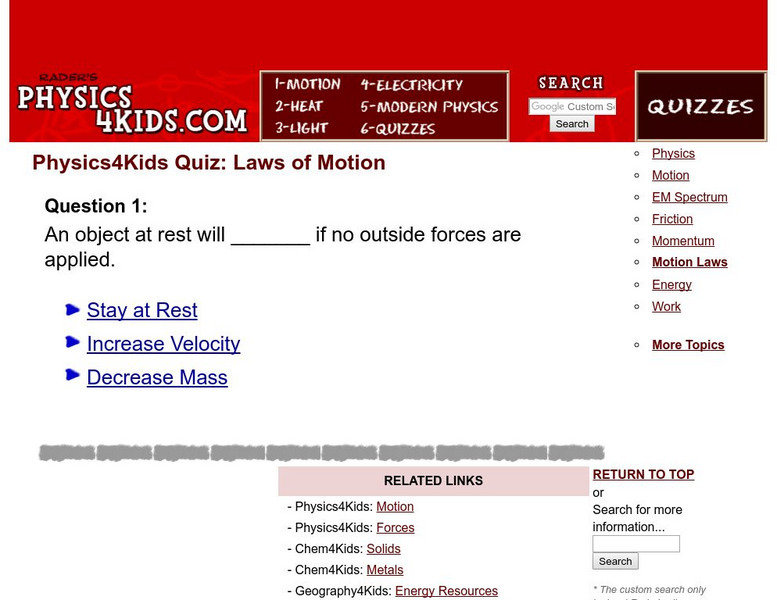
Physics 4 Kids: Laws of Motion Quiz
Take this ten question multiple choice quiz on laws of motion.
University of Minnesota
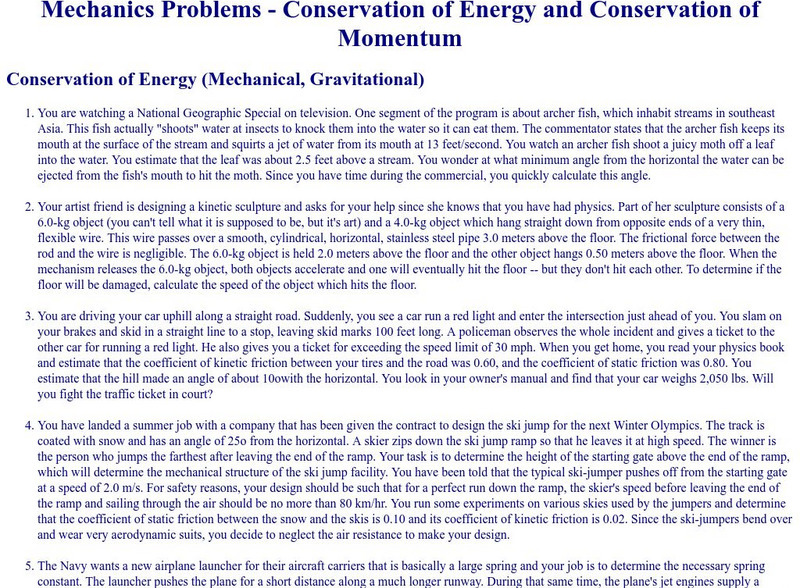
University of Minnesota: Conservation of Momentum
This site provides a set of four Physics problems dealing with the conservation of momentum principle.
University of Manchester
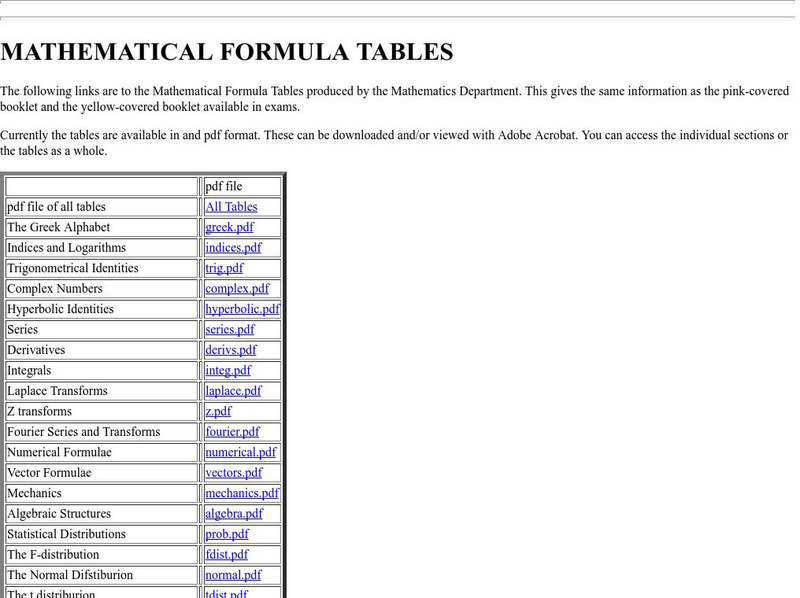
Umist: Mathematical Formula Tables
This site has links to tables of mathematical formulas. To view them, the student must download the formulas in pdf format.