Hi, what do you want to do?





NASA
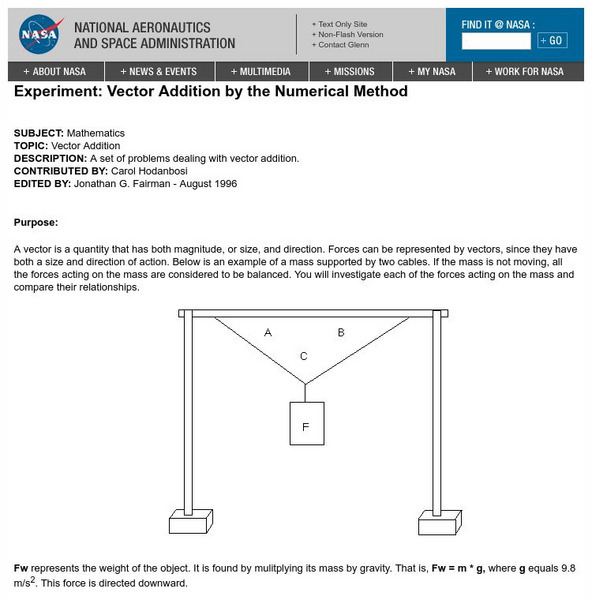
Nasa: Vector Addition by the Numerical Method
A lab experiment involving readily available materials. Students analyze three forces acting upon one point to determine the resultant force. Questions and accompanying answers are provided.

Physics Classroom
The Physics Classroom: Resultants
A tutorial that describes what a resultant is and how a resultant is determined.
Physics Classroom
The Physics Classroom: Vectors: Net Force Problems Revisited
Through interactive examples and practice problems, this tutorial helps students understand net force-acceleration problems in which an applied force is directed at an angle to the horizontal.
Physics Classroom
The Physics Classroom: Vectors: Double Trouble in 2 Dimensions
In this interactive tutorial, analyze two-body problems in which the objects are moving in different directions.
US Department of Energy
Fermilab: Questions About Physics: Big Bang & Bosons
What are serious scientists are saying about bosons? This site provides text correspondence between two scientists in question-answer format. Shows why bosons are so important in particle physics.
Physics Classroom
The Physics Classroom: Horizontally Launched Projectile Problems
In the case of projectiles, students use information about the initial velocity and position of a projectile to predict such things as how much time the projectile is in the air and how far the projectile will go. They do this to make...
Physics Classroom
The Physics Classroom: 1 D Kinematics: Acceleration
Explore illustrated examples and try some practice acceleration problems to better understand this vector quantity in physics.
Georgia State University
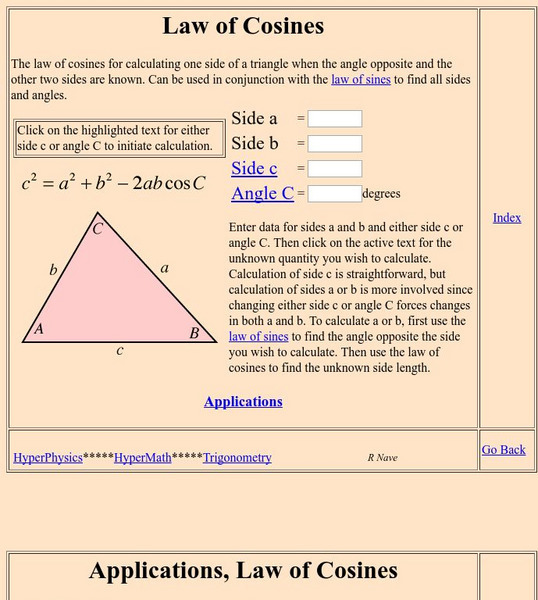
Georgia State University: Hyper Physics: Laws of Sines and Cosines
At the bottom of this page from the Georgia State University, you will two real-world applications of the Laws of Sines and Cosines (in the context of velocity vectors.)
Physics Classroom
The Physics Classroom: Motion and Forces in Two Dimensions: Relative Velocity
Through illustrated examples and interactive practice problems, students explore problems that involve relative velocity- where the actual motion of an object is different than its motion relative to a stationary observer.
Science Education Resource Center at Carleton College
Serc: Vector Addition: Determining the Displacement in Your School
In this physics indoor lab students calculate the displacement from one corner of the school to the other.
Texas Education Agency
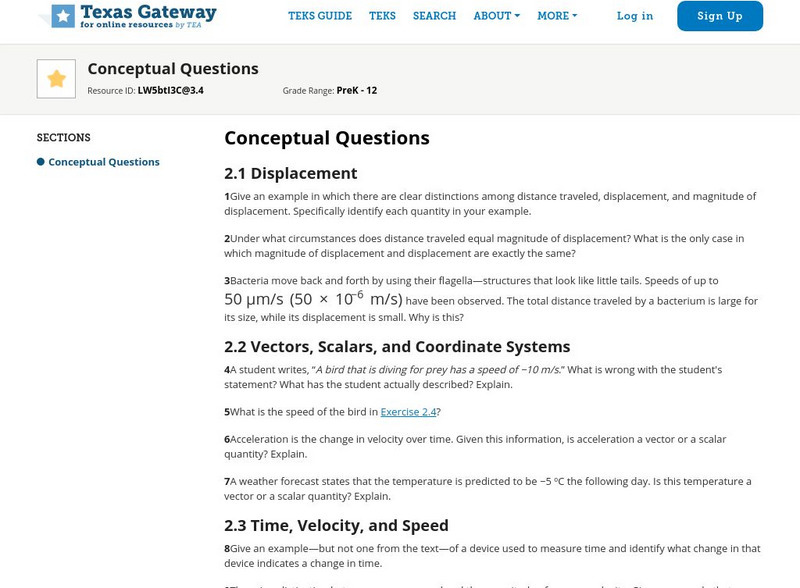
Texas Gateway: Ap Physics: Kinematics Conceptual Questions
This page provides practice questions on each of the conceptual content sections in AP Physics: Chapter 2: Kinematics.
Physics Classroom
The Physics Classroom: Circular and Satellite Motion: Principles for Satellites
Students explore how a satellite's motion is governed by the same physics principles and described by the same mathematical equations.

American Association of Physics Teachers
Com Padre Digital Library: Open Source Physics: Electric Multipole Field Model
Simulation demonstrating how a point charge, a dipole, or a quadrupole shows field vectors or voltage. Change the charge and see the electric field direction and magnitude, and then record the detector values using a built-in data...
Learn AP Physics
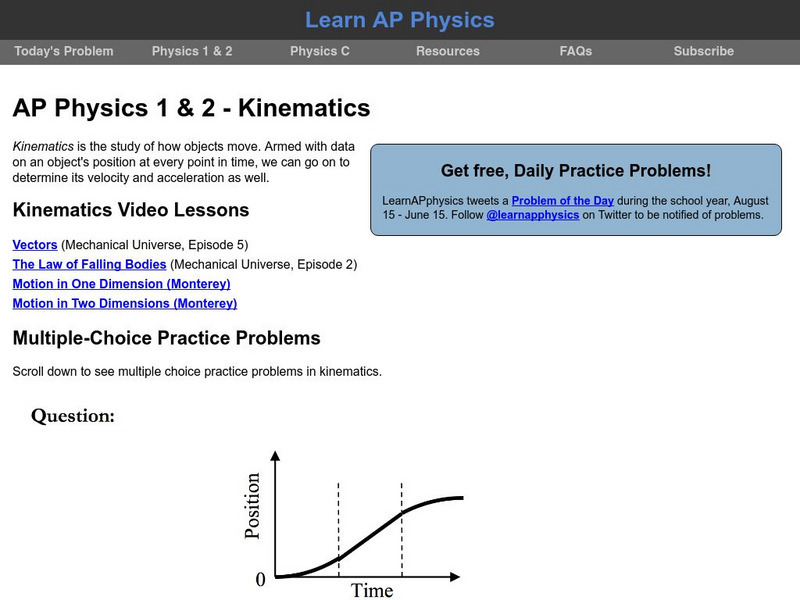
Learn Ap Physics: Physics B: Kinematics
A site dedicated to help students prepare for the AP Physics B test. This specific site reviews kinematics including one and two dimensional motion and vectors. Site contains links to video lectures and practice problems.
Texas Education Agency
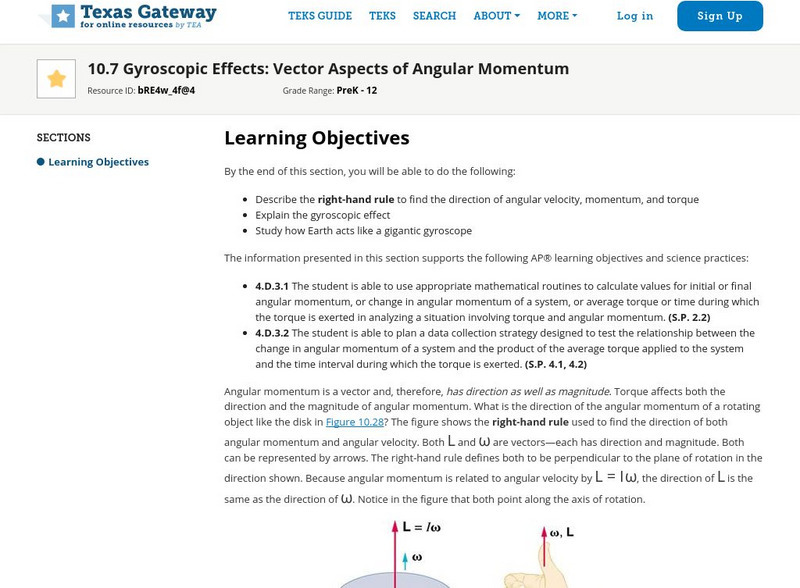
Texas Gateway: Gyroscopic Effects: Vector Aspects of Angular Momentum
By the end of this section, you will be able to describe the right-hand rule to find the direction of angular velocity, momentum, and torque; explain the gyroscopic effect; and study how Earth acts like a gigantic gyroscope.
Physics Classroom
The Physics Classroom: Projectile Motion
Scroll down to Lesson 2 for a complete tutorial on projectile motion. Content covered in these tutorials includes an explanation of what a projectile is, what the characteristics of a projectile's trajectory are, horizontal and vertical...

Georgia State University
Georgia State University: Hyper Physics: The Inverse Square Law Problem
Illustrated examples of the Inverse Square Law with interactive opportunities to practice the problems.
Physics Classroom
The Physics Classroom: Describing Motion With Words
This lesson from the Glenbrook South High School gives a nice review and detailed explanation of velocity, speed, distance, displacement, and acceleration. A good introduction to the "language of Kinematics."

Khan Academy
Khan Academy: Applying Gravity to a Particle
Next, let's apply all these ideas to the case where a particle is being acted on by both gravity and air resistance using this 5-question quiz/practice. The gravity force vector points downward, and the air resistance force opposes it.

Khan Academy
Khan Academy: Start: How Do Computers Simulate the Motion of Virtual Particles?
In this lesson we'll explore how we use fairly simple physics to draw particles which move according to the forces we feel in the real world (such as wind & gravity).
Cosmo Learning
Cosmo Learning: Physics 240: Science and Engineering I
A collection of video lectures from a physics for science and engineering course taught at the University of Missouri-Kansas City. The course discusses the concepts of mechanics, wave motion, sound, heat and thermodynamics in thirty-five...
Physics Classroom
The Physics Classroom: Acceleration
Topics covered include what acceleration is, the difference between constant and non-constant acceleration, acceleration in a free-falling object, the equation used to compute acceleration, and the difference between positive and...

Other
Rutgers: c.o.o.l. Class: Physics Project: Plankton and Ocean Current
This c.o.o.l. Project focuses on tiny sea plankton and how they move in the oceans. Follow the scientific process outlined on the left, calculate and collect data to form your own predictions.
Georgia State University
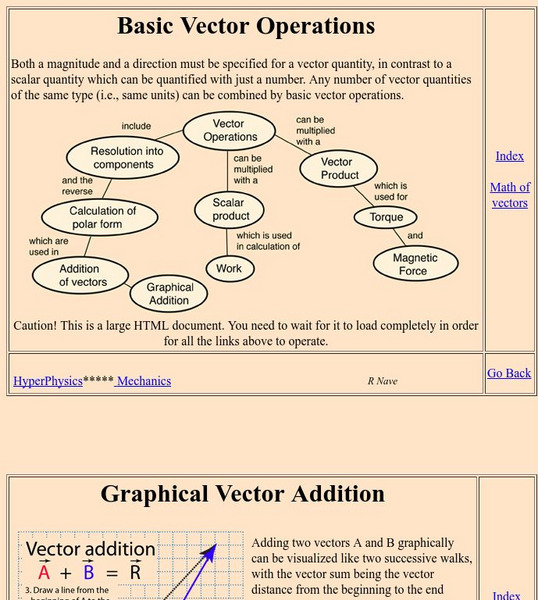
Georgia State University: Hyper Physics: Basic Vector Operations: Graphical Vector Addition
The process of graphical addition with vectors is shown at this site.