Hi, what do you want to do?






Physics Classroom
The Physics Classroom: Horizontally Launched Projectile Problems
In the case of projectiles, students use information about the initial velocity and position of a projectile to predict such things as how much time the projectile is in the air and how far the projectile will go. They do this to make...
Physics Classroom
The Physics Classroom: Motion and Forces in Two Dimensions: Relative Velocity
Through illustrated examples and interactive practice problems, students explore problems that involve relative velocity- where the actual motion of an object is different than its motion relative to a stationary observer.

Khan Academy
Khan Academy: Polar Coordinates
An illustration of Cartesian coordinates (the x,y components of a vector) and Polar coordinates (the magnitude and direction of a vector) as related to natural Simulation and angular movement.
Science and Mathematics Initiative for Learning Enhancement (SMILE)
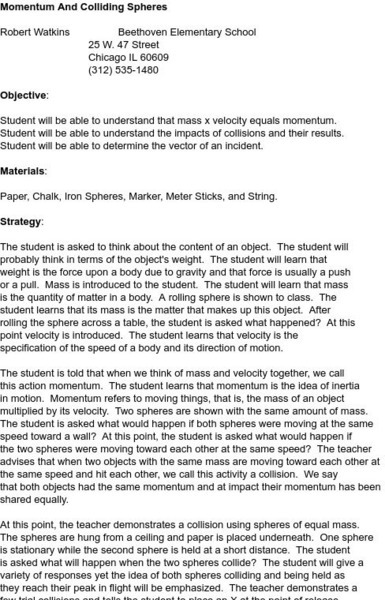
Smile: Colliding Spheres
This lab activity from the Illinois Institute of Technology lets students investigate the impact of collisions upon the velocity and momentum of the colliding objects. Requires understanding of vectors.
Cosmo Learning
Cosmo Learning: Principles of Digital Communications I
A collection of video lectures from a course introducing students to the theory and practices in digital communications. Webpage includes twenty-four lectures from a professor at the Massachusetts Institute of Technology. Lectures vary...
Wolfram Research
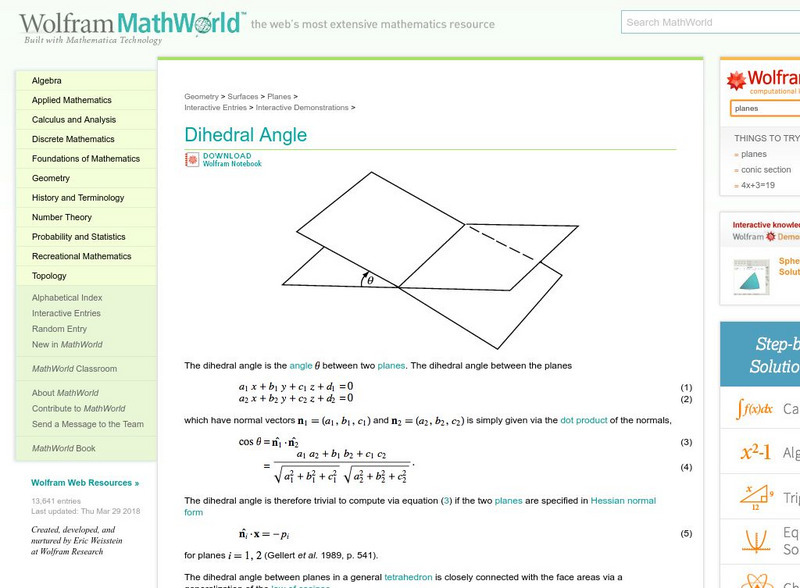
Wolfram Math World: Dihedral Angle
This MathWorld page discusses the dihedral angle, or the angle between two planes that can be found using the dot product of the two normal vectors of each plane.

University of Colorado
University of Colorado: Ph Et Interactive Simulations: Radio Waves & Electromagnetic Fields
Manually or computer generated, students can test radio waves being transmitted from a virtual radio station to a home. Study the curve, vectors, electric field, and more.

Stefan Warner and Steven R. Costenoble
Finite Mathematics & Applied Calculus: Topic Summaries: Markov Systems
The topic summary outlines Markov systems. Some topics reviewed are expected number, distribution vectors, and transition probability. The resource consists of definitions, notes, and examples.
American Association of Physics Teachers
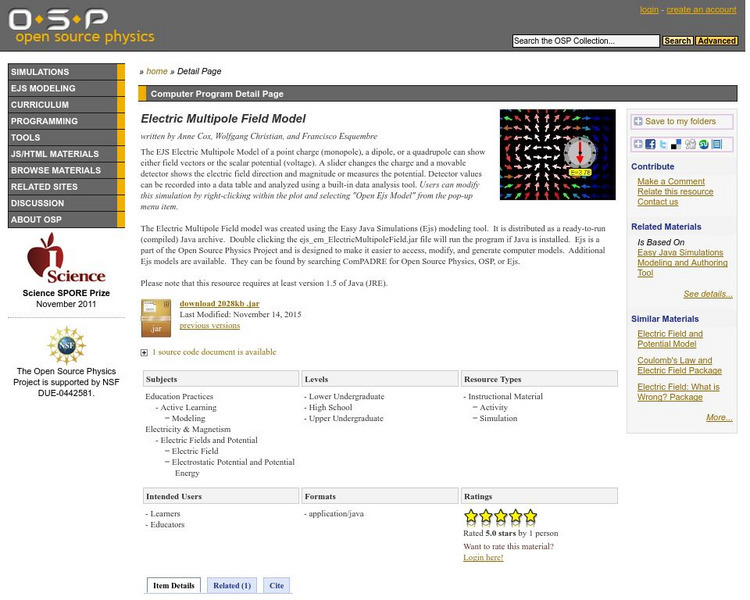
Com Padre Digital Library: Open Source Physics: Electric Multipole Field Model
Simulation demonstrating how a point charge, a dipole, or a quadrupole shows field vectors or voltage. Change the charge and see the electric field direction and magnitude, and then record the detector values using a built-in data...

National High Magnetic Field Laboratory
Magnet Academy: Peter Debye
Peter Debye carried out pioneering studies of molecular dipole moments, formulated theories of magnetic cooling and of electrolytic dissociation, and developed an X-ray diffraction technique for use with powdered, rather than...
CK-12 Foundation
Ck 12: Flex Book: Trigonometry
[Free Registration/Login may be required to access all resource tools.] Six-chapter book that introduces students to trigonometry. Topics include right angles, circular functions, trigonometric identities, vectors, and polar equations.

CK-12 Foundation
Ck 12: Plix: Motion: Determining Net Force
[Free Registration/Login Required] Shown are three different systems with two forces acting upon it and a red vector showing the net force acting upon the system. Move the red dots to accurately reflect the net force experienced by each...

University of St. Andrews (UK)
University of St. Andrews: Hermann Gunter Grassmann
The vector methods, called Grassmannian, are Grassmann's most significant work. His work took many years to be adopted, but it has since been used in studying calculus and geometry.
BBC
Bbc: Gcse Bitesize: Forces
Forces are responsible for all the interactions between particles and objects. They can be put into two categories: contact forces and non-contact forces. Forces can be added up as vectors.

Alabama Learning Exchange
Alex: Topography of Fruit
This is an attempt to help students understand contour lines in map-making through the vector of digital photography. This hands-on activity will create an art piece out of fruit that will be analyzed to create topographic maps.
Concord Consortium
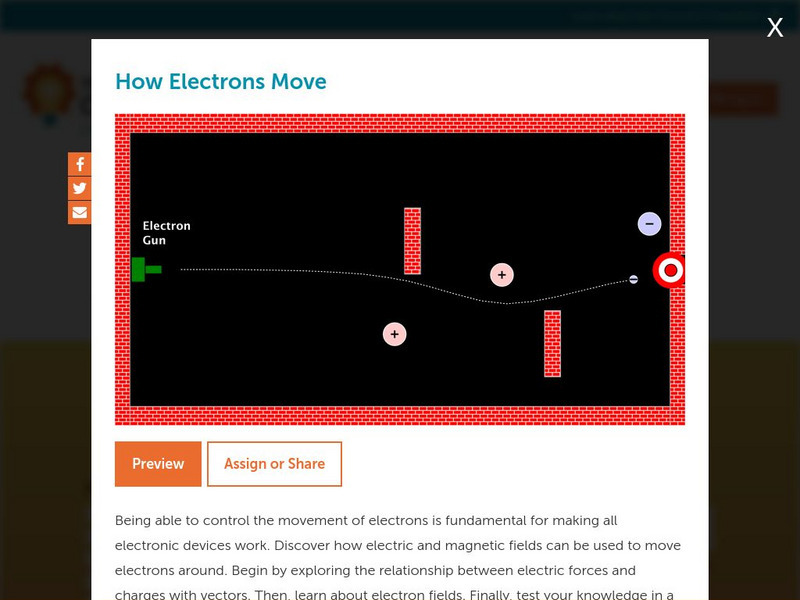
Concord Consortium: How Electrons Move
Being able to control the movement of electrons is fundamental for making all electronic devices work. Discover how electric and magnetic fields can be used to move electrons around. Begin by exploring the relationship between electric...

Khan Academy
Khan Academy: Pointing Towards Movement
The concept of rotating the object to point in the direction of movement is understood as rotate according to the velocity vector is explained.

Khan Academy
Khan Academy: Particle Systems With Forces
Applying the forces of wind and/or gravity to a particle system so that the system can apply force to all individual particles. In addition, adding a repeller where all the force vectors have a different direction is illustrated.
National Council of Teachers of Mathematics
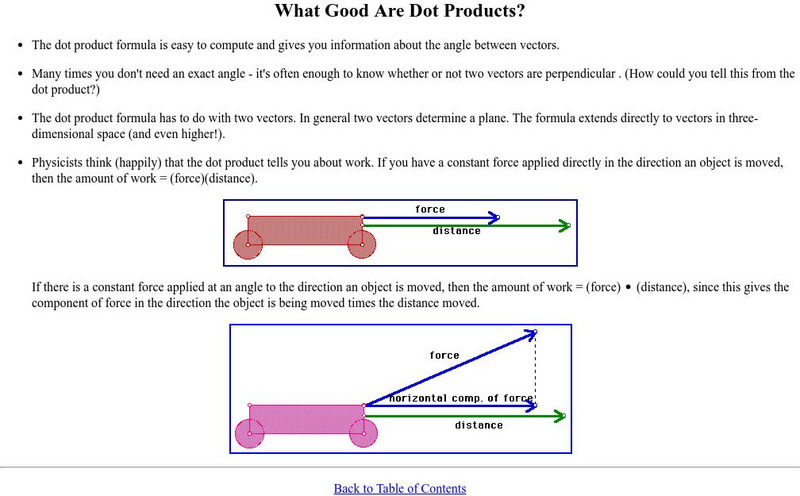
The Math Forum: What Good Are Dot Products?
Explanation and illustration of the use of dot products in physics.
National Council of Teachers of Mathematics
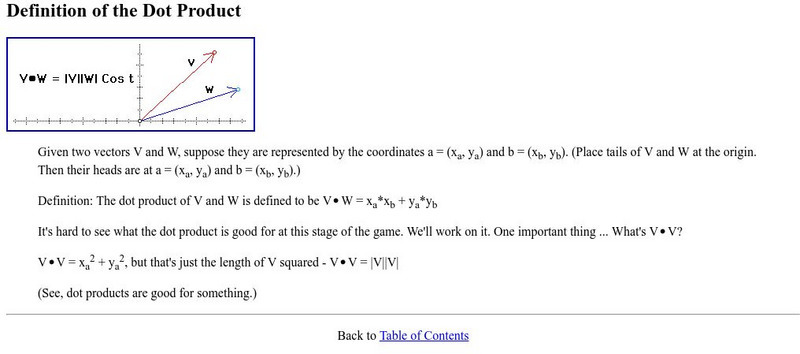
The Math Forum: Definition of the Dot Product
Definition of dot product and an application.

University of Colorado
University of Colorado: Ph Et Interactive Simulations: Gravity and Orbits
An interactive simulation that teaches about gravitational force, circular motion, and astronomy by manipulating the sun, earth, moon, and a space station to observe the effects of gravity and orbital paths. This simulation can either be...

University of Colorado
University of Colorado: Ph Et Interactive Simulations: Hooke's Law
An interactive simulation that teaches about force and potential energy by changing variables to stretch and compress springs. This simulation can either be downloaded or played online and includes handouts, lesson plans, and additional...
University of Colorado
University of Colorado: Ph Et Interactive Simulations: Projectile Motion
An interactive simulation that teaches about kinematics, air resistance, and parabolic curve by shooting a car out of a cannon while trying to hit a target. Observe how changes in angle, initial speed, mass, air resistance, and drag...
University of Colorado
University of Colorado: Ph Et Interactive Simulations: Gravity Force Lab
An interactive simulation that teaches about gravitational force, Newton's Third Law, and force pairs by varying properties affect the gravitational force exerted between two objects. This simulation can either be downloaded or played...
Other popular searches
- Adding Vectors
- Physics Vectors
- Force Vectors
- Drawing Vectors
- Vectors and Scalars
- Velocity Vectors
- Force and Vectors
- Add and Subtract Vectors
- Vectors in Plane
- Adding Vectors Graphically
- Displacement Vectors
- Introduction to Vectors