Hi, what do you want to do?





University of Minnesota
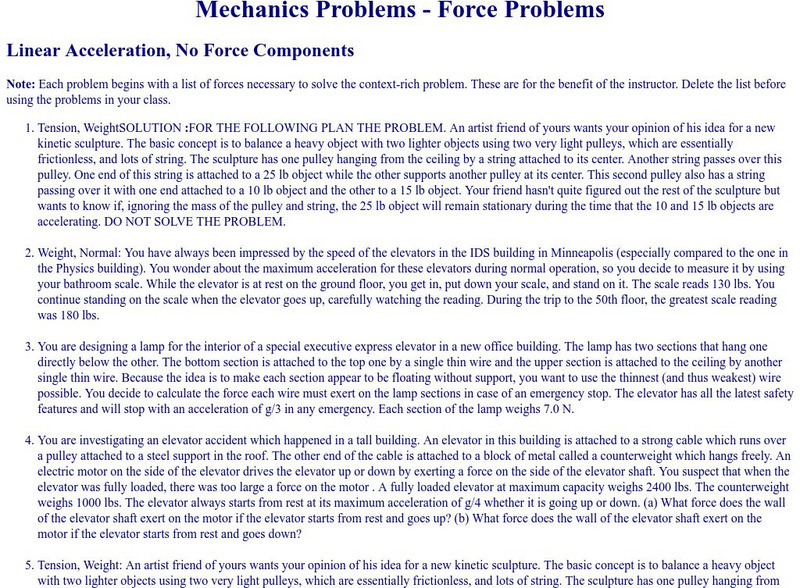
University of Minnesota: Mechanics Problems: Force Problems
This University of Minnesota site provides a series of contextually rich, real-world problems demonstrating force and Newton's second law of motion.
BBC
Bbc: Gcse Bitesize: Forces
Forces are responsible for all the interactions between particles and objects. They can be put into two categories: contact forces and non-contact forces. Forces can be added up as vectors.
Wikimedia
Wikipedia: Centripetal Force
Wikipedia's site on centripetal force provides a section explaining the difference between centripetal force and centrifugal force. Includes formulas and hyperlinked terms.

CK-12 Foundation
Ck 12: Plix: Motion: Determining Net Force
[Free Registration/Login Required] Shown are three different systems with two forces acting upon it and a red vector showing the net force acting upon the system. Move the red dots to accurately reflect the net force experienced by each...
Open Door Team
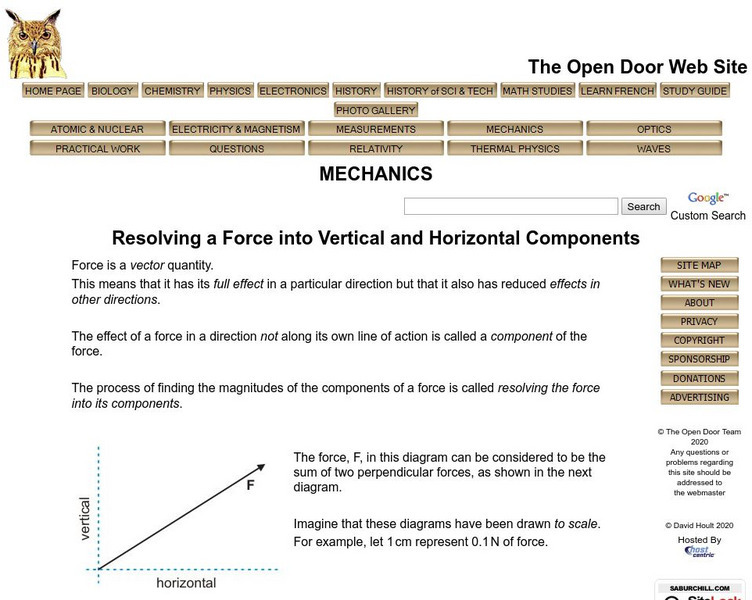
Open Door Web Site: Physics Equilibrium of Forces
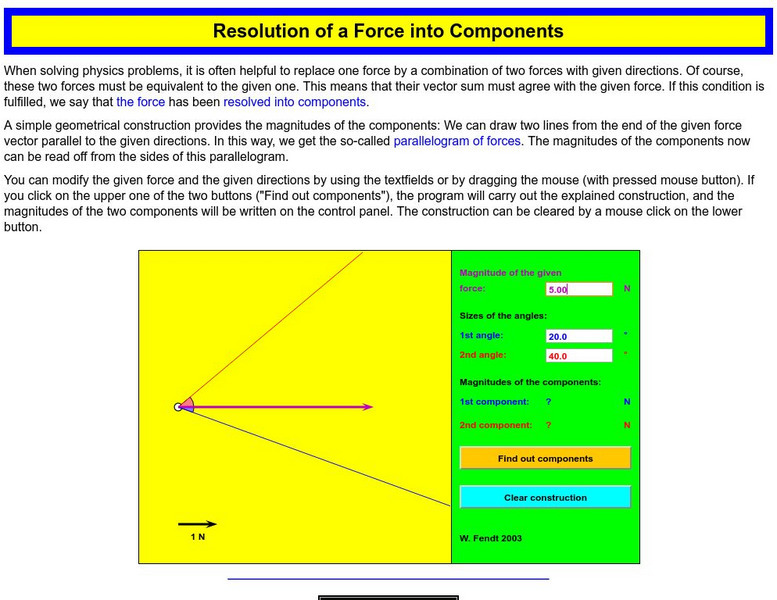
The process of finding the magnitudes of the components of a force, called resolving the force, is explained at this site.

Physics Classroom
The Physics Classroom: Static Electricity: Electric Force: Coulomb's Law
This informative tutorial on Coulomb's Law and electric force in physics features a definition as well as formulas, diagrams, and learning exercises.
Physics Classroom
The Physics Classroom: Motion and Forces in Two Dimensions: Vector Addition
In this physics tutorial, the task of summing vectors will be extended to cases in which the vectors are directed in directions other than purely vertical and horizontal.
Physics Classroom
The Physics Classroom: Vectors Motion and Forces in Two Dimensions: Resultants
This physics tutorial illustrates problems that show the vector sum of two or more vectors is the resultant.

Khan Academy
Khan Academy: Particle Systems With Forces
Applying the forces of wind and/or gravity to a particle system so that the system can apply force to all individual particles. In addition, adding a repeller where all the force vectors have a different direction is illustrated.
Physics Classroom
The Physics Classroom: Motion/forces in Two Dimensions: Projectile's Trajectory
This illustrated tutorial discusses the horizontal and vertical components of a projectile's motion; specific attention will be given to the presence/absence of forces, accelerations, and velocity.
Sophia Learning
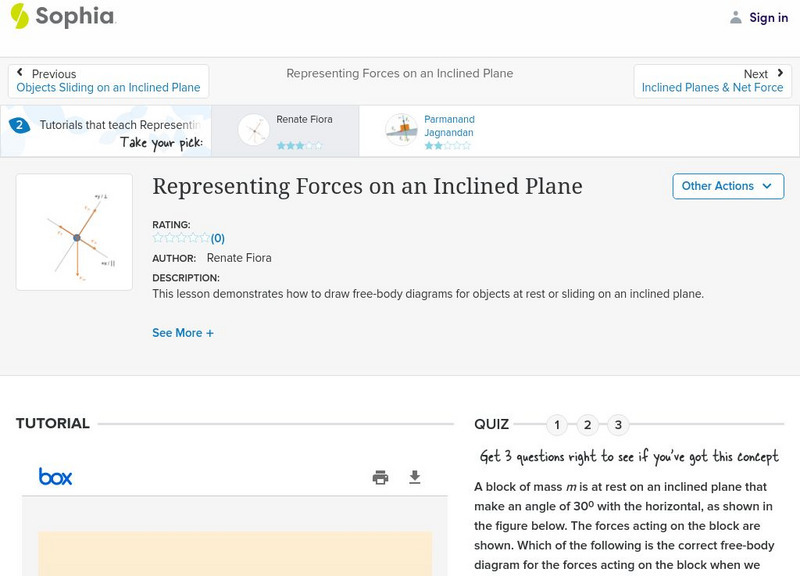
Sophia: Representing Forces on an Inclined Plane: Lesson 2
This lesson demonstrates how to draw free-body diagrams for objects at rest or sliding on an inclined plane. It is 2 of 2 in the series titled "Representing Forces on an Inclined Plane."

CK-12 Foundation
Ck 12: Physical Science: Force
[Free Registration/Login may be required to access all resource tools.] Definition of force, how it relates to motion, and force as a vector.
University of Virginia
Uva Physics: Using Vectors to Describe Motion
Background information on vectors and their use in describing motion in two dimensions. A comparison of Aristotle's and Galileo's perspectives on force and motion is given.
Physics Classroom
The Physics Classroom: Motion/forces in Two Dimensions: Perpendicular Components
This physics tutorial provides students illustrated examples and interactive practice problems containing perpendicular components of motion.
Science Education Resource Center at Carleton College
Serc: Understanding Vectors Vector Addition
By participating in a group activity, students will learn how to add force vectors. They will see the significance of direction when adding vector quantities.
Physics Classroom
The Physics Classroom: Vectors: Double Trouble in 2 Dimensions
In this interactive tutorial, analyze two-body problems in which the objects are moving in different directions.
Physics Classroom
The Physics Classroom: Motion and Forces in Two Dimensions: Relative Velocity
Through illustrated examples and interactive practice problems, students explore problems that involve relative velocity- where the actual motion of an object is different than its motion relative to a stationary observer.

Science Education Resource Center at Carleton College
Serc: Exploring Acceleration Through Vectors
The goal of this activity is to get students to think about what is happening when velocity and acceleration vectors point in different directions. The pictures, sentences, and cars used allow the students to picture each situation in...
Other
Forces on Bridges: Mathematical Model
This resource presents information about the mathematical model of forces on bridges. Examples of a classroom activity are provided. The resource also involves using matrices to solve systems of equations.
Walter Fendt
Walter Fendt: Resolution of a Force Into Components
A short interactive activity which allows you to calculate the sum of two component vectors.
University of Minnesota
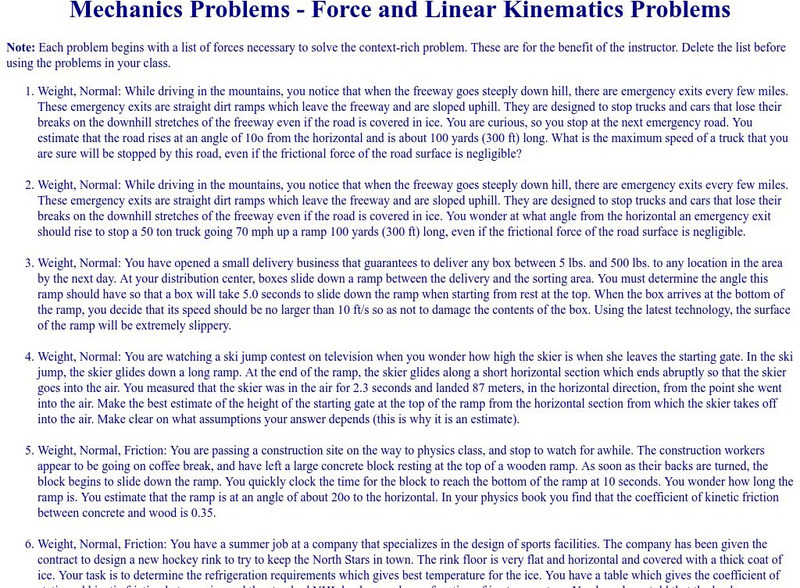
University of Minnesota: Mechanics Problems: Force and Linear Kinematics Problem
This University of Minnesota site provides a series of contextually rich problems pertaining to force, Newton's second law of motion, and linear kinematics.
CK-12 Foundation
Ck 12 Exploration Series: Simulations: Physics: Portrait Gallery
[Free Registration/Login Required] Learn about adding force vectors in two dimensions using the example of a painting hanging from two strings. Experiment with variables of weight and angles to hang a portrait in this physics simulation....
CK-12 Foundation
Ck 12 Exploration Series: Simulations: Physics: Driverless Car
[Free Registration/Login Required] Learn about adding two vectors together by components in the context of a GPS-style city map. Adjust magnitude and angles in the two vectors to simulate the driverless car. Examples taking this concept...
Science Struck
Science Struck: Guide to Free Body Diagrams in Physics
A detailed explanation of the different types of forces that can be applied to an object and how to represent them in a free body diagram. Includes examples and some practice problems to try, with solutions provided.